Many people get confused between affects or effects. Even native English speakers sometimes make mistakes!
This article will clearly explain the difference between affect and effect in simple English.
By the end, you’ll be confident using these words correctly every time.
Why People Get Confused
Affect and effect sound similar, and both are about change or influence.
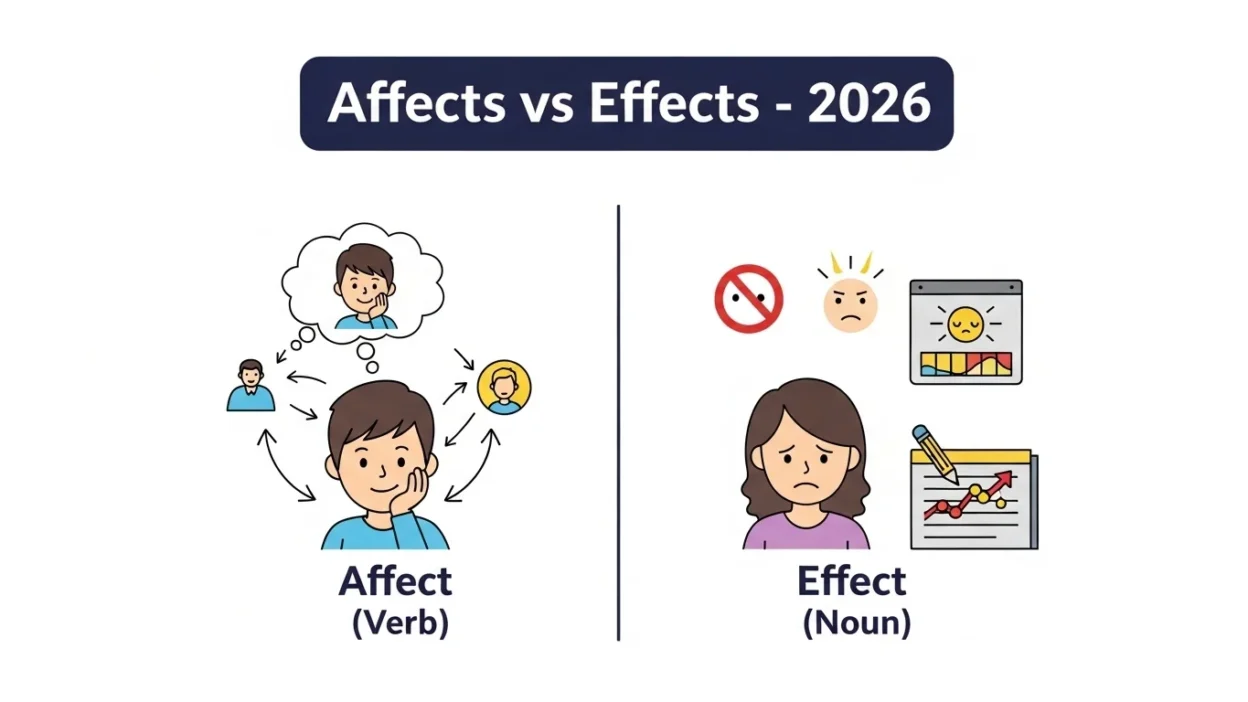
- Affect is usually a verb (an action).
- Effect is usually a noun (a result).
Because they are related, it’s easy to mix them up. Don’t worry—we’ll make it simple.
Quick Answer: The Simple Difference
- Affect → verb → to influence or change something
- Example: Loud noise affects my concentration.
- Example: Loud noise affects my concentration.
- Effect → noun → the result or outcome of something
- Example: Loud noise has a bad effect on my concentration.
- Example: Loud noise has a bad effect on my concentration.
Remember:
- A = Action → Affect (verb)
- E = End result → Effect (noun)
Where the Words Come From
Knowing the origin can help you remember:
- Affect comes from Latin afficere, meaning to influence.
- Effect comes from Latin effectus, meaning result or outcome.
So, affect is about doing something, and effect is about what happens.
Clear Explanation of the Difference
| Word | Part of Speech | Meaning | Example Sentence |
| Affect | Verb | To influence or change | Loud music affects my mood. |
| Effect | Noun | The result of a change | Loud music has a bad effect on my mood. |
Tips:
- Replace with “cause” → usually affect.
- ✅ The new law affects students.
- ❌ The new law effects students.
- ✅ The new law affects students.
- Replace with “result” → usually effect.
- ✅ The new law has a big effect on students.
- ❌ The new law has a big affect on students.
- ✅ The new law has a big effect on students.
When to Use Affect or Effect
Use Affect (Verb)
- When talking about an action that changes something.
Examples:
- Stress affects your sleep.
- Rain affects travel plans.
- Her speech affected everyone in the room.
Use Effect (Noun)
- When talking about the result of an action.
Examples:
- The new medicine has a positive effect on patients.
- Pollution has many harmful effects.
- His words had a strong effect on me.
Common Mistakes People Make
- Using effect instead of affect:
- ❌ Smoking will effect your lungs.
- ✅ Smoking will affect your lungs.
- ❌ Smoking will effect your lungs.
- Using affect instead of effect:
- ❌ The medicine had no affect.
- ✅ The medicine had no effect.
- ❌ The medicine had no affect.
- Confusing the psychology meaning of affect:
- In psychology, affect means a person’s emotion (expression).
- Example: The patient showed flat affect (no emotion).
- In psychology, affect means a person’s emotion (expression).
- Forgetting to check context: always ask yourself: Is this an action or a result?
Everyday Real Life Examples
Emails / Work:
- “The new policy will affect your schedule.”
- “The effect of the new policy on your schedule is big.”
News / Media:
- “Heavy rain will affect traffic tomorrow.”
- “The effect of the storm was seen across the city.”
Social Media / Daily Life:
- “This movie really affected me emotionally.”
- “The effect of the movie stayed with me all day.”
Mini Practice: Fill in the Blank
- The weather _______ our picnic plans. (affect/effect)
- The _______ of the weather was a canceled picnic. (affect/effect)
- Loud music _______ my concentration.
- The _______ of loud music is a headache.
✅ Answers: 1. affects 2. effect 3. affects 4. effect
Learning Tips for Students and Beginners
- Quick Trick:
- A = Action → Affect
- E = End result → Effect
- A = Action → Affect
- Step 1: Ask: Am I talking about doing something (affect) or the result (effect)?
- Step 2: Practice with short sentences daily:
- “Coffee affects my sleep.”
- “The effect of coffee on my sleep is clear.”
- “Coffee affects my sleep.”
- Step 3: Watch out for common mistakes affect effect in emails, messages, or homework.
FAQ Section
1. Can “effect” be a verb?
Yes, but rarely. It means to make something happen.
- Example: The company effected new changes.
2. Can “affect” be a noun?
Yes, in psychology, it means emotion or expression.
3. How do I know which one to use?
Ask: Is it an action → use affect. Is it a result → use effect.
4. Are the words always positive?
No, both can be positive or negative depending on context.
5. How do beginners remember the difference?
Use the quick trick: A = Action → Affect, E = End result → Effect
6. Can “affect” be past tense?
Yes, past tense is affected.
7. Are there simple everyday examples?
Yes! Emails, social media, news, and conversations often use these words.
8. How can I practice?
Write sentences and try the mini practice exercises in this article.
Conclusion
Now you know the difference:
- Affect = verb → to influence or change something
- Effect = noun → the result or outcome of something
With these simple rules, real life examples, and practice exercises, you can confidently use affect or effect in daily life.
Remember: action → affect, result → effect, and practice a little every day.