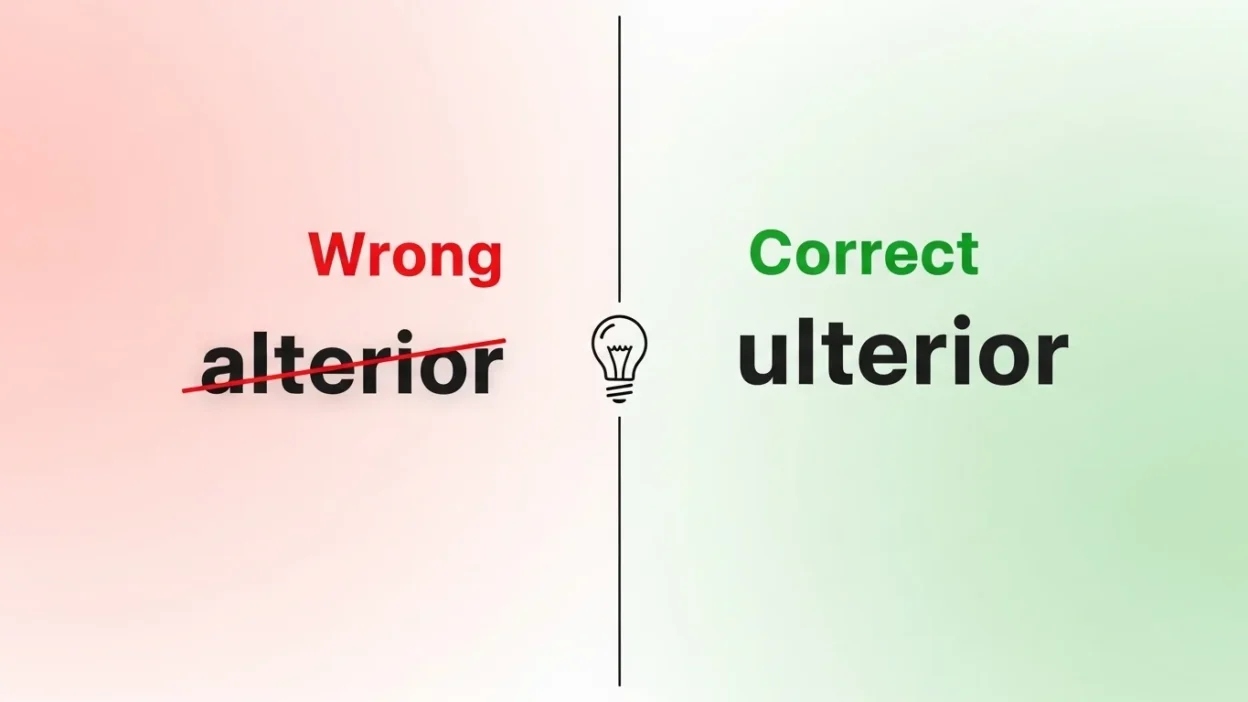
Many English learners get confused between “ulterior” and “alterior.” The reason is simple: both words look and sound very similar.
Because of this, people often assume they are two different words with similar meanings. However, this is not true.
A common search question is “alterior meaning” or “ulterior vs alterior”, but only one of these is correct in standard English. The other is usually just a mistake caused by spelling or pronunciation confusion.
Quick Answer
- Ulterior
- Correct English word
- Means hidden, secret, or not openly shown
- Used in phrases like ulterior motive
- Example: He had an ulterior reason for helping
- Alterior
- Not a standard English word
- No valid meaning in dictionaries
- Usually a spelling mistake of “ulterior”
- Should not be used in writing or speaking
👉 Simple rule: Always use ulterior. Avoid alterior completely.
Why People Get Confused
The confusion between ulterior vs alterior happens because:
- They sound almost the same when spoken quickly
- The spelling difference is small
- Learners often rely on how words sound instead of correct spelling
- Online content sometimes includes mistakes, which increases confusion
Also, when people hear the phrase ulterior motive, they may misinterpret the beginning sound as “alterior.”
Pronunciation Made Simple
Understanding pronunciation can help avoid mistakes:
- Ulterior is pronounced like: ul-TEER-ee-or
- The first sound is “ul,” not “al”
👉 Many learners mistakenly hear “alterior” because:
- The “u” sound is soft
- Fast speech can make it unclear
Tip: Focus on the “ul” sound at the beginning.
Clear Meaning of Ulterior
The word ulterior is used to describe something hidden or not directly expressed.
Ulterior Definition (Simple)
- Hidden intention
- Secret reason
- Not openly stated
Ulterior Motive Meaning
An ulterior motive is a hidden reason behind someone’s action.
Examples:
- She helped me, but I think she had an ulterior motive.
- He asked many questions for an ulterior reason.
- The decision may have an ulterior purpose.
👉 In simple words: ulterior = hidden intention
About Alterior Meaning
Many people search for alterior meaning, but this word does not exist in standard English.
- It has no official definition
- It is not accepted in formal writing
- It is usually a typo or misunderstanding
👉 If you see “alterior,” treat it as a mistake.
Side by Side Comparison
| Feature | Ulterior | Alterior |
| Status | Correct word | Incorrect / non-standard |
| Meaning | Hidden intention or purpose | No accepted meaning |
| Usage | Common in English | Not used |
| Dictionaries | Listed | Not listed |
| Example | Ulterior motive | Not valid |
| Pronunciation | ul-TEER-ee-or | Misheard form of ulterior |
How to Decide Which One to Use
Use this simple decision rule:
- Are you talking about a hidden intention? → Use ulterior
- Are you unsure about spelling? → Choose ulterior
- Did you write “alterior”? → Correct it to ulterior
👉 There is no situation where “alterior” should be used in standard English.
Common Mistakes Learners Make
1. Spelling Error
- ❌ He had an alterior motive
- ✅ He had an ulterior motive
2. Believing Both Words Are Correct
Some learners think “alterior” is a synonym of “ulterior.” This is incorrect.
3. Mishearing the Word
When listening to spoken English, learners may hear “alterior” instead of “ulterior.”
4. Using It in Exams or Writing
Using “alterior” in academic or professional writing can:
- Reduce clarity
- Be marked as incorrect
- Show lack of vocabulary accuracy
Error Correction Examples
Learning from mistakes is very helpful. Here are clear corrections:
- ❌ She had an alterior reason for calling.
✅ She had an ulterior reason for calling. - ❌ There might be an alterior plan behind this.
✅ There might be an ulterior plan behind this. - ❌ He acted with an alterior motive.
✅ He acted with an ulterior motive.
👉 Always replace “alterior” with “ulterior.”
Real Life Usage Examples
1. Daily Conversation
- “I think he invited us with an ulterior motive.”
- “She was kind, but maybe she had an ulterior reason.”
2. Email Writing
- “We should review the proposal carefully to ensure there are no ulterior intentions.”
3. Workplace Communication
- “The manager’s decision may have an ulterior purpose behind it.”
4. Social Media
- “Not everything people do is honest sometimes there are ulterior motives.”
5. Academic Writing
- “The character’s actions reveal an ulterior motive in the story.”
Comparison in Real Context
Correct usage (clear and natural):
- He offered help, but his ulterior motive was to gain trust.
Incorrect usage (avoid this):
- He offered help, but his alterior motive was to gain trust.
👉 The second sentence looks similar but is incorrect.
Simple Learning Tips for Beginners
1. Remember the Meaning
- Ulterior = hidden
- Think of something “under the surface”
2. Focus on Spelling
- “U” in ulterior = correct start
- Avoid replacing it with “A”
3. Practice with Sentences
Try creating your own sentences using “ulterior.”
4. Repetition Helps
The more you see correct usage, the easier it becomes to remember.
FAQ Section
1. What is the correct word: alterior or ulterior?
“Ulterior” is the correct word. “Alterior” is not standard English.
2. What is the meaning of ulterior?
It means hidden, secret, or not openly shown.
3. What is ulterior motive meaning?
It means a hidden reason behind someone’s actions.
4. Is alterior a real word?
No, it is not recognized in standard English dictionaries.
5. Why do people write alterior?
Because of spelling mistakes, pronunciation confusion, or mishearing the word.
6. How do I pronounce ulterior correctly?
It is pronounced as ul-TEER-ee-or.
7. Can I use alterior in informal writing?
No. Even in informal writing, it is better to avoid it and use the correct word “ulterior.”
8. How can I remember the difference easily?
Remember this:
- Ulterior = hidden intention
- Alterior = incorrect spelling
Conclusion
The confusion between ulterior vs alterior is very common, especially among beginners and ESL learners. However, the solution is simple:
- Ulterior is the correct and accepted word in English
- It means something hidden or not openly shown
- Ulterior motive refers to a secret reason behind an action
- Alterior is not a real or valid English word
By understanding pronunciation, meaning, and correct usage, you can easily avoid this mistake in writing and speaking.
👉 Final rule to remember:
If you want to express a hidden intention, always use “ulterior” never “alterior.”

David Robert is a passionate innovator driven by creativity, vision, and purpose. He turns bold ideas into impactful realities through focus, leadership, and dedication.