Many students and English learners get confused about any time vs anytime. They look the same and sound the same, but they are not always used the same way.
Using the wrong one can make your sentences unclear.
This guide will explain the difference between any time and anytime in the simplest way.
It also includes examples, tables, exercises, and real-life sentences to help you remember.
Quick Definition (Snippet-Friendly Box)
Quick tip:
| Word | Meaning | Example |
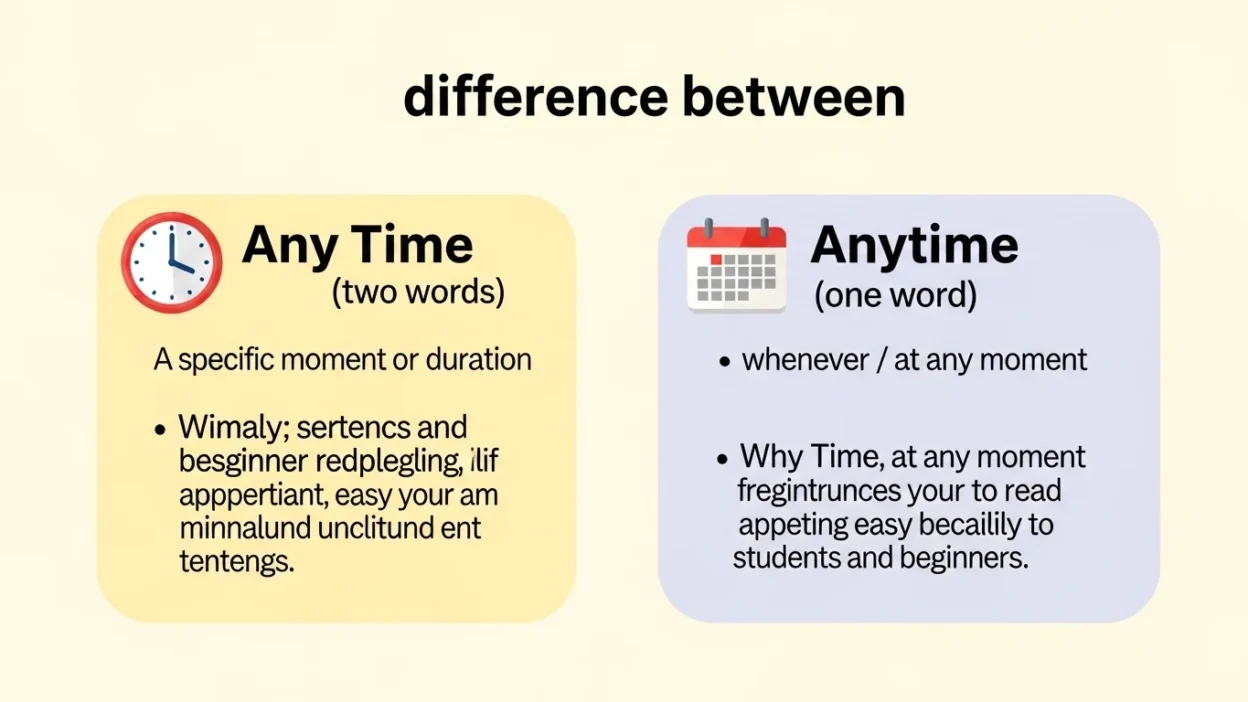
| Any time (two words) | A certain amount of time or a specific moment | “Do you have any time to help me today?” |
| Anytime (one word) | Whenever, at any moment (informal) | “You can call me anytime.” |
✅ Trick: If you can replace it with “whenever”, use anytime. If it talks about a quantity of time, use any time.
Background
- Any time = formal, two words, noun phrase → talks about time itself
- Anytime = informal, one word, adverb → talks about when something happens
Think of it this way:
- Any time = “a block of time”
- Anytime = “whenever you want”
The Difference in Simple Words
1. Any Time (two words)
- Talks about a specific amount of time.
- Comes after words like have, take, spend, need.
- Example sentences:
- “I don’t have any time this morning.”
- “She can’t spend any time with us today.”
- “I don’t have any time this morning.”
2. Anytime (one word)
- Means whenever or at any moment.
- More informal, often used in texts, emails, and conversations.
- Example sentences:
- “You can call me anytime.”
- “I’m free anytime this week.”
- “You can call me anytime.”
Rule of Thumb: You cannot use “anytime” to mean a certain amount of time.
Comparison Table
| Feature | Any Time (two words) | Anytime (one word) |
| Part of Speech | Noun phrase | Adverb |
| Meaning | A specific amount or moment of time | Whenever / at any moment |
| Formality | Formal / school, work writing | Informal / everyday writing |
| Can replace with “whenever”? | ❌ No | ✅ Yes |
| Example 1 | “Do you have any time today?” | “Call me anytime.” |
| Example 2 | I don’t have any time to waste.” | “I’m ready to help anytime.” |
When to Use Each
- Any time → Use for a specific duration or moment.
- Anytime → Use for whenever, informal situations like texts, emails, and messages.
Tip: Use any time in school, reports, essays. Use anytime with friends, family, and casual writing.
Common Mistakes
| Mistake | Correct Version | Why? |
| “I don’t have anytime to finish this project.” | “I don’t have any time to finish this project.” | Talking about a specific amount of time → use any time |
| “You can call me any time.” | “You can call me anytime.” | Offering freely → use anytime |
| Confusing informal/formal | Check if “whenever” fits | If yes → anytime; if no → any time |
Everyday Real Life Examples
Emails
- “Please let me know if you have any time to meet this week.”
- “You can email me anytime with questions.”
Social Media
- “I’m online anytime if you want to chat.”
- “I don’t spend any time scrolling on social media.”
Daily Life
- “Do you have any time to help me with homework?”
- “I can come over anytime today.”
News / Articles
- “There isn’t any time left before the deadline.”
- “Citizens can call anytime to report issues.”
Short Learning Section for Students
Steps to Remember:
- Am I talking about a specific amount of time? → Any time
- Do I mean whenever / at any moment? → Anytime
- Practice makes perfect: make sentences from daily life.
Mini Exercise: Fill in the blanks:
- I don’t have ______ to go shopping today. → any time
- You can visit me ______ this weekend. → anytime
- There isn’t ______ to waste before the exam. → any time
- Call me ______ if you need help. → anytime
Extra Tip: Use anytime examples and any time examples from emails, social media, or textbooks to remember better.
FAQ
1. Can I use “anytime” in formal writing?
- Usually no. Use any time in essays, schoolwork, or reports.
2. Are “anytime” and “any time” pronounced the same?
- Yes, they sound exactly the same.
3. Can I replace “anytime” with “whenever”?
- Yes, it usually works.
4. Can I replace “any time” with “whenever”?
- No, it changes the meaning.
5. Is “anytime soon” correct?
- Yes. It means in the near future.
6. How do I remember the difference easily?
- Think: any time = amount of time, anytime = whenever.
7. Can “any time” be used in questions?
- Yes. Example: “Do you have any time to meet me?”
8. How can learners practice?
- Make anytime examples and any time examples from your daily life. Try writing 5 sentences for each.
Conclusion
The difference is simple:
- Any time → talks about a specific amount or moment of time.
- Anytime → means whenever, used more casually.
Tip for beginners: Always ask yourself: “Do I mean a block of time, or just whenever?”
Use any time in formal writing and anytime in daily conversation.
With these examples, mini exercises, and tables, remembering any time vs anytime will become easy and natural.

David Robert is a passionate innovator driven by creativity, vision, and purpose. He turns bold ideas into impactful realities through focus, leadership, and dedication.