Many students and English learners get confused about anyone or anybody. Both words mean any person, but the correct choice depends on formality, context, and style.
For example:
- “Is there anyone who can help me?”
- “Can anybody answer this question?”
This guide explains the difference between anyone and anybody, provides real life examples, extended practice, and tips for emails, exams, social media, and conversation.
Quick Answer
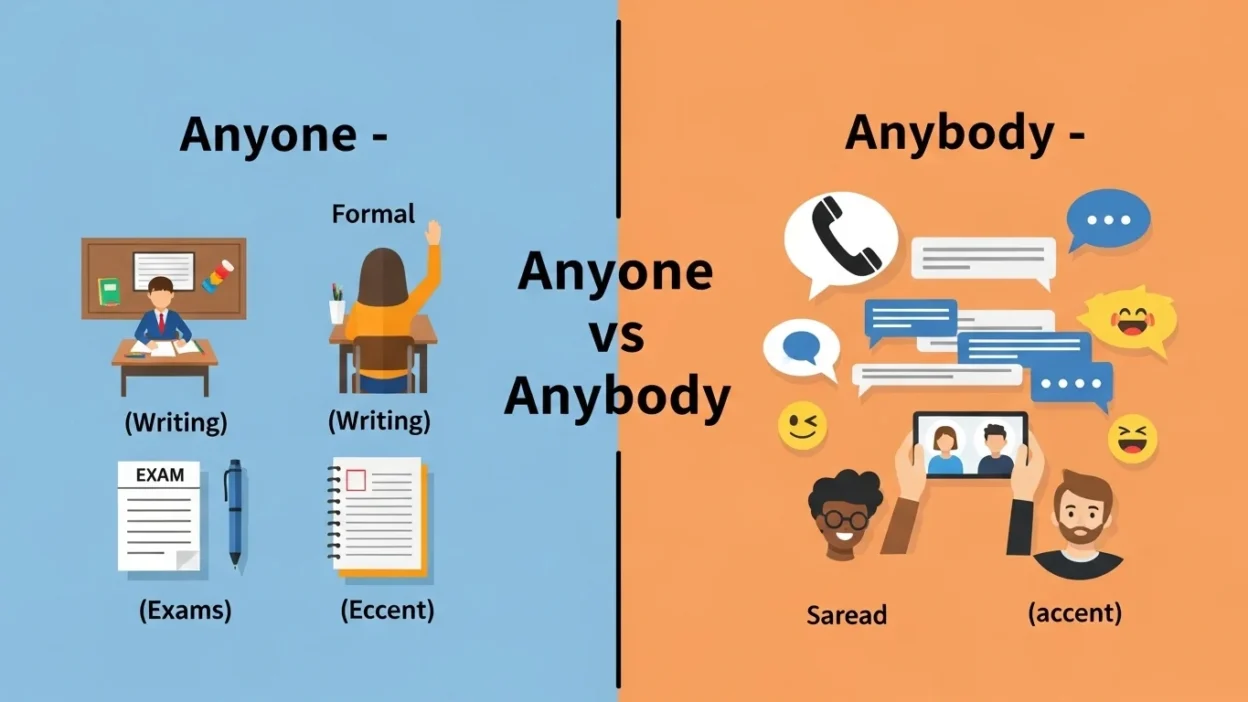
- Anyone → more formal; used in writing, exams, emails, or professional settings
- Anybody → more casual; used in conversation, texting, and social media
Memory Tip:
“Writing or exams → anyone. Talking or texting → anybody.”
Background and Origin
- Anyone comes from “any + one,” emphasizing any single person.
- Anybody comes from “any + body,” referring to any human being.
Modern usage:
- Anyone → preferred in exams, professional emails, formal writing
- Anybody → common in casual conversation, social media, forums, and texting
Tip:
Ask: “Am I writing formally or speaking casually?” → Formal = anyone, Casual = anybody
Clear Explanation of the Difference
| Feature | Anyone | Anybody |
| Meaning | Any person | Any person |
| Usage | Formal / exams / writing | Informal / casual / conversation |
| Context | Emails, essays, classroom, exams | Social media, texting, spoken English |
| Examples | “Does anyone want to join the class?” | “Can anybody help me move this table?” |
| Preference | Formal writing, exams | Everyday speech, social media |
Key point: Both words mean the same thing. The difference is formality, style, and context.
How to Use Them
Using Anyone (Formal / Standard)
- “Has anyone seen my notebook?”
- “If anyone wants to participate, please raise your hand.”
- “Does anyone in the class understand this topic?”
- Tip: Use in exams, essays, emails, and professional writing
Using Anybody (Informal / Casual)
- “Can anybody help me move this table?”
- “Is anybody free for lunch?”
- “Has anybody tried this new app?”
- Tip: Use in conversation, social media, texting, and casual chat
Real Life Examples
Emails / School Work
- “If anyone has questions, please email me.”
- “Does anybody know the answer to question 3?”
Conversation / Social Media / Texting
- “Can anybody recommend a good movie?”
- “Has anyone tried this new app?”
- “Is anybody coming to the party tonight?”
Exams / Formal Writing
- “If anyone fails to submit the assignment, they will get zero marks.”
- “Does anyone in the class understand this topic?”
Negative Sentences
- “I didn’t see anyone at the park.”
- “I didn’t see anybody at the park.”
These examples cover multiple contexts for anyone or anybody.
Common Mistakes Students Make
- ❌ Using anybody in formal essays → sounds too casual
- ❌ Using anyone in very casual conversation → may sound stiff
- ❌ Confusing usage in negative sentences → both work, but “anyone” is slightly preferred in formal negatives
Memory Trick:
Exams, emails, professional writing → anyone
Casual conversation, social media, texting → anybody
Short Learning Section (For Students & Beginners)
Easy Trick
- Anyone = formal / writing / exams
- Anybody = informal / casual / conversation
Practice Exercises
Fill in the blanks:
- Has ______ seen my homework?
- Can ______ help me carry these books?
- If ______ wants to join, please raise your hand.
- Is ______ free to answer this question?
- ______ can submit the form before Friday.
- Does ______ know the answer to question 10?
- Has ______ tried this new app yet?
- Can ______ recommend a good book?
- I didn’t see ______ at the park yesterday.
- ______ in the class can ask questions after the lecture.
Answers:
- anyone
- anybody
- anyone
- anybody
- anyone
- anyone
- anybody
- anybody
- anyone
- anyone
Matching Exercise: Match “anyone” or “anybody” to formal or casual:
- Emails → anyone
- Text messages → anybody
- Exams → anyone
- Social media → anybody
FAQ (Simple Questions & Answers)
1. Are anyone and anybody the same?
Yes, both mean any person, but formality differs.
2. Which is more formal?
Anyone is preferred in exams, professional emails, and writing.
3. Can I use anybody in formal writing?
It’s better to use anyone for essays, exams, and professional writing.
4. Can anyone and anybody be used in questions?
Yes, both are used in questions:
- “Has anyone seen this?”
- “Can anybody help?”
5. Can anyone and anybody be used in negative sentences?
Yes:
- “I didn’t see anyone there.”
- “I didn’t see anybody there.”
6. Can anyone and anybody be used in spoken English?
Yes, but anybody is more common in conversation.
7. Are there regional differences?
Slightly. In US English, anyone is often used in writing and exams; anybody is more casual. In UK English, usage is similar.
8. Can anyone be pluralized?
Rarely, but technically possible: “anyones” is not common. Same for “anybodies.”
Conclusion
Now you fully understand anyone or anybody and the difference between anyone and anybody.
Final Rule to Remember:
- Anyone = formal / writing / exams / professional
- Anybody = informal / casual / spoken English / social media
Memory Tip:
“Writing or exams → anyone. Talking, texting, or social media → anybody.”

Andrew Christopher is a passionate visionary who blends creativity with purpose to bring ideas to life. With a focus on innovation and integrity, he inspires growth and lasting impact.