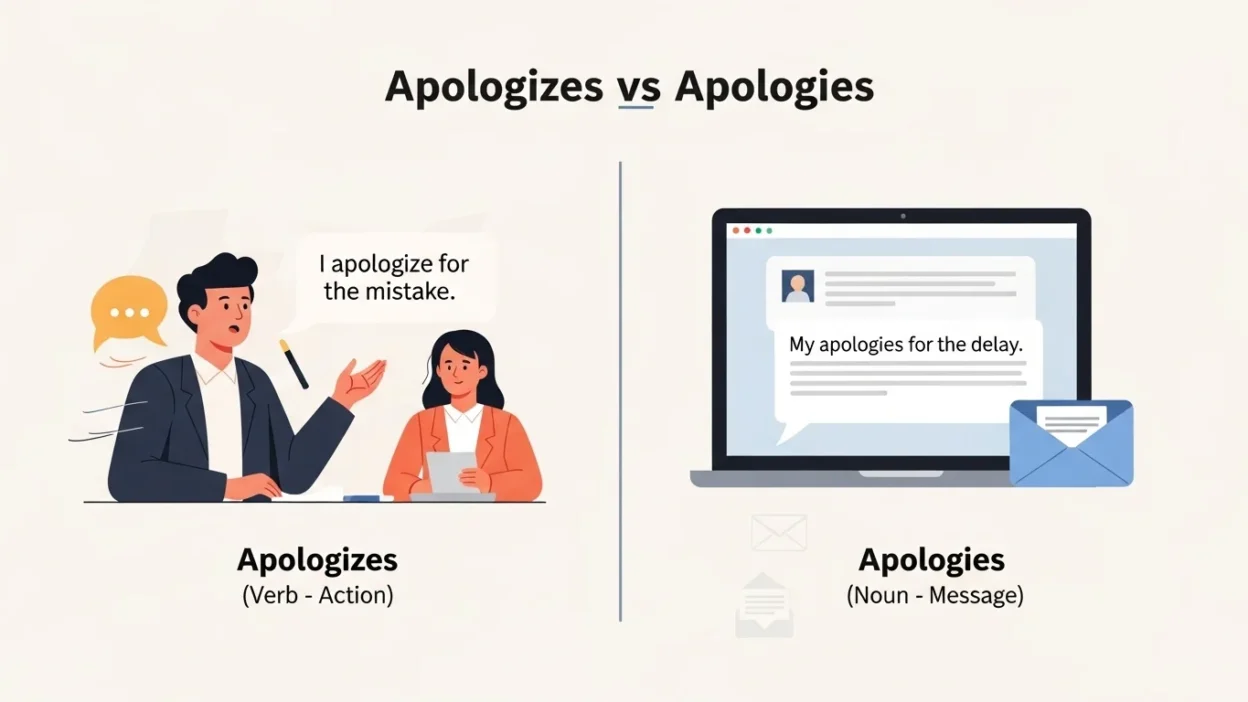
Many English learners get confused between “apologizes” and “apologies.” Both words come from the idea of saying sorry, and they look very similar. Because of this, students often use them in the wrong way.
The confusion usually happens because:
- One is a verb (action)
- The other is a noun (thing)
- Both are used in similar situations
This article will remove that confusion completely. You will learn the difference between apologizes and apologies, how to use them correctly, and how to choose the right one instantly in real sentences.
Quick Understanding (At a Glance)
- Apologizes → action word (verb)
- Used when someone is doing the act of saying sorry
- Example: She apologizes for the mistake.
- Apologies → naming word (noun)
- Used when referring to the message or expression of sorry
- Example: My apologies for the delay.
👉 Simple rule:
- Action = apologizes
- Expression/message = apologies
What is “Apologize” and “Apologizes”?
To understand apologizes vs apologies, we first need to understand the base verb.
Base Verb: Apologize
Apologize means: to say sorry for something.
Forms of the verb:
- Apologize (base form)
- Apologizes (present tense for he/she/it)
- Apologized (past tense)
- Apologizing (continuous form)
When do we use “apologizes”?
We use apologizes when:
- The subject is he, she, or it
- We are describing an action happening in the present
Sentence patterns:
- Subject + apologizes + (reason)
✅ Examples:
- She apologizes for her behavior.
- He apologizes to his teacher.
- The company apologizes for the inconvenience.
👉 Notice the structure:
Someone (subject) is doing the action of apologizing.
What are “Apologies”?
Apologies is a noun. It refers to the words or message of saying sorry.
It is often used in:
- Formal communication
- Emails
- Polite expressions
Common patterns:
- My apologies for + reason
- Our apologies for + reason
- Please accept our apologies
Examples:
- My apologies for the late reply.
- Please accept our apologies.
- He sent his apologies through email.
👉 Here, “apologies” is not an action. It is the message itself.
Key Difference Explained Simply
The easiest way to understand apologizes or apologies is this:
- Apologizes = doing
- Apologies = giving
Think of it like this:
- When someone is speaking and saying sorry → apologizes
- When you are presenting or writing the sorry message → apologies
Side by Side Comparison Table
| Feature | Apologizes | Apologies |
| Type | Verb | Noun |
| Meaning | The act of saying sorry | The expression/message of sorry |
| Usage | With he/she/it | Used in phrases or statements |
| Function | Shows action | Represents a thing or message |
| Example | She apologizes for the delay | My apologies for the delay |
| Sentence role | Main verb | Object or phrase |
How to Choose the Correct Word (Simple Method)
If you are unsure whether to use apologizes or apologies, follow this quick decision method:
Step 1: Ask yourself
- Is this sentence describing an action?
- Or is it giving a statement/message?
Step 2: Choose accordingly
- Action → use apologizes
- Message → use apologies
Quick checklist:
- If the sentence has a subject doing something → use verb → apologizes
- If the sentence sounds like a polite phrase → use noun → apologies
Common Sentence Patterns
Using “Apologizes”:
- She apologizes for her mistake.
- He apologizes immediately.
- The teacher apologizes to the class.
Using “Apologies”:
- My apologies for the confusion.
- Our apologies for the inconvenience.
- Please accept my apologies.
Common Mistakes Learners Make
1. Using “apologies” as a verb
❌ Wrong: He apologies for being late
✅ Correct: He apologizes for being late
👉 Remember: “apologies” cannot act as a verb.
2. Using “apologizes” as a noun
❌ Wrong: My apologizes for the delay
✅ Correct: My apologies for the delay
👉 “Apologizes” is only an action word.
3. Mixing spelling forms
- Apologize (American English)
- Apologise (British English)
Both are correct, but keep your usage consistent.
4. Forgetting prepositions
- Apologize for something
- Apologize to someone
Examples:
- She apologizes for the mistake.
- He apologizes to his friend.
Real Life Examples in Different Situations
1. Email Writing
- My apologies for the delayed response.
- I apologize for not replying earlier.
2. Workplace Communication
- The manager apologizes for the error.
- Please accept our apologies for the inconvenience.
3. Social Media
- He apologizes to his followers.
- She shared her apologies publicly.
4. Daily Conversation
- I apologize for being late.
- Please accept my apologies.
Important Variations You Should Know
In real English, people often use other forms of “apologize”:
- I apologize (very common in formal writing)
- We sincerely apologize (polite/business tone)
- Sending my apologies (casual written tone)
These forms are all based on the same verb and help you sound more natural.
Error Diagnosis: How to Check Your Sentence
Use this simple method to check your sentence:
- Identify the subject
- Ask: Is the subject doing something?
- Yes → use “apologizes”
- No → check if it’s a phrase → use “apologies”
- Check if the sentence is formal
- Formal message → “apologies” or “I apologize”
Practice Section
Fill in the blanks:
- She ______ for the mistake.
- My ______ for the delay.
- He always ______ when he is wrong.
- Please accept our ______.
Answers:
- apologizes
- apologies
- apologizes
- apologies
FAQ (Frequently Asked Questions)
1. What is the main difference between apologizes and apologies?
“Apologizes” is a verb (action), while “apologies” is a noun (message of sorry).
2. Can I say “I apologies”?
No. The correct form is I apologize or my apologies.
3. Which is more formal?
- “I apologize” is more formal in writing
- “My apologies” is also formal and commonly used in emails
4. Is “apologizes” used in formal English?
Yes, but “I apologize” is more commonly used in formal writing.
5. Can “apologies” be plural?
Yes, it is the plural form of “apology,” but it is often used as a fixed polite expression.
6. What is the easiest way to remember?
- Action = apologizes
- Message = apologies
7. Are both words used in daily English?
Yes, both are very common in spoken and written English.
8. Why do people confuse these words?
Because they look similar, come from the same root, and are used in similar situations.
Conclusion
Understanding apologizes or apologies becomes easy when you focus on their roles:
- Apologizes is a verb that shows action (someone is saying sorry).
- Apologies is a noun that represents the message of sorry.
The key to mastering this topic is to remember one simple idea:
👉 If someone is doing the action → use apologizes
👉 If you are giving a polite expression → use apologies
With practice and simple thinking, you can confidently use both words correctly in writing and speaking.

David Robert is a passionate innovator driven by creativity, vision, and purpose. He turns bold ideas into impactful realities through focus, leadership, and dedication.