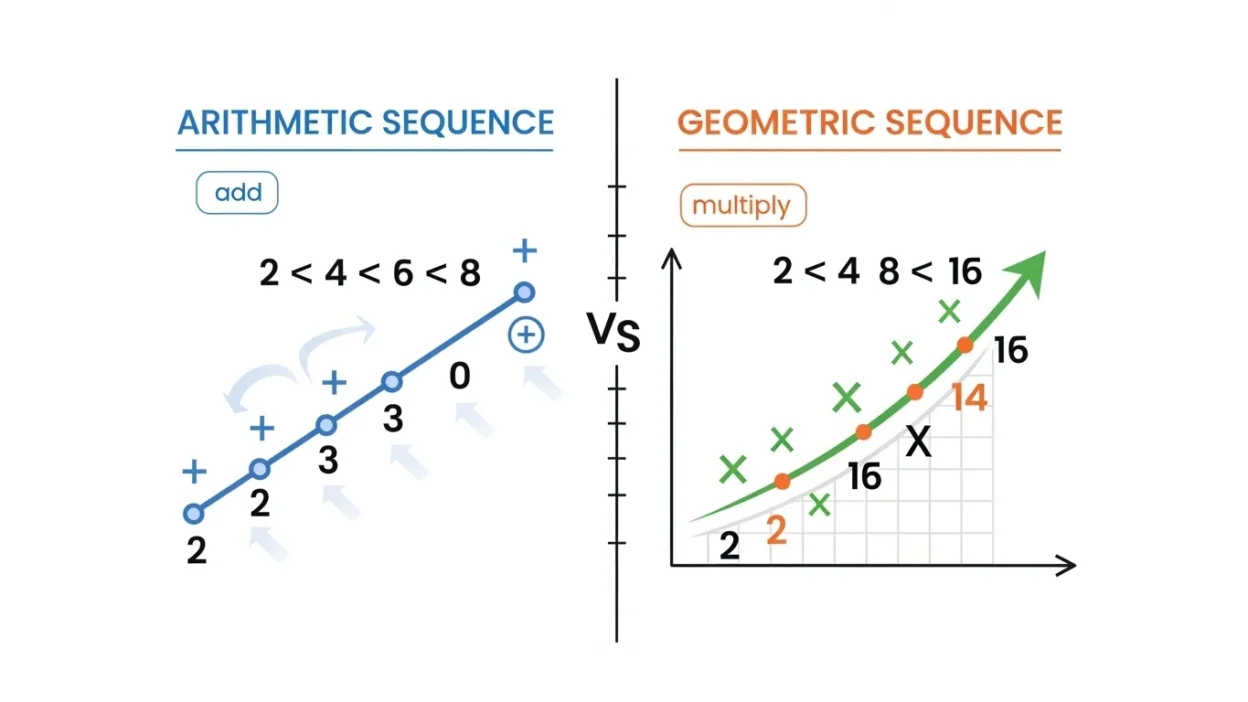
Many students feel confused when they first learn about arithmetic and geometric sequences.
Both involve numbers that follow a pattern, but the way the pattern works is different. Some sequences grow by adding, while others grow by multiplying.
This guide explains the idea of arithmetic or geometric in very simple English. It will help you clearly understand the difference, identify each type, and avoid common mistakes.
Quick Understanding
- An arithmetic sequence changes by adding or subtracting the same number each time
- A geometric sequence changes by multiplying or dividing by the same number
- Arithmetic uses a common difference
- Geometric uses a common ratio
👉 Simple idea:
If numbers increase by addition → arithmetic
If numbers increase by multiplication → geometric
What Is an Arithmetic Sequence?
An arithmetic sequence is a list of numbers where the difference between each pair of consecutive terms is the same.
This fixed amount is called the common difference.
Examples
- 3, 6, 9, 12, 15
- 10, 20, 30, 40
- 5, 8, 11, 14
In each case, the same number is added every time.
How It Works
- 6 − 3 = 3
- 9 − 6 = 3
- 12 − 9 = 3
The difference remains constant, so it is an arithmetic sequence.
👉 Arithmetic sequences show a steady, linear pattern.
What Is a Geometric Sequence?
A geometric sequence is a list of numbers where each term is found by multiplying or dividing by the same number.
This fixed multiplier is called the common ratio.
Examples
- 2, 4, 8, 16, 32
- 3, 9, 27, 81
- 10, 5, 2.5, 1.25
In each case, the same number is multiplied each time.
How It Works
- 4 ÷ 2 = 2
- 8 ÷ 4 = 2
- 16 ÷ 8 = 2
The ratio stays constant, so it is a geometric sequence.
👉 Geometric sequences show exponential growth or decay.
Clear Difference Between Arithmetic and Geometric
The main difference lies in how the sequence progresses:
- Arithmetic sequences use addition or subtraction
- Geometric sequences use multiplication or division
Simple Comparison
Arithmetic example:
- 5, 10, 15, 20
- Each step adds 5
Geometric example:
- 5, 10, 20, 40
- Each step multiplies by 2
👉 One grows by adding, the other grows by multiplying.
How to Identify the Sequence Type
To identify whether a sequence is arithmetic or geometric, follow these simple steps:
Step for Arithmetic
- Subtract consecutive terms
- If the result is the same each time, it is arithmetic
Example:
- 12 − 7 = 5
- 17 − 12 = 5
- 22 − 17 = 5
Since the difference is constant, it is arithmetic.
Step for Geometric
- Divide consecutive terms
- If the result is the same each time, it is geometric
Example:
- 20 ÷ 10 = 2
- 40 ÷ 20 = 2
- 80 ÷ 40 = 2
Since the ratio is constant, it is geometric.
Common Difference and Common Ratio Explained
- The common difference is the fixed amount added in an arithmetic sequence
- The common ratio is the fixed number multiplied in a geometric sequence
Example of Common Difference
- 4, 7, 10, 13
- Difference is always 3
Example of Common Ratio
- 3, 6, 12, 24
- Ratio is always 2
👉 These two ideas are the key to understanding sequence patterns.
Arithmetic and Geometric Examples in Real Life
Arithmetic Examples
Arithmetic sequences appear in situations where things increase steadily:
- Saving the same amount of money every month
- Increasing steps in a workout plan
- Paying a fixed bonus each year
- Adding a fixed number of pages while reading daily
👉 These are real-world patterns of constant growth.
Geometric Examples
Geometric sequences appear where growth multiplies:
- Population growth over time
- Compound interest in banking
- Spread of a virus
- Growth of followers on social media
👉 These situations grow faster because each step builds on the previous one.
Arithmetic Growth vs Geometric Growth
Arithmetic growth increases by a constant amount, while geometric growth increases by a multiplying factor.
Arithmetic growth is steady and linear. Geometric growth is rapid and exponential.
For example:
- Arithmetic: 2, 5, 8, 11
- Geometric: 2, 4, 8, 16
Over time, geometric growth becomes much larger than arithmetic growth.
When to Use Arithmetic or Geometric Sequences
To decide which type to use, always observe the pattern:
- If the numbers change by adding or subtracting the same value → arithmetic
- If the numbers change by multiplying or dividing by the same value → geometric
In problem-solving, the first step is always to check whether the change is constant in difference or ratio.
Step by Step Example for Beginners
Example Sequence:
6, 12, 18, 24
Step 1: Find the difference
12 − 6 = 6
18 − 12 = 6
Step 2: Check if the difference is the same
Yes, it is constant
Conclusion: Arithmetic sequence
Another Example:
3, 6, 12, 24
Step 1: Find the ratio
6 ÷ 3 = 2
12 ÷ 6 = 2
Step 2: Check if the ratio is the same
Yes, it is constant
Conclusion: Geometric sequence
Common Mistakes Students Make
- Confusing addition with multiplication
- Forgetting to check both difference and ratio
- Assuming a sequence type without verifying
- Mixing up patterns in longer sequences
- Not checking all consecutive terms
👉 Always verify the pattern carefully before deciding.
Simple Learning Tips
- Look at how the numbers change, not just the numbers themselves
- Use subtraction to check arithmetic
- Use division to check geometric
- Practice with different examples
- Compare patterns side by side for better understanding
FAQ
What is the main difference between arithmetic and geometric sequences?
Arithmetic sequences use addition or subtraction, while geometric sequences use multiplication or division.
How do I know if a sequence is arithmetic?
Check if the difference between consecutive terms is the same.
How do I know if a sequence is geometric?
Check if the ratio between consecutive terms is the same.
What is the common difference?
It is the fixed value added in an arithmetic sequence.
What is the common ratio?
It is the fixed value multiplied in a geometric sequence.
Which type grows faster?
Geometric sequences grow faster because they multiply at each step.
Can a sequence change between arithmetic and geometric?
No, a sequence should follow one consistent pattern.
Why are these sequences important?
They help in understanding patterns in mathematics, science, finance, and real-life situations like growth and change.
Conclusion
Understanding arithmetic or geometric sequences becomes easy once you focus on the pattern of change.
- Arithmetic sequences change by a constant difference
- Geometric sequences change by a constant ratio
- The key is to observe whether the sequence is adding or multiplying
By practicing simple examples and checking the pattern carefully, anyone can confidently identify and work with arithmetic and geometric sequences in mathematics and real life situations.

David Robert is a passionate innovator driven by creativity, vision, and purpose. He turns bold ideas into impactful realities through focus, leadership, and dedication.