English can be tricky sometimes, and one thing that often confuses learners is “awhile” vs “a while.”
These two look almost the same, but they are used differently. Many students, learners, and beginners mix them up, even in simple sentences.
Don’t worry! By the end of this article, you will understand the difference clearly and feel confident using both.
Why People Get Confused
- Both “awhile” and “a while” sound exactly the same.
- Both refer to a period of time.
- Many learners try to use them interchangeably, but that can lead to mistakes.
- The difference is small but important: one is an adverb, and the other is a noun phrase.
Think of it this way: one is one word (adverb) and one is two words (noun phrase). Knowing this simple rule makes it much easier to use them correctly.
Quick Answer
Here’s a fast, easy way to remember:
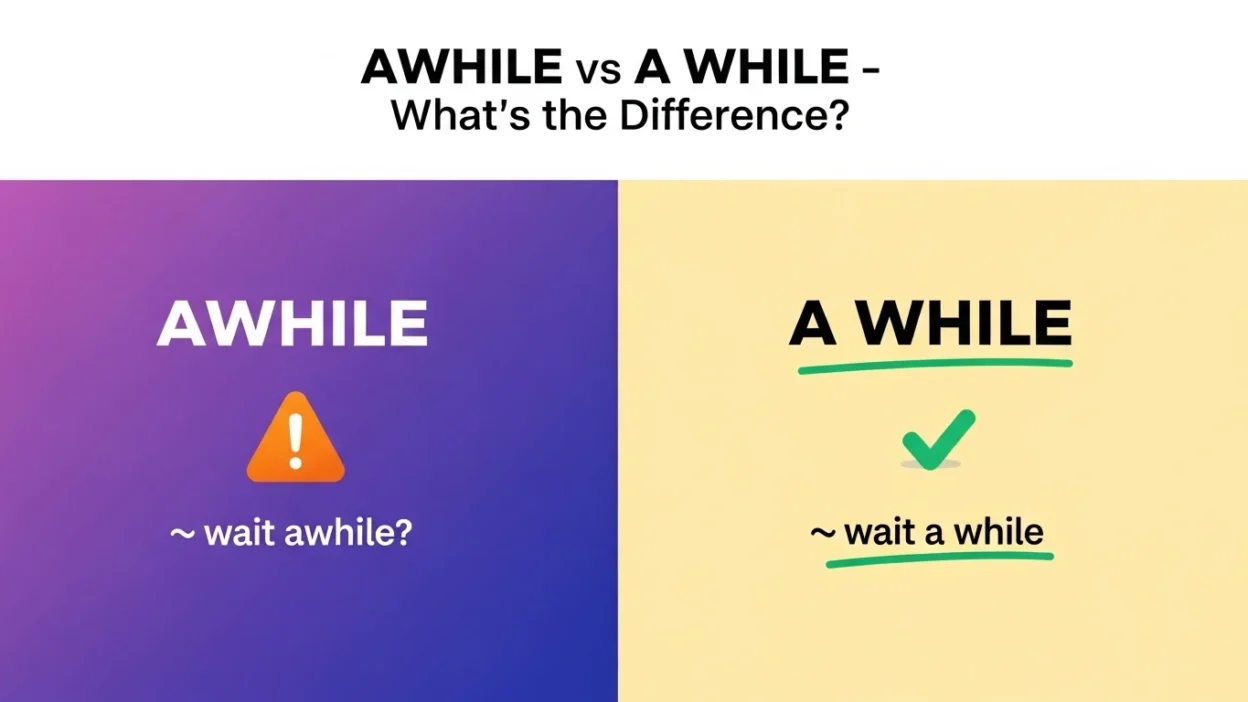
- Awhile → one word → adverb → means “for a short time.”
- Example: Sit down and rest awhile.
- A while → two words → noun phrase → means “a period of time.”
- Example: It has been a while since we met.
Tip: If you can replace it with “for a short time” → use awhile.
If you can replace it with “a period of time” → use a while.
Simple Origin / Background
- Awhile is older in English. It comes from “a” + “while” joined together over time.
- A while stayed as two separate words.
- Over centuries, English grammar decided:
- awhile → adverb
- a while → noun phrase
This history explains why people sometimes get confused: they used to be almost the same, but now grammar rules make them different.
Clear Explanation of the Difference
1. Awhile (one word)
- Type: Adverb
- Meaning: For a short time
- Use: Modifies a verb
- Examples:
- Rest awhile before you start studying. → “for a short time”
- Stay awhile and enjoy the view. → “for a short time”
2. A While (two words)
- Type: Noun phrase
- Meaning: A period of time
- Use: Works with prepositions like “for,” “in,” or “after”
- Examples:
- It’s been a while since we last met. → “a period of time”
- We will wait for a while before leaving. → “a period of time”
Remember:
- Awhile = adverb → no “for” needed
- A while = noun → usually needs “for”
Comparison Table
| Feature | Awhile (one word) | A While (two words) |
| Type | Adverb | Noun phrase |
| Meaning | For a short time | A period of time |
| Usage with “for” | No | Often yes |
| Example 1 | Sit awhile and relax. | Sit for a while and relax. |
| Example 2 | Stay awhile longer. | We will wait a while. |
Which One to Use and When
- Use awhile:
- When you want to say someone is doing something for a short time.
- After a verb.
- Use a while:
- When you talk about a period of time.
- Often after prepositions like for, in, or after.
Trick: Try replacing with “for a short time” → awhile.
Try replacing with “a period of time” → a while.
Common Mistakes People Make
- Incorrect: Wait awhile for me.
Correct: Wait for a while for me. → “for” is needed because it’s a noun phrase. - Incorrect: It has been awhile since we met.
Correct: It has been a while since we met. → “a while” is correct because it’s a period of time. - Using awhile after prepositions like “for” or “in” → ❌
- Example: for awhile → ❌
- Correct: for a while ✅
Everyday Real Life Examples
Emails / Messages:
- “Let’s chat awhile before the meeting starts.”
- “It’s been a while since I emailed you.”
Social Media / News:
- “Stay awhile and enjoy our live stream!”
- “It’s been a while since the last update.”
Daily Conversation:
- “Sit awhile and drink some tea.”
- “We haven’t seen each other for a while.”
Short Learning Section for Students and Beginners
- Step 1: Identify if the phrase modifies a verb → probably awhile.
- Step 2: Check if it shows a period of time → probably a while.
- Step 3: Test by replacing:
- “for a short time” → awhile
- “a period of time” → a while
Quick memory tip:
- One word → adverb → short time
- Two words → noun → period of time
FAQ
1. Can I use “awhile” and “a while” interchangeably?
- No. “Awhile” is adverb; “a while” is noun phrase. Using them wrongly can make your sentence incorrect.
2. Is “awhile” formal or informal?
- It is neutral. You can use it in formal and informal writing.
3. Can “a while” stand alone without “for”?
- Sometimes yes, e.g., It’s been a while. But often it comes with “for.”
4. How do I remember the difference quickly?
- Replace with “for a short time” → awhile
- Replace with “a period of time” → a while
5. Is “awhile” used in questions?
- Yes. Can you stay awhile? → correct
6. Can “a while” be plural?
- No, it is uncountable. You say for a while, not for a whiles.
7. Example for beginner-friendly practice:
- Let’s sit awhile. → adverb
- We haven’t met for a while. → noun phrase
8. Can “awhile” come at the start of a sentence?
- Yes. Awhile, he sat quietly. (means “for a short time”)
Conclusion
Now you know the clear difference between awhile and a while:
- Awhile → one word → adverb → for a short time
- A while → two words → noun phrase → a period of time
Remember the simple test:
- Replace with “for a short time” → awhile
- Replace with “a period of time” → a while
With practice, you will never confuse them again. Start using these in your emails, messages, and daily conversations.
English is easier when you know small but important differences like this!

Michael is a passionate thinker and visionary creator who turns ideas into action. With focus and integrity, he strives to make every project purposeful and inspiring.