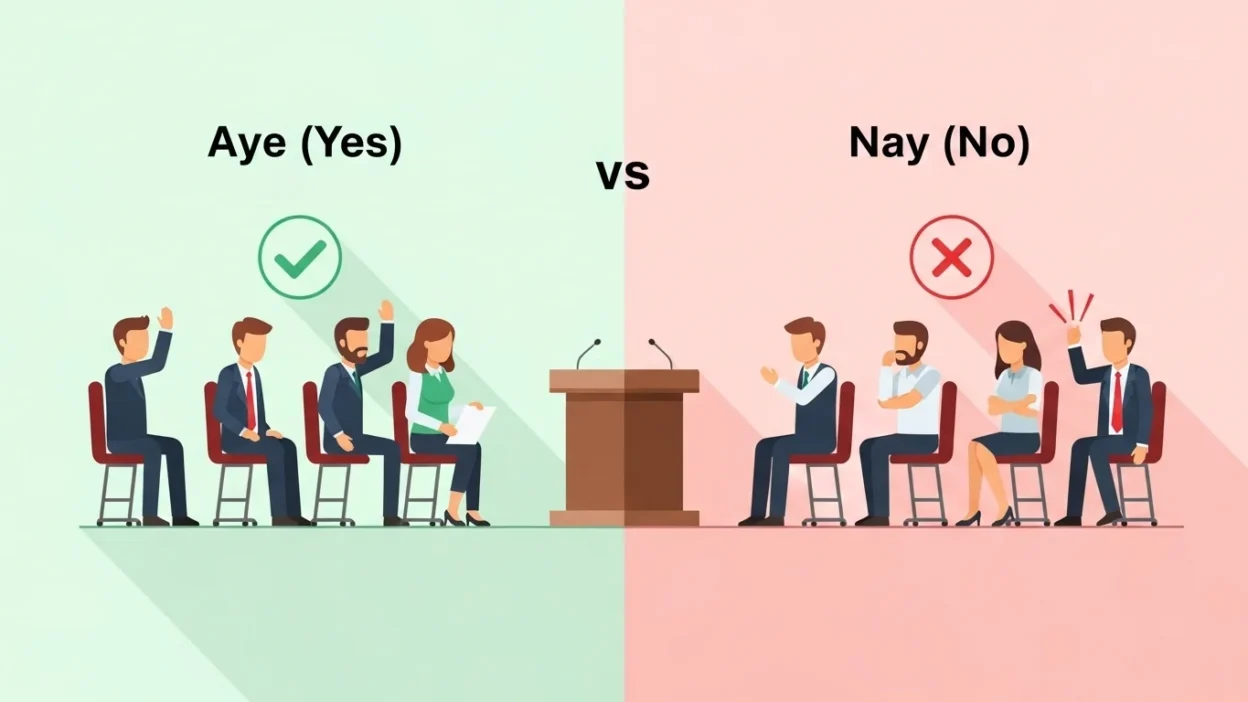
Many learners get confused when they hear the phrase “aye or nay.” The words look old, unusual, and different from everyday English.
Because people usually say “yes” and “no,” they often wonder about the aye meaning and nay meaning, and when these words should be used.
Another reason for confusion is that these words are not commonly used in daily conversation. Instead, they appear in formal situations like voting, meetings, or official discussions. This makes it harder for beginners and learners to understand their exact use.
This guide explains everything in very simple English. By the end, you will clearly understand aye vs nay, how to use them, and when each word is appropriate.
Quick Answer
- Aye = Yes (agreement)
- Nay = No (disagreement)
In simple terms:
- Use aye when you agree or support something
- Use nay when you disagree or reject something
The phrase “aye or nay” simply means choosing between yes or no in a formal way.
Simple Origin or Background
The words aye and nay in voting come from old English language traditions. Many years ago, these words were commonly used in official meetings, councils, and parliaments.
- Aye meaning developed as a formal way to express “yes”
- Nay meaning developed as a formal way to express “no”
Even today, these voting terms aye nay are still used in formal settings where people must clearly express their opinion during a vote. Although modern English prefers “yes” and “no,” these traditional words remain part of formal communication.
Clear Explanation of the Difference
Understanding the difference between aye and nay is very easy:
- Aye = Yes
- Nay = No
In voting situations:
- People who agree say “aye”
- People who disagree say “nay”
Simple meaning comparison:
- aye vs yes → Aye is the formal version of yes
- nay vs no → Nay is the formal version of no
Tone and usage:
- Both words sound formal and traditional
- They are mainly used in structured environments like meetings or official votes
- They are rarely used in everyday casual conversation
So, when someone asks “aye or nay,” they are asking you to choose between agreement (yes) or disagreement (no).
Comparison Table
| Feature | Aye | Nay |
| Basic meaning | Yes | No |
| Function | Agreement | Disagreement |
| Usage context | Formal voting | Formal voting |
| Tone | Formal | Formal |
| Everyday use | Rare | Rare |
| Example sentence | “I vote aye.” | “I vote nay.” |
This table makes it easy to quickly understand aye vs nay at a glance.
Which One to Use and When
Understanding aye and nay usage depends on the situation.
Use “aye” when:
- You agree with a proposal
- You support a decision in a formal vote
- You are part of a group decision-making process
Use “nay” when:
- You disagree with a proposal
- You want to reject an idea
- You are voting against something in a formal setting
In daily life:
- Use “yes” instead of aye
- Use “no” instead of nay
So while what does aye mean is simply “yes,” it is mainly reserved for formal contexts rather than casual speech.
Common Mistakes People Make
1. Using aye and nay in casual conversation
Many learners try to use these words in normal talk. This can sound unusual. In daily conversation, “yes” and “no” are more natural.
2. Confusing their meanings
Some people think “aye” and “nay” have complex meanings. In reality:
- Aye = yes
- Nay = no
3. Mispronouncing the words
- Aye pronunciation: sounds like “eye”
- Nay pronunciation: rhymes with “day”
4. Using them without context
These words are best used in voting or formal discussions. Using them randomly may confuse listeners.
Everyday Real Life Examples
Even though aye and nay usage is not common in daily speech, here are some real-life situations where you might see them:
1. Formal meetings or voting sessions
- Leader: “All in favor say aye.”
- Members: “Aye” or “Nay”
2. School or student council decisions
Students may vote using:
- “Aye” for yes
- “Nay” for no
3. News or reports
- “The proposal passed with 15 ayes and 4 nays.”
This shows how many people agreed or disagreed.
4. Clubs and organizations
Groups may use aye and nay in voting when deciding rules or events.
5. Online polls or discussions (modern context)
Sometimes people jokingly use “aye or nay” in polls on social media or group chats to ask for quick opinions.
Short Learning Section for Students and Beginners
To remember easily:
- Aye = Yes (I agree)
- Nay = No (I disagree)
Memory trick:
- Aye sounds like “eye” → imagine opening your eyes and agreeing
- Nay sounds like “no” → think of refusing something
Practice exercise:
Choose the correct word (aye or nay):
- I support the plan → ______
- I do not agree → ______
- The group voted in favor → ______
- The proposal was rejected → ______
Answers:
- Aye
- Nay
- Aye
- Nay
Practicing like this helps you clearly understand aye meaning and nay meaning.
FAQ (Frequently Asked Questions)
1. What does “aye or nay” mean?
It means choosing between yes and no in a formal way, usually during voting.
2. What is the aye meaning?
“Aye” means yes or agreement.
3. What is the nay meaning?
“Nay” means no or disagreement.
4. What is the difference between aye and nay?
Aye means yes, while nay means no. This is the basic aye vs nay difference.
5. Can I use aye and nay in daily conversation?
You can, but it is uncommon. People usually say yes and no in everyday speech.
6. Where are aye and nay commonly used?
They are used in meetings, parliaments, voting sessions, and formal group decisions.
7. How do you pronounce aye and nay?
- Aye pronunciation: like “eye”
- Nay pronunciation: like “day”
8. Why do people still use these words?
They are traditional formal words used to clearly express agreement or disagreement in structured settings.
Conclusion
The phrase “aye or nay” simply refers to a choice between agreement and disagreement. The aye meaning is yes, and the nay meaning is no. Understanding the difference between aye and nay helps beginners, students, and learners follow formal discussions and voting situations more easily.
While aye vs yes and nay vs no are similar in meaning, the words “aye” and “nay” are mainly used in formal contexts, not in everyday conversation.
In simple terms:
- Say aye when you agree
- Say nay when you disagree
- And remember: “aye or nay” = yes or no in formal language
With this clear and simple explanation, you can now confidently understand and use these words whenever you come across them.

Michael is a passionate thinker and visionary creator who turns ideas into action. With focus and integrity, he strives to make every project purposeful and inspiring.