Many students and English learners get confused about begun vs began because both words come from the verb begin and both talk about actions related to the past.
The confusion usually happens because:
- Began describes something that started in the past.
- Begun is also about the past but must be used with helping verbs like has, have, or had.
Once you understand this simple rule, the difference between begun and began becomes very easy to remember.
This guide explains begun vs began meaning, usage, examples, and common mistakes in clear and simple English.
Quick Answer: Begun vs Began
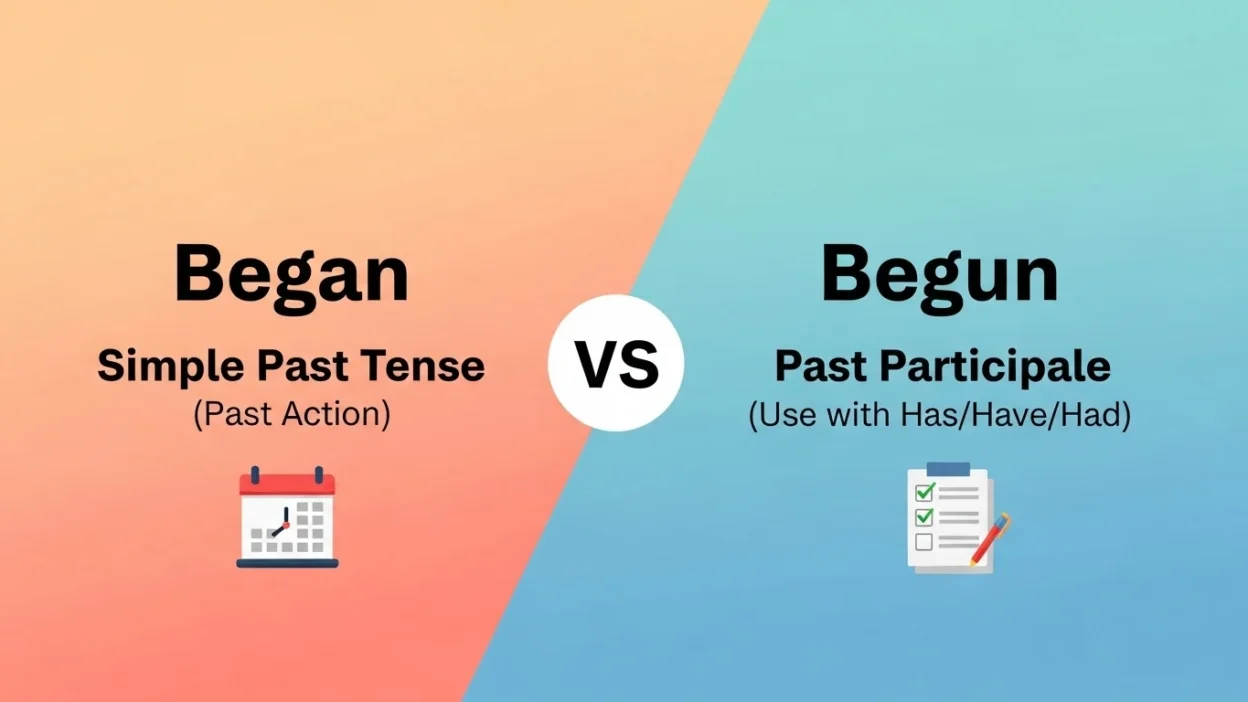
Began is the simple past tense of “begin.” Begun is the past participle and must be used with helping verbs like has, have, or had.
Simple Rule
- Began = past action without a helping verb
- Begun = used with has, have, or had
Example
- The meeting began at 10 AM.
- The meeting has begun.
Began Meaning in English
Began is the simple past tense of the verb begin.
It describes an action that started in the past and finished in the past.
Examples of Began
- The class began at nine o’clock.
- She began learning Spanish last year.
- The movie began late.
- They began the project yesterday.
In all these examples, began is used alone without helping verbs.
Begun Meaning in English
Begun is the past participle of the verb begin.
It cannot be used alone. It must appear with helping verbs such as:
- has
- have
- had
Examples of Begun
- The meeting has begun.
- They have begun building the new school.
- She had begun cooking before we arrived.
- The students have begun their exams.
These examples show correct begun vs began usage.
Origin and Verb Pattern
The verb begin is an irregular verb, which means its forms change differently than regular verbs.
Here is the pattern:
| Verb Form | Word |
| Base Verb | begin |
| Past Tense | began |
| Past Participle | begun |
Other verbs follow a similar pattern.
| Base Verb | Past | Past Participle |
| Begin | Began | Begun |
| Sing | Sang | Sung |
| Drink | Drank | Drunk |
| Ring | Rang | Rung |
Learning these patterns helps learners understand begun vs began grammar rules more easily.
Begun vs Began: Key Difference
The difference between begun and began becomes clearer when you compare them directly.
| Feature | Began | Begun |
| Verb type | Simple past tense | Past participle |
| Helping verb needed | No | Yes |
| Usage | Describes a past action | Used with has, have, or had |
| Example | The show began late. | The show has begun. |
Sentence Pattern for Begun vs Began
Understanding sentence structure makes begun vs began usage much easier.
| Pattern | Example |
| Subject + began | She began reading the book. |
| Subject + has/have/had + begun | She has begun reading the book. |
This pattern helps beginners quickly identify the correct word.
Common Mistakes with Begun and Began
Many learners make mistakes with begun vs began. Here are the most common ones.
Mistake 1: Using Begun Without a Helping Verb
Incorrect:
❌ The meeting begun yesterday.
Correct:
✔ The meeting began yesterday.
Mistake 2: Using Began with a Helping Verb
Incorrect:
❌ The meeting has began.
Correct:
✔ The meeting has begun.
Incorrect vs Correct Sentences
Seeing mistakes side by side makes the difference between begun and began easier to understand.
| Incorrect Sentence | Correct Sentence |
| The meeting begun at noon | The meeting began at noon |
| The class has began | The class has begun |
| The project begun yesterday | The project began yesterday |
| The work has began already | The work has begun already |
Everyday Examples of Begun vs Began
Here are some begun vs began examples from everyday life.
In Emails
- The meeting began earlier today.
- The meeting has begun, please join now.
In News
- The investigation began last week.
- Authorities have begun searching the area.
In Conversation
- The movie began ten minutes ago.
- The show has begun already.
These real-life examples help learners understand begun vs began sentences in daily communication.
Easy Memory Trick for Students
A simple way to remember begun vs began is the verb pattern:
Begin → Began → Begun
You can also remember this rule:
| Situation | Word |
| Past action without helping verb | Began |
| With has / have / had | Begun |
Think of it like this:
- Yesterday → Began
- Has / Have / Had → Begun
This trick is very helpful for ESL learners and beginners.
FAQ: Begun vs Began
What is the difference between begun and began?
Began is the simple past tense of begin, while begun is the past participle used with helping verbs like has, have, or had.
Is it correct to say “has began”?
No. The correct phrase is has begun.
Example:
✔ The meeting has begun.
Can begun be used alone?
No. Begun must always be used with a helping verb.
Example:
✔ The event has begun.
Is began the past tense of begin?
Yes. Began is the simple past tense of begin.
Example:
The class began at nine.
Why do learners confuse begun vs began?
People confuse them because both words come from begin and describe past actions.
Can I say “had began”?
No. The correct form is had begun.
Example:
✔ She had begun studying before dinner.
What are simple begun vs began examples?
- The show began at eight.
- The show has begun.
Conclusion
Understanding begun vs began becomes easy once you remember the basic rule.
- Began is the simple past tense of begin.
- Begun is the past participle used with has, have, or had.
Remember the verb pattern:
Begin → Began → Begun
If there is no helping verb, use began.
If the sentence includes has, have, or had, use begun.
Learning this rule will help you avoid common mistakes with begun and began and use English more confidently in writing and conversation.

Michael is a passionate thinker and visionary creator who turns ideas into action. With focus and integrity, he strives to make every project purposeful and inspiring.