Many learners of English get confused between complement or compliment. They sound very similar, but their meanings are completely different.
By the end, you will know how to use complement and compliment correctly in writing, speaking, emails, social media, and daily life.
Why People Get Confused
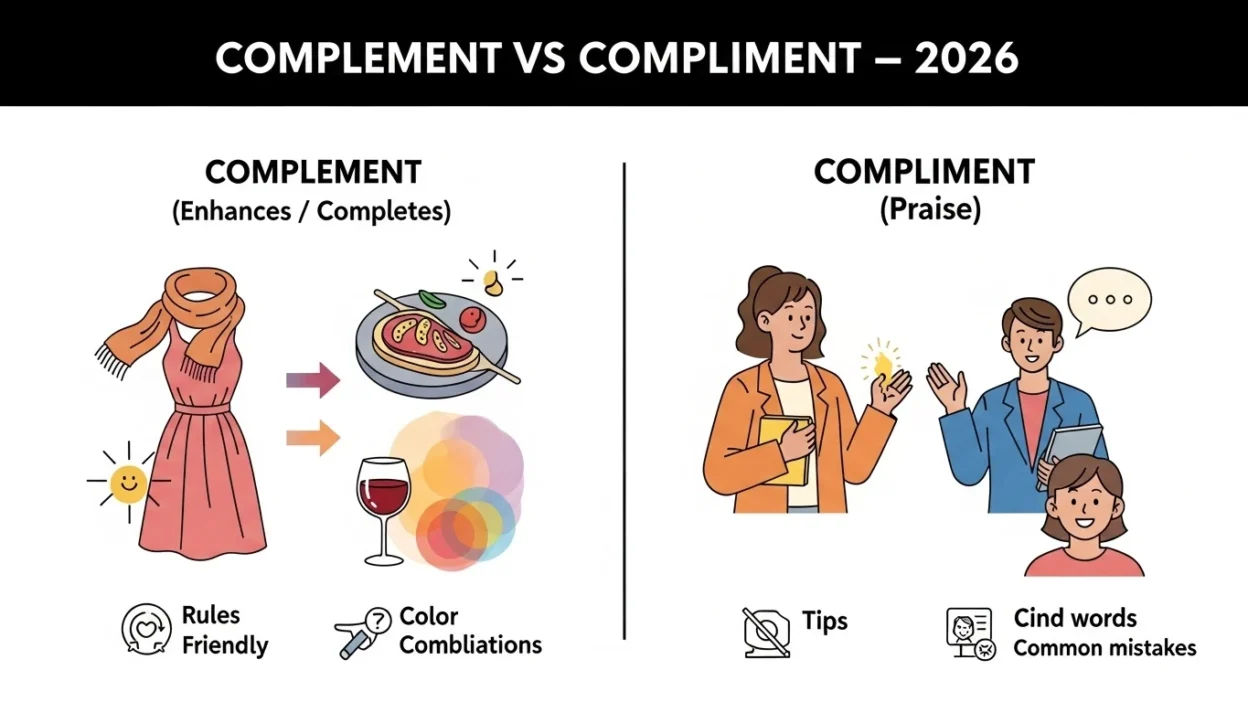
- Complement → something that completes or goes well with another thing
- Compliment → a polite expression of praise or admiration
Because they sound almost the same, learners often mix them up in writing or speaking.
💡 Tip: Ask yourself: “Am I talking about completing something or praising someone?”
Quick Answer: Simple Difference
| Word | Meaning / Use | Example |
| Complement | Something that enhances or completes | The wine complements the cheese perfectly. |
| Compliment | A praise or kind words | She complimented me on my new dress. |
Easy Trick:
- Complement = completes / enhances
- Compliment = praise someone
How to Use Complement or Compliment
✅ Use Complement When:
- Something enhances or completes another thing
- Talking about objects, colors, food, or skills
Examples (complement or compliment examples):
- Red shoes complement the black dress.
- A fresh salad complements the main course.
- His skills complement the team’s strengths.
- Green and purple are complementary colors.
✅ Use Compliment When:
- Giving praise or kind words
- Expressing admiration for someone
Examples (complement or compliment examples):
- I complimented him on his presentation.
- She received many compliments on her painting.
- Don’t forget to compliment your friend when they try something new.
✅ Scenario Based Practice
- Two colors that look good together → ______ (complement/compliment)
- Telling someone their work is great → ______ (complement/compliment)
- Foods that taste good together → ______ (complement/compliment)
- Praising a friend’s outfit → ______ (complement/compliment)
✅ Answers: 1. complement 2. compliment 3. complement 4. compliment
Common Mistakes to Avoid ⚠️
- Using complement when giving praise
- ❌ She complemented me on my outfit.
- ✅ She complimented me on my outfit.
- ❌ She complemented me on my outfit.
- Using compliment when talking about completing or enhancing
- ❌ The blue scarf compliments the dress.
- ✅ The blue scarf complements the dress.
- ❌ The blue scarf compliments the dress.
- Ignoring spelling and pronunciation differences
- Confusing complement or compliment examples in emails, social media, or schoolwork
💡 Tip: Remember the mnemonic:
- “E in complement → Enhance / complete; I in compliment → I praise you!”
Everyday Real Life Examples 💡
School / Homework:
- The new textbook complements the curriculum.
- She complimented her classmate on a good presentation.
Daily Life / Decisions:
- The sauce complements the grilled fish perfectly.
- I complimented my friend on her cooking skills.
Emails / Messages:
- “Your idea complements the project goals very well.”
- “I wanted to compliment you on your excellent report.”
Pronunciation Tips 🎤
Both words sound similar, but the stress is slightly different:
- Complement → COM-ple-ment
- Compliment → COM-pli-ment
Say it slowly at first, emphasizing the middle syllable. Practice with real examples from emails or conversations.
Related Grammar / Forms
| Word | Example |
| Complement | The scarf complements her outfit. |
| Compliment | I complimented him on his success. |
| Complementary | Red and green are complementary colors. |
Quick Tips for Beginners
✔ Remember:
- Complement = completes or enhances
- Compliment = praise or kind words
✔ Use complement for objects, food, or skills that go together
✔ Use compliment for praising someone
✔ Practice with real-life complement or compliment examples
FAQ Section
1. What is complement meaning?
Something that completes or goes well with another thing.
2. What is compliment meaning?
A polite expression of praise or admiration.
3. What is the difference between complement and compliment?
Complement = completes or enhances; Compliment = praise.
4. Can I use complement for people?
Yes, it refers to their skills or qualities completing or enhancing a group, not praise.
5. Can I use compliment for objects?
No, compliment is only for praising people or their work.
6. How do I remember complement vs compliment?
Use this mnemonic: E in complement → Enhance / complete; I in compliment → I praise you!
7. Where can I find complement or compliment examples?
In daily life, school, emails, and conversations.
8. How do I pronounce complement and compliment?
Complement → COM-ple-ment
Compliment → COM-pli-ment
Cheat Sheet: Complement vs Compliment ✅
| Word | Use | Example |
| Complement | Enhances or completes | The wine complements the cheese. |
| Compliment | Praise or admiration | She complimented me on my new haircut. |
| Complementary | Adjective form | Red and green are complementary colors. |
Quick Takeaway Box:
👉 Completing or enhancing → complement
👉 Praising someone → compliment
💡 Tip: Ask yourself, “Am I completing/enhancing or giving praise?”
Conclusion
Now you clearly understand complement or compliment and how to use them correctly:
- Use complement for things that go well together
- Use compliment for praising someone
By practicing with scenario exercises, cheat sheets, pronunciation tips, and real life examples, beginners can confidently use complement and compliment in writing, speaking, emails, and daily English.