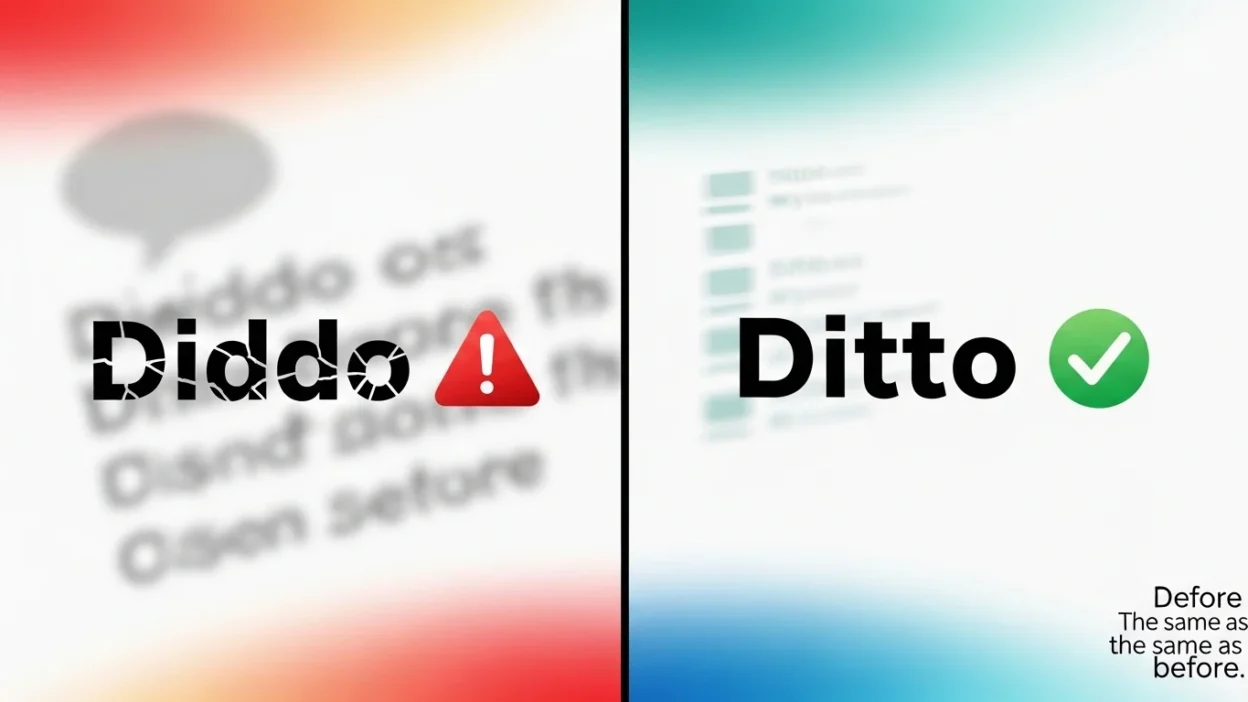
Many people get confused about diddo vs ditto because the words sound almost the same when spoken. In casual conversation, some people pronounce it like “diddo,” which leads to mistakes in writing.
Here’s the quick definition:
Ditto is the correct spelling and means “the same as before” or “I agree with what was just said.”
Diddo is usually a misspelling and is not a standard English word.
Understanding the difference between diddo and ditto will help you write clearly in emails, messages, social media, and everyday communication.
Quick Answer: Diddo vs Ditto
- Ditto → ✅ correct spelling
- Diddo → ❌ incorrect spelling
Ditto meaning: the same as before, or agreement with a previous statement.
Quick Examples
- “I love pizza.” — “Ditto!”
- She ordered coffee, and I ordered ditto.
Remember: always use ditto in writing. Diddo is a common mistake.
The Origin of Ditto
The word ditto comes from the Italian “detto,” meaning “said” or “the same thing.”
Historically, people used ditto in lists and records to avoid repeating the same word multiple times.
Example (old style):
| Item | Quantity |
| Apples | 5 |
| Ditto | 3 |
Here, ditto means apples again.
Over time, ditto became common in everyday English to indicate agreement or repetition.
Diddo vs Ditto: Key Difference
| Word | Meaning | Usage |
| ditto | the same as before, agreement | ✅ correct spelling |
| diddo | informal pronunciation or misspelling | ❌ incorrect |
Simple rule: Use ditto when you want to show agreement or repeat something already mentioned.
How to Use Ditto in Sentences
Ditto can be used in conversation, writing, and lists.
Everyday Conversation
- “That movie was amazing.” — “Ditto!”
- “I’m tired today.” — “Ditto.”
Emails
- “Your feedback matches mine — ditto.”
Social Media
- Friend: “I need coffee.”
- Reply: “Ditto!”
Lists or Notes
- She ordered pasta, and I ordered ditto.
Common Mistakes With Diddo
- Writing diddo instead of ditto
❌ Diddo! I agree with you.
✔ Ditto! I agree with you. - Thinking diddo is a standard word
Only ditto is recognized in dictionaries. - Mispronouncing ditto as diddo
Correct pronunciation helps avoid spelling mistakes.
Common Phrases With Ditto
- ditto mark
- ditto reply
- ditto response
- ditto in lists
- say ditto
Including these phrases increases your natural English fluency.
Why People Say Diddo
People often say diddo because:
- It sounds similar to ditto.
- Seeded confusion: the pronunciation may lead some to type “diddo.”
Remember: ditto is always correct, and diddo is a mistake.
Easy Learning Tips for Beginners
Tip 1: Remember the Double “T”
Ditto spelling: di + tto → ✅
Tip 2: Think “Same Thing”
Whenever you want to say “same as before” or “I agree,” you can use ditto.
Tip 3: Practice Sentences
- “I enjoyed the movie.” — “Ditto.”
- She ordered tea, and I ordered ditto.
Frequently Asked Questions (FAQ)
1. What is the difference between diddo and ditto?
Ditto is correct. Diddo is incorrect or informal.
2. Is diddo a word?
No. Only ditto is standard English.
3. What does ditto mean?
It means the same as before or agreement with a statement.
4. How do you use ditto in a sentence?
Example: “I love ice cream.” — “Ditto!”
5. Can I use ditto in formal writing?
It is better for conversation, emails, or lists, but formal writing may repeat the word instead.
6. Why do people say diddo?
Because it sounds similar to ditto, but it’s a spelling mistake.
7. Are there alternatives to ditto?
Yes: same here, me too, I agree.
Conclusion
The confusion between diddo vs ditto is common, but the rule is very simple:
- Ditto is the correct spelling.
- It means “the same as before” or agreement.
- Diddo is usually a mistake.
Examples to remember:
- “I loved the movie.” — “Ditto!”
- She ordered coffee, and I ordered ditto.
- “That sounds great.” — “Ditto.”
Memory tip: Ditto is correct because it comes from “the same thing.” Once you remember this, you will never confuse diddo vs ditto again.

Andrew Christopher is a passionate visionary who blends creativity with purpose to bring ideas to life. With a focus on innovation and integrity, he inspires growth and lasting impact.