It is very common for people to confuse “die” and “dye”. Even native English speakers sometimes mix them up.
The words sound almost the same, but their meanings are very different.
This guide will help you understand the difference in a simple and clear way so you never make this mistake again.
Why People Get Confused
- Sound alike: “Die” and “dye” are pronounced almost the same, which causes confusion in speaking.
- Spelling is short: Both words are short, just three letters, making it easy to mix them up in writing.
- Different meanings: One word talks about life ending, and the other is about changing color.
Understanding the difference will make your English stronger and clearer.
Quick Answer: Die vs Dye
Here’s the simplest way to remember the difference:
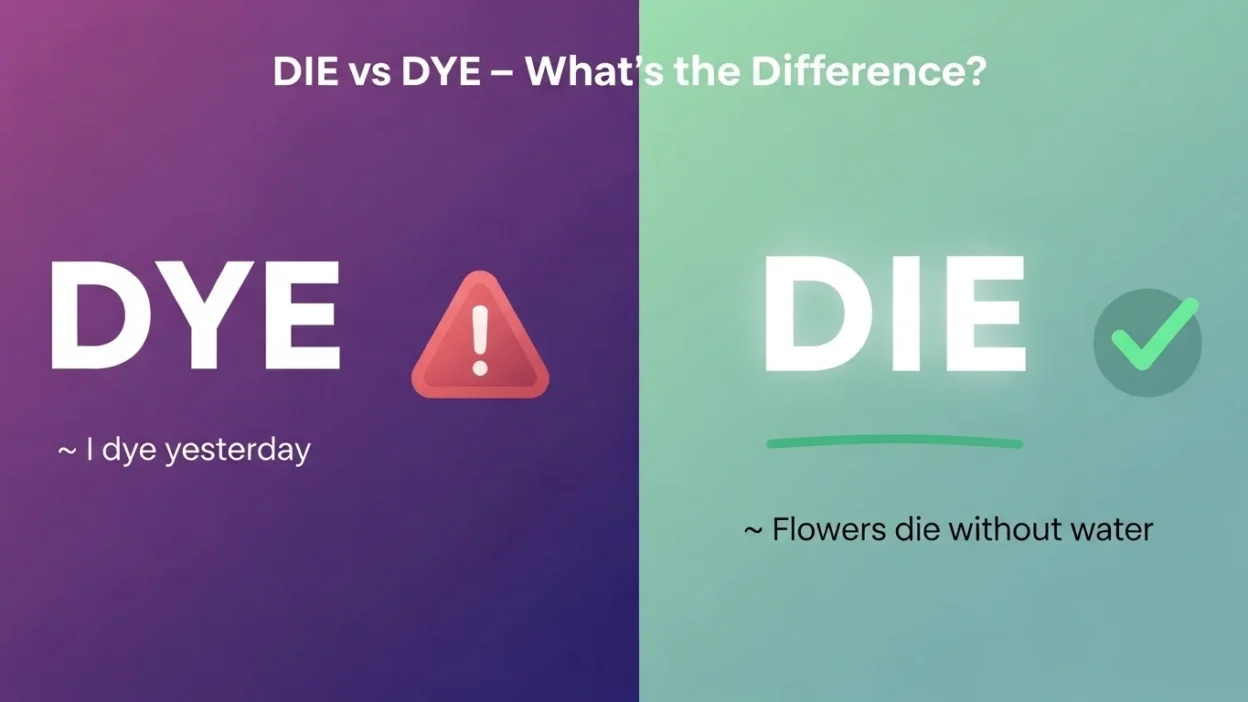
- Die – means to stop living.
- Dye – means to change the color of something.
Example:
- Die: “Plants die without water.”
- Dye: “I will dye my hair blue.”
Origins and Background
Die:
- Comes from Old English “dīegan” which meant to pass away or end life.
- Used for centuries in literature and daily speech to talk about death or stopping living.
Dye:
- Comes from Old English “dēag” or Latin “tingere”, which means to color or tint.
- Traditionally used when coloring fabrics, clothes, or even food.
Knowing where the words come from can help you remember their meanings more easily.
Clear Explanation of the Difference
| Word | Meaning | Use |
| Die | To stop living | Used with people, animals, plants, or ideas |
| Dye | To change the color | Used with hair, clothes, fabrics, or materials |
Key tip:
- If the word talks about life ending, it is die.
- If the word talks about changing color, it is dye.
Comparison Table: Easy to Scan
| Feature | Die | Dye |
| Meaning | Stop living, end existence | Change color |
| Part of speech | Verb | Verb / Noun (sometimes “a dye”) |
| Example | “My goldfish died yesterday.” | “I dyed my shirt red.” |
| Common phrases | die of, die for, die down | hair dye, fabric dye, food dye |
| Sounds like | “dai” | “dai” (same sound, different meaning!) |
Which One to Use and When
- Use die when you talk about life ending:
- People, animals, plants, machines (sometimes figuratively: “The light died out”)
- Use dye when you talk about color:
- Hair, clothes, fabrics, eggs (like for Easter), or food coloring
Memory trick:
- Dye has a “y” like “colorful” or “yarn”
- Die has an “i” like “end of life”
Common Mistakes People Make
- Writing “I want to die my hair” instead of “I want to dye my hair”
- Using “dye” when talking about someone passing away
- Wrong: “My cat dyed last night.”
- Correct: “My cat died last night.”
- Confusing the two in expressions like “die for”
- “I would die for chocolate” → death metaphor, not color!
Avoid these mistakes by always asking:
“Is this about life ending or color changing?”
Everyday Real Life Examples
- Emails / Messages:
- “I’m sad to hear your plant died.”
- “I just dyed my hoodie green look!”
- News / Articles:
- “Hundreds of fish died in the river due to pollution.”
- “The festival featured eggs dyed in bright colors.”
- Social Media Posts:
- “My favorite singer died last year 😢”
- “Just dyed my hair pink, loving it!”
- Daily Conversation:
- “Don’t let the flowers die!”
- “I want to dye my curtains blue.”
Learning Section for Students and Beginners
- Step 1: Listen carefully: die and dye sound the same.
- Step 2: Ask: “Is this about death or color?”
- Step 3: Remember:
- i → die → life ends
- y → dye → color changes
- Step 4: Practice simple sentences every day.
Try saying these aloud:
- “My dog died last year.”
- “I dyed my socks red.”
Repeat until your brain separates the meanings automatically.
FAQ
Q1: Can “die” ever mean color?
- No. “Die” only refers to ending life or stopping.
Q2: Can “dye” be a noun?
- Yes. Example: “This fabric needs a new dye.”
Q3: Do native speakers confuse them?
- Sometimes, especially in writing, because they sound the same.
Q4: Is “dyeing” the correct form when coloring?
- Yes. Example: “I am dyeing my hair brown.”
Q5: Is “dying” used for color too?
- Yes. “Dyeing” is the process, “dying” is for life ending. Remember context.
Q6: Can “die” be used metaphorically?
- Yes. Example: “The candle died” or “The light of the room died down.”
Q7: How can I remember them easily?
- Think i → life ends, y → color changes.
Q8: Are there other confusing words like this?
- Yes, words like bare / bear or there / their / they’re are similar in sound but different in meaning.
Conclusion
Understanding die vs dye is easy if you focus on their meanings and contexts. Remember:
- Die = stop living
- Dye = change color
With a little practice, you can never confuse them again. Use the tables, examples, and memory tips above to strengthen your English.
Soon, choosing the right word will feel natural and simple.