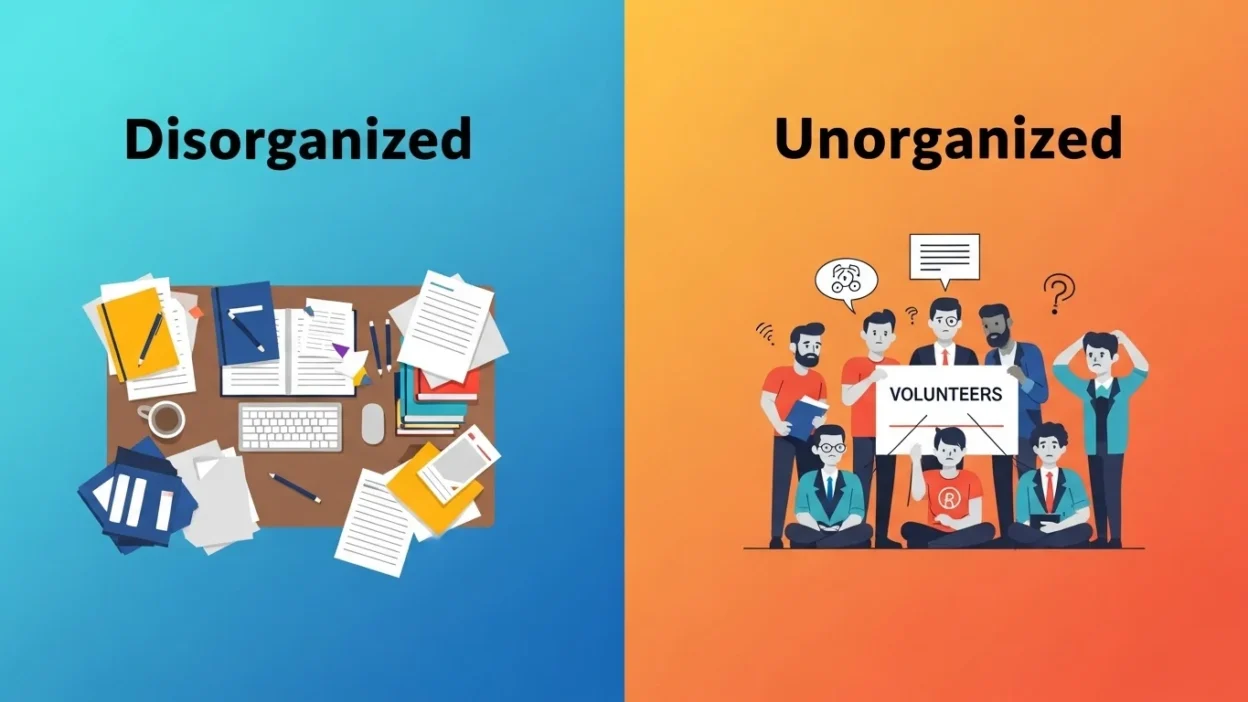
Many learners, students and everyday English speakers confuse disorganized vs unorganized.
Both words describe things that are “not in order,” but they are used differently:
- Disorganized → messy, chaotic, or in disorder
- Unorganized → not officially arranged, structured, or formed
Understanding the difference helps you:
- Write correct sentences using disorganized or unorganized
- Speak clearly about messy situations or unstructured groups
- Avoid common mistakes in emails, school, work, or social media
Quick Answer: Disorganized vs Unorganized
Here’s the simple rule:
- Disorganized → Something messy, chaotic, or in disorder
- Unorganized → Something not officially arranged or structured
Example sentences:
- “His desk is very disorganized.” ✅
- “The volunteers are unorganized for the event.” ✅
Tip: Remember: messy = disorganized, not structured = unorganized
Disorganized Meaning
Disorganized meaning:
A disorganized person, object, or place is messy, chaotic, or lacking order.
Pronunciation
- Disorganized → /dɪsˈɔːr.ɡə.naɪzd/ (“dis-OR-ga-nized”)
Usage Examples
- Her notes are disorganized, making it hard to study.
- The office files are disorganized after the move.
- A disorganized student often forgets homework or deadlines.
Tip: Use disorganized when talking about messiness, personal habits, or objects.
Unorganized Meaning
Unorganized meaning:
An unorganized group, event, or system is not officially arranged, structured, or formed.
Pronunciation
- Unorganized → /ʌnˈɔːr.ɡə.naɪzd/ (“un-OR-ga-nized”)
Usage Examples
- The volunteers were unorganized before the coordinator arrived.
- The committee is still unorganized.
- An unorganized team has no formal plan yet.
Tip: Use unorganized for groups, events, or plans lacking formal structure.
Disorganized vs Unorganized: Key Differences
| Feature | Disorganized | Unorganized |
| Meaning | Messy, chaotic, in disorder | Not officially arranged or structured |
| Usage | Personal habits, rooms, objects | Groups, plans, organizations |
| Example Sentence | “His desk is disorganized.” | “The volunteers are unorganized.” |
| Focus | Messiness or lack of order | Lack of formal arrangement |
| Pronunciation | /dɪsˈɔːr.ɡə.naɪzd/ | /ʌnˈɔːr.ɡə.naɪzd/ |
| Formal vs Informal | Informal or casual situations | Slightly formal or organizational context |
| Regional Notes | Common in US and general English | Used in both US & UK for structured groups |
Which One to Use and When
- Disorganized → messy rooms, desks, papers, or habits
- Unorganized → groups, teams, events, or committees without formal plans
Example:
- “He is a disorganized student who loses his books.” ✅
- “The charity event is unorganized because there is no coordinator.” ✅
Tip for learners:
- If it’s about objects or personal mess, choose disorganized
- If it’s about groups or plans, choose unorganized
Real Life Examples
In Work
- “The office files are disorganized, so it takes time to find documents.”
- “The project team is unorganized, and tasks are unclear.”
In School
- “Her notes are disorganized after the semester.”
- “The student council is unorganized without a clear president.”
On Social Media
- “My desk is so disorganized today 😅”
- “The local charity is unorganized, need more planning!”
In Emails
- “Please don’t send disorganized reports; it slows us down.”
- “The volunteers remain unorganized; a meeting is needed.”
Short Learning Section for Students
Memory tips:
- Disorganized = messy, chaotic
- Unorganized = not structured, not arranged
Practice:
- The papers on his desk are ______. → Disorganized
- The student club is still ______. → Unorganized
- Her room is completely ______. → Disorganized
- The volunteers are ______ before the coordinator arrives. → Unorganized
Mnemonic:
- “Dis = disorder → messy”
- “Un = unformed → no structure”
FAQ: Disorganized vs Unorganized
What is the difference between disorganized and unorganized?
- Disorganized → messy, chaotic
- Unorganized → not officially arranged or structured
Can they be used interchangeably?
No. They focus on different aspects: personal/object chaos vs lack of structure.
Which word is more common?
- Disorganized is more common in everyday life.
- Unorganized is used in formal or group contexts.
Can people be unorganized?
Yes, if they lack a system or plan for tasks.
Can rooms or objects be unorganized?
No. For objects or rooms, use disorganized.
Is unorganized formal or informal?
It is slightly formal, mostly for groups, events, or planning.
Can unorganized be used in British English?
Yes, it is correct in both American and British English when referring to groups or plans.
How can I remember the difference?
- Messy → Disorganized
- Lacking structure → Unorganized
Conclusion
Now you clearly understand disorganized vs unorganized:
- Disorganized → messy, chaotic, personal or object-related disorder
- Unorganized → not officially arranged, related to groups or events
Next time you write about messy desks, rooms, or unstructured teams, you’ll know exactly which word to use.
No more confusion between disorganized and unorganized!

Daniel Matthew is a passionate visionary who believes in creativity, purpose, and innovation. With a focus on growth and authenticity, he turns every idea into meaningful impact.