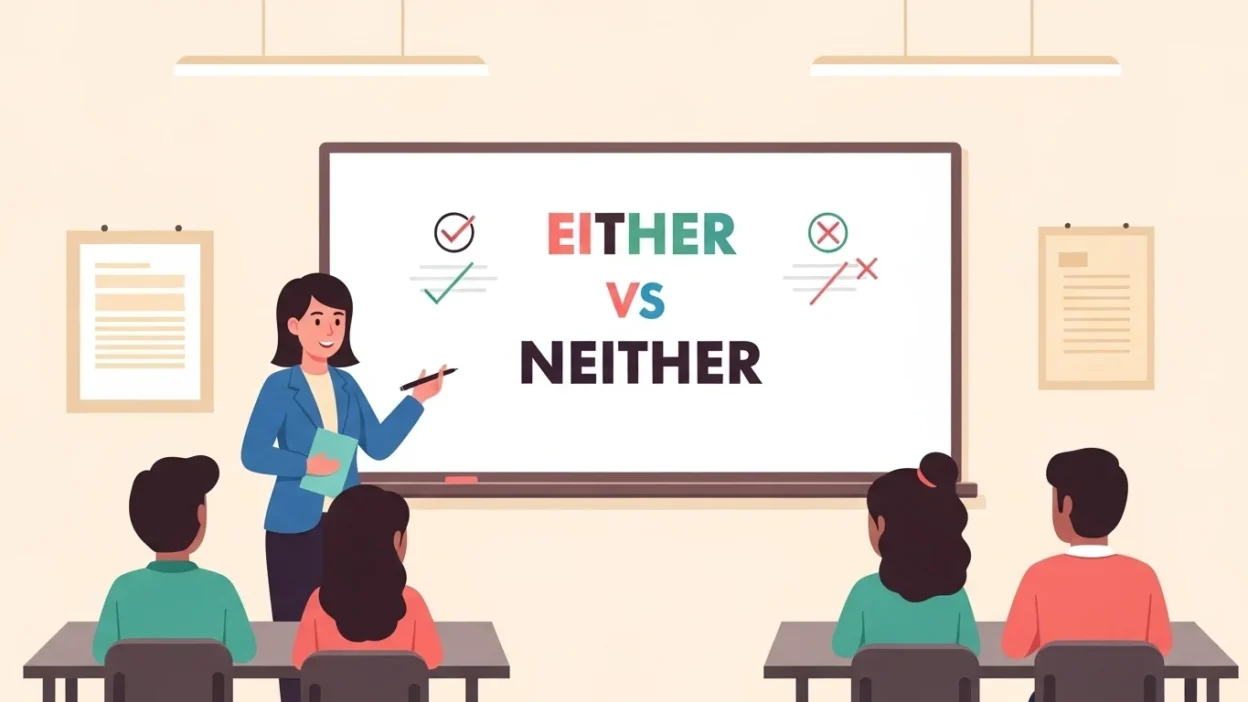
Many students, learners and even native English speakers feel confused about either vs neither. These two small words look simple, but their meanings are very different. Because they are often used in similar sentence structures, people easily mix them up.
The main confusion comes from:
- Similar sentence patterns
- Similar sounds
- Similar positions in sentences
Many learners search for the difference between either and neither because they want a simple explanation, not complicated grammar rules. This guide explains everything in very easy English, using clear logic, examples, tables, and real-life situations so that you can understand it on the first read.
Quick Answer: In One Simple Look
In short:
Either = one of two choices is okay
Neither = none of the two choices is okay
Very Simple Examples:
- You can choose either tea or coffee.
(One is fine.) - I like neither tea nor coffee.
(I like none.)
If you remember only this rule, you will understand either vs neither easily.
Decision Logic: Which One Should You Use?
Ask yourself two simple questions:
Step 1: Are there two choices only?
→ If yes, continue.
Step 2:
- Is one choice okay? → Use Either
- Are both choices not okay? → Use Neither
Simple Decision Chart:
| Situation | Use |
| One option is okay | Either |
| No option is okay | Neither |
Simple Origin and Background
The word either comes from old English and means one of two.
The word neither also comes from old English and means not one and not the other.
Over time, their meanings stayed the same. That is why either and neither in English still follow these simple ideas.
Clear Explanation of the Difference Between Either and Neither
What Does Either Mean?
Either is used when you have two choices, and at least one of them is acceptable.
It shows a positive or neutral choice.
Examples:
- You can sit on either chair.
- You can call me on either number.
- Either answer is correct.
Here, either means:
One of the two is fine.
What Does Neither Mean?
Neither is used when you have two choices, and both are rejected.
It shows a negative meaning.
Examples:
- I like neither apples nor bananas.
- Neither plan works.
- Neither answer is correct.
Here, neither means:
Not this and not that.
Grammar Logic: Why Either and Neither Work This Way
This simple logic will remove confusion forever:
- Either agrees with positive choice logic
- Neither agrees with negative choice logic
Simple Formula:
- Either → 1 acceptable option
- Neither → 0 acceptable options
Comparison Table: Either vs Neither
| Feature | Either | Neither |
| Meaning | One or the other | Not this and not that |
| Polarity | Positive / Neutral | Negative |
| Purpose | Making a choice | Rejecting both |
| Pair word | Or | Nor |
| Example | You can take either book | I want neither book |
Sentence Patterns You Must Know
Either…or
Used when one of two choices is possible.
- You can choose either tea or coffee.
- We can go either today or tomorrow.
Neither…nor
Used when both choices are rejected.
- I like neither tea nor coffee.
- She speaks neither French nor German.
Spoken vs Written English Usage
In Spoken English:
People often shorten sentences:
- “I don’t like coffee.”
“Me neither.” - “I don’t want pizza.”
“Me either.”
Here, either is used in negative agreement, meaning also not.
In Written English:
Sentences are more complete and formal:
- I like neither option.
- You may choose either plan.
Formal vs Informal Usage
Informal (Daily conversation):
- I don’t like it either.
- Neither do I.
Formal (Emails, writing, school):
- I accept neither proposal.
- You may choose either alternative.
Which One to Use and When
Use Either When:
- There are two choices
- One choice is acceptable
- You are offering options
Examples:
- You can sit either here or there.
- You may choose either topic.
Use Neither When:
- There are two choices
- Both are rejected
- You are expressing dislike or refusal
Examples:
- I like neither color.
- Neither option works.
Common Mistakes and Why They Happen
Mistake 1: Double Negatives
❌ I don’t like neither tea nor coffee.
✅ I like neither tea nor coffee.
Why it happens:
Learners forget that neither already contains a negative meaning.
Mistake 2: Mixing Or and Nor
❌ Either tea nor coffee
❌ Neither tea or coffee
✅ Either tea or coffee
✅ Neither tea nor coffee
Mistake 3: Using Either for More Than Two Items
❌ Choose either tea, coffee, or juice.
✅ Choose tea, coffee, or juice.
Rule: Either and neither are mainly used for two choices only.
Everyday Real Life Examples
Daily Conversation:
- You can sit on either side.
- I want neither of those shoes.
Emails:
- You may reply either today or tomorrow.
- Unfortunately, neither option works for me.
Workplace / Business:
- We can schedule the meeting on either Monday or Tuesday.
- Neither proposal meets the company rules.
Academic Writing:
- Students may choose either topic.
- Neither theory explains the result fully.
Social Media:
- Message me on either WhatsApp or Instagram.
- I support neither team.
Short Learning Section for Students and Beginners
Memory Trick:
- Either = One is okay
- Neither = None is okay
Simple Practice:
- I like ___ tea or coffee. → Either
- I like ___ tea nor coffee. → Neither
- You may come ___ today or tomorrow. → Either
- ___ answer is correct. → Neither
FAQ: Frequently Asked Questions
1. What is the difference between either and neither?
Either means one choice is okay.
Neither means no choice is okay.
2. Can either be used in negative sentences?
Yes.
- I don’t like apples, and I don’t like bananas either.
3. Can neither be used alone?
Yes.
- Which one do you want?
Neither.
4. Can I use either and neither for more than two choices?
In simple English, they are mainly used for two choices only.
5. Is either always positive?
Mostly yes, but it can also be neutral.
6. Why do people confuse either and neither?
Because:
- They look similar
- They sound similar
- They are used in similar sentence structures
7. Is this topic important for learners?
Yes. These words appear very often in daily English, so learning them improves both speaking and writing.
Conclusion
Understanding either vs neither is easy when you remember one simple rule:
Either = one good choice
Neither = no good choice
This simple idea removes confusion and helps you speak and write English correctly.
Practice using them in daily conversation, emails, school work, and social media. With a little practice, these words will feel natural and easy.
Keep learning, stay confident, and enjoy improving your English 😊

David Robert is a passionate innovator driven by creativity, vision, and purpose. He turns bold ideas into impactful realities through focus, leadership, and dedication.