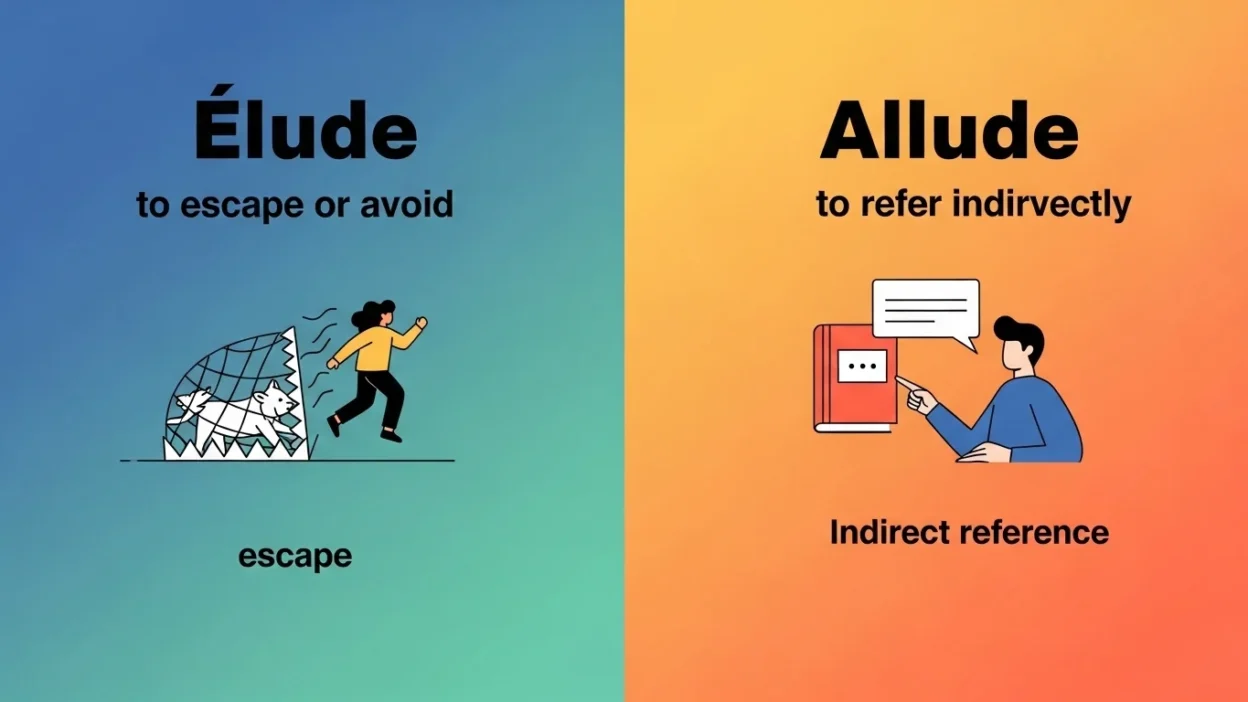
Many students and learners struggle with elude vs allude. These words:
- Look very similar
- Sound almost the same
- Are often used incorrectly in writing or speaking
Common questions include:
- What is the elude meaning?
- What is the allude meaning?
- What is the difference between elude and allude?
- When should I use elude or allude?
This article explains everything with examples, tables, exercises, dialogues, and FAQs, so you can use both words correctly every time.
Quick Answer
- Elude → verb → to escape, avoid, or fail to be understood (elude verb meaning)
- Allude → verb → to refer indirectly or hint at something (allude verb meaning)
Memory Tip:
- Elude = escape or avoid
- Allude = refer or hint
Background: Origins of Elude and Allude
- Elude comes from Latin eludere, meaning “to escape or evade.”
- Allude comes from Latin alludere, meaning “to refer or hint at something.”
Adding -ing makes eluding or alluding, but the base meanings stay the same.
⚠️ Remember: Although these words look and sound alike, their meanings are completely different.
Clear Explanation: Elude vs Allude
What Does “Elude” Mean?
Elude meaning:
- To escape or avoid someone or something (elude verb meaning)
- To fail to be understood or grasped
Examples:
- The thief eluded the police. 🏃♂️
- Happiness seemed to elude her despite her hard work.
- The answer to the question eluded me.
Formal vs Informal Usage:
- Informal: “The solution eludes me.”
- Formal: “The criminal eluded capture for days.”
What Does “Allude” Mean?
Allude meaning:
- To refer indirectly or hint at something (allude verb meaning)
- To mention without saying directly
Examples:
- The teacher alluded to the previous lesson. 📝
- He alluded to a famous book without naming it.
- In her speech, she alluded to past mistakes.
Formal vs Informal Usage:
- Informal: “He alluded to the movie without naming it.”
- Formal: “The article alludes to classical mythology.”
Regional Notes: Both words are used in US and UK English, though pronunciation may slightly differ.
Comparison Table: Elude vs Allude
| Feature | Elude | Allude |
| Meaning | Escape, avoid, fail to understand (elude meaning) | Refer indirectly, hint at something (allude meaning) |
| Part of speech | Verb (elude verb meaning) | Verb (allude verb meaning) |
| Usage | “The solution eludes me.” | “He alluded to Shakespeare.” |
| Tone | Neutral to formal | Neutral to formal |
| Memory Tip | Elude = e = escape | Allude = a = attention / hint |
| Examples | “The criminal eluded capture.” | “She alluded to a famous author.” |
Real Life Examples and Dialogues
At School
- “The solution eludes me.”
- “The teacher alluded to the next chapter in class.”
In Reading / Writing
- “The main idea eluded the reader.”
- “The article alludes to ancient myths.”
In Conversations
- “He eluded the question cleverly.”
- “She alluded to a funny incident without naming it.”
Mini Dialogue Example
- Anna: “I didn’t understand the poem.”
- Ben: “Yes, the meaning eluded me too.”
- Anna: “But the author alluded to Shakespeare in the second stanza.”
Easy Learning Section for Students and Beginners
Memory Trick
- Elude → e = escape / evade
- Allude → a = attention / hint
Quick Rule:
- If it escapes or avoids, use elude
- If it hints or refers indirectly, use allude
Practice Exercises
Fill in the blanks:
- The thief ______ the police. → eluded
- The teacher ______ to the last lesson. → alluded
- The answer ______ me. → eluded
- In his speech, he ______ to a famous author. → alluded
Mini Quiz: Choose the correct word
- The meaning of the poem ______ me.
- a) alluded
- b) eluded ✅
- She ______ to a movie without naming it.
- a) alluded ✅
- b) eluded
Common Mistakes People Make
| Mistake | Wrong | Correct |
| Confusing elude and allude | “He eluded to the book.” | “He alluded to the book.” |
| Using allude to mean escape | “The answer alluded me.” | “The answer eluded me.” |
| Mixing spelling | Randomly using “elude” and “allude” | Remember: Elude = escape, Allude = refer |
FAQ
- Are elude and allude the same?
- No. Elude = escape or avoid; Allude = hint or refer indirectly.
- Can adults use these words?
- Yes, both are common in formal and informal English.
- Can “elude” refer to ideas?
- Yes, e.g., “The solution eluded me.”
- Can “allude” be used in casual speech?
- Yes, e.g., “He alluded to the party without saying it directly.”
- Is there a spelling trick?
- Elude = e = escape, Allude = a = attention / hint
- Are these words formal?
- Both can be formal, but are also used in casual English.
- Can “elude” be used with people and objects?
- Yes, e.g., “The criminal eluded capture.”
- Can “allude” be used with books or movies?
- Yes, e.g., “The article alludes to a famous novel.”
- Can these words be confused in writing?
- Yes, always check: elude = escape, allude = refer/hint
- How to teach students the difference?
- Use emoji or visual memory tricks: escape = 🏃♂️ (elude), hint = 💡 (allude)
References and Authority
- Merriam-Webster – Elude
- Merriam-Webster – Allude
- Cambridge Dictionary – Elude/Allude
Conclusion
The elude vs allude difference is simple:
- Elude = escape, avoid, or be hard to catch (elude meaning)
- Allude = refer, hint, or mention indirectly (allude meaning)
Tip for learners:
- Elude → e = escape
- Allude → a = attention / hint

Daniel Matthew is a passionate visionary who believes in creativity, purpose, and innovation. With a focus on growth and authenticity, he turns every idea into meaningful impact.