Many people feel confused when they see the words envelope and envelop. These two words look almost the same. They have the same letters, but their meanings and uses are very different.
One small change in spelling can completely change the meaning of a sentence. This can be confusing for students, learners, and even native English speakers.
In this article, you will learn the clear difference between envelope and envelop in very simple English.
By the end, you will understand when to use each word, how to say them correctly, and how to avoid common mistakes.
Quick Answer: Envelope vs Envelop
Here is the simple difference:
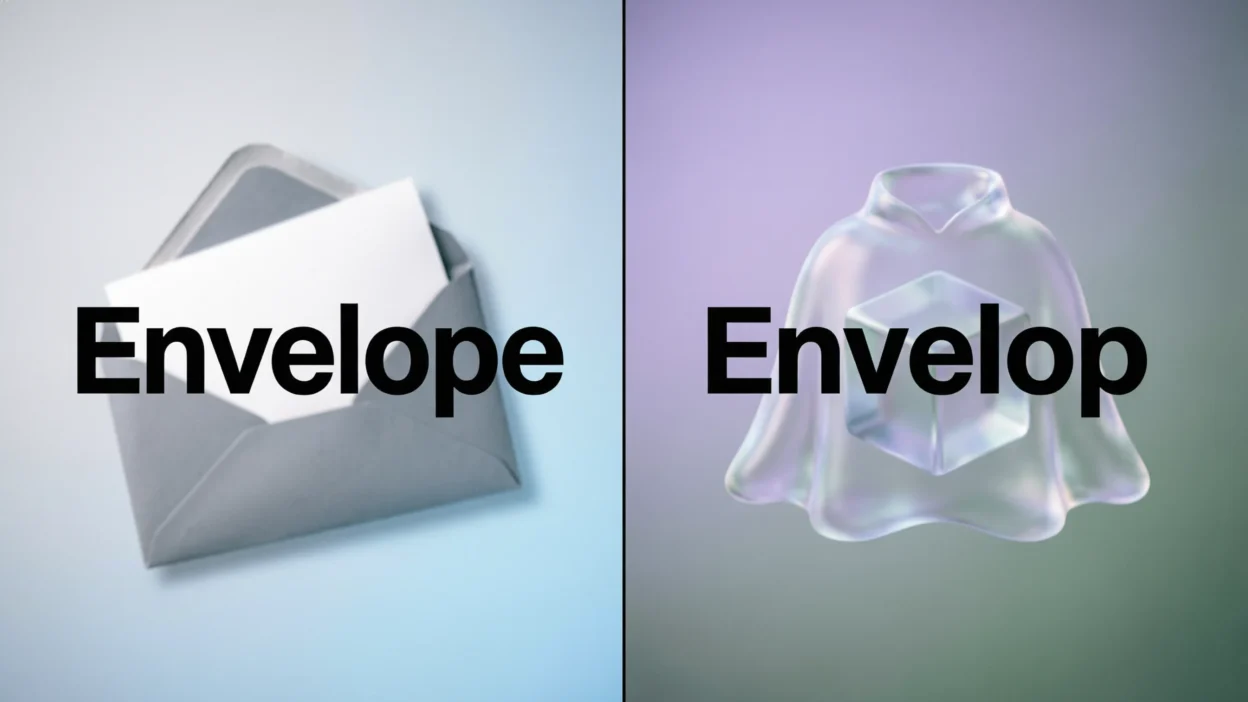
- Envelope (noun) → A paper cover used to send letters.
- Envelop (verb) → To cover or surround something completely.
Easy example:
- I put the letter in an envelope.
- Thick fog enveloped the city.
Simple trick:
If it is a thing you can hold, use envelope.
If it is an action of covering, use envelop.
Simple Origin and Background Explanation
Both words come from old French and Latin words that mean to wrap or cover.
- Envelope became a noun meaning a paper cover.
- Envelop became a verb meaning the action of covering something.
Over time, English separated their meanings, but the spelling stayed very close. That is why many learners mix them up today.
Clear Explanation of the Difference
Let’s look at both words one by one.
What Does Envelope Mean?
Envelope is a noun.
It means a paper cover used to hold and send letters or documents.
Examples:
- I bought a blue envelope.
- Put the bill inside the envelope.
- She opened the envelope carefully.
Important points:
- It is a thing.
- You can touch it, hold it, and see it.
- It is mainly used for mail and letters.
What Does Envelop Mean?
Envelop is a verb.
It means to cover, surround, or wrap something completely.
Examples:
- Darkness enveloped the room.
- Smoke enveloped the building.
- Fear enveloped his heart.
Important points:
- It is an action.
- It shows something covering something else.
- Often used for feelings, weather, smoke, fog, or darkness.
Comparison Table: Envelope vs Envelop
| Feature | Envelope | Envelop |
| Part of speech | Noun | Verb |
| Meaning | Paper cover for letters | To cover or surround |
| Is it a thing? | Yes | No |
| Is it an action? | No | Yes |
| Example | I sealed the envelope. | Fog enveloped the road. |
| Easy memory tip | A thing you hold | An action of covering |
Which One to Use and When
Here is a simple guide to help you choose the right word.
Use Envelope When:
- You talk about letters or documents.
- You mean a paper cover.
- You can physically touch the object.
Examples:
- Write the address on the envelope.
- The envelope is on the table.
- He tore the envelope open.
Use Envelop When:
- You talk about covering or surrounding.
- You describe feelings, weather, smoke, or darkness.
- You want to show an action happening.
Examples:
- Heavy rain enveloped the village.
- Silence enveloped the room.
- Warmth enveloped her body.
Common Mistakes People Make
Many learners mix these words because of similar spelling. Let’s see common mistakes and how to fix them.
Mistake 1: Using “envelop” for letters
❌ I put the letter in an envelop.
✅ I put the letter in an envelope.
Why?
Because a letter goes into a thing, not an action.
Mistake 2: Using “envelope” as a verb
❌ Fog enveloped the road.
❌ Fog envelope the road.
✅ Fog enveloped the road.
Why?
Because fog is covering, which is an action — so use envelop.
Mistake 3: Wrong pronunciation
- Envelope → EN-vuh-lohp
- Envelop → en-VEL-up
They sound different, so pronunciation helps you remember.
Everyday Real-Life Examples
Here are simple daily examples to make everything very clear.
In Emails and Messages
- Please send the documents in a sealed envelope.
- Silence enveloped the room after the news.
In News
- Thick smoke enveloped the building.
- The official letter came in a brown envelope.
In Social Media Posts
- Happiness enveloped me today.
- I received a beautiful handwritten note inside an envelope.
In Daily Life
- Put the money in an envelope.
- Cold air enveloped us during the night.
Short Learning Section for Students and Beginners
Let’s make learning super easy.
One Minute Rule
Ask yourself:
Is it a thing?
→ Use envelope
Is it an action?
→ Use envelop
Memory Trick
- Envelope has “e” at the end → e for envelope you can see
- Envelop has no “e” → action without object
Practice Sentences
Fill in the blanks:
- I opened the __________.
- Darkness __________ the forest.
Answers:
- envelope
- enveloped
Frequently Asked Questions (FAQ)
1. Is envelope a noun or a verb?
Envelope is a noun.
It is the paper cover used to hold letters.
2. Is envelop a verb?
Yes, envelop is a verb.
It means to cover or surround.
3. Can envelope and envelop be used in the same sentence?
Yes.
Example:
He opened the envelope as fear enveloped him.
4. How do I pronounce envelope and envelop?
- Envelope: EN-vuh-lohp
- Envelop: en-VEL-up
5. Why do these words look so similar?
They come from the same old root meaning to wrap or cover, but their meanings changed over time.
6. Which word is more common in daily life?
Envelope is more common because we often send letters and documents.
7. Can envelop mean emotional covering?
Yes.
Example: Joy enveloped her heart.
8. Is envelop formal or informal?
It is neutral and often used in writing, stories, and news.
Conclusion
The difference between envelope and envelop is easy once you understand one key idea:
- Envelope is a thing : the paper cover for letters.
- Envelop is an action : to cover or surround.
If you remember this simple rule, you will never feel confused again. With practice and reading, these two words will soon feel natural and easy to use.
Keep learning, keep practicing, and trust yourself English becomes easier step by step. 😊

Andrew Christopher is a passionate visionary who blends creativity with purpose to bring ideas to life. With a focus on innovation and integrity, he inspires growth and lasting impact.