Many people get confused between ETC and ECT. They look similar, sound almost the same, and are easy to mix up.
But don’t worry! This guide will explain everything in simple, clear English so you can understand the difference on your first read.
Quick Answer: ETC vs ECT
Here’s the simplest way to remember the difference:
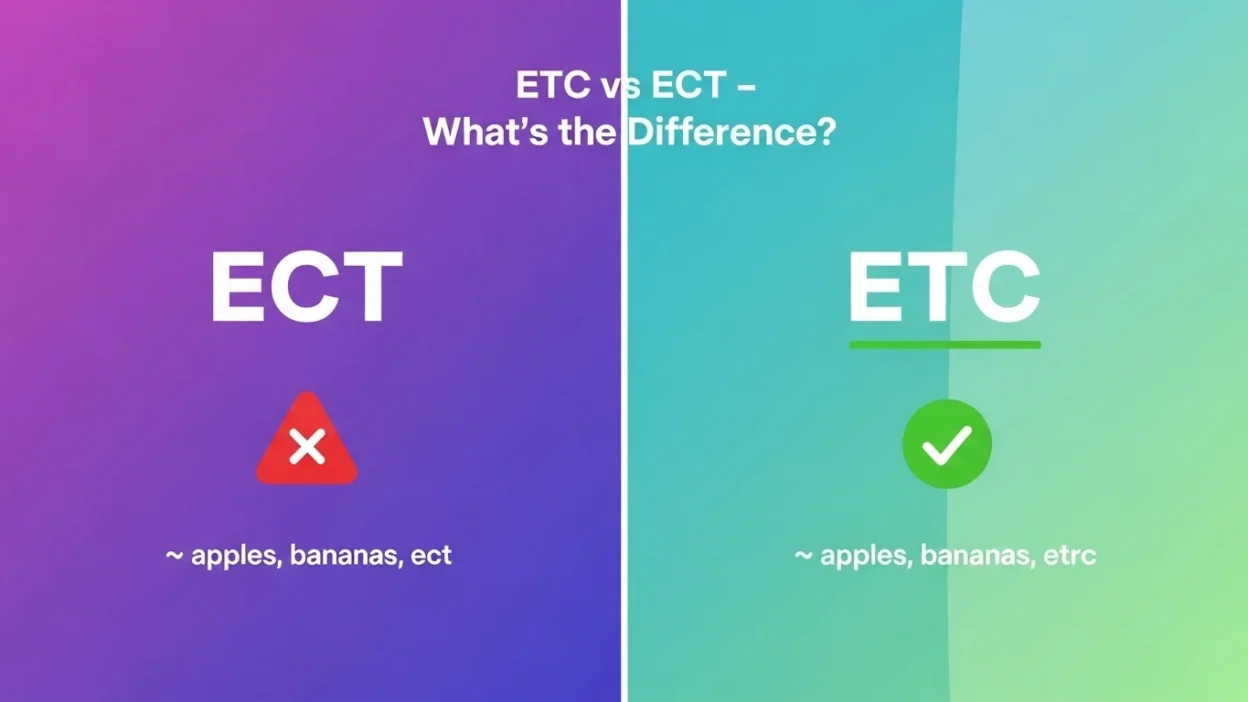
- ETC: Stands for “et cetera”, meaning “and other similar things” or “and so on.”
- ECT: Is usually a spelling mistake. There is no word “ECT” in standard English.
Quick tip: If you are writing “and so on” at the end of a list, use ETC. Never use ECT.
Origin or Background
- ETC comes from Latin “et cetera”.
- Et = “and”
- Cetera = “the rest” or “other things”
- People have been using ETC in English writing for hundreds of years.
- ECT is often just a typo or a misremembering of ETC.
Clear Explanation of the Difference
| Term | Meaning | Correct Usage? | Example |
| ETC | “and other things” or “and so on” | ✅ Correct | “I like apples, bananas, oranges, etc.” |
| ECT | No meaning in English | ❌ Incorrect | “I like apples, bananas, oranges, ect.” (Wrong) |
Remember: ETC is a real abbreviation. ECT is not.
Which One to Use and When
- Use ETC at the end of a list to show there are more similar items.
- Do not use ECT, even if it sounds the same.
- ETC should always follow a comma in a list, except if it ends a sentence.
Example sentences:
- Correct: “We need pencils, pens, erasers, etc.”
- Incorrect: “We need pencils, pens, erasers, ect.”
Common Mistakes People Make
- Writing ECT instead of ETC.
- Forgetting the period in American English (etc.)
- Using ETC for one item only (it should indicate more than one other thing)
- Confusing ETC with similar abbreviations like i.e., e.g.
Tip: If you can replace the word with “and so on” in the sentence, ETC is correct.
Everyday Real Life Examples
Emails:
- “Please bring notebooks, pens, calculators, etc.”
News:
- “The festival will feature music, food, games, etc.”
Social Media:
- “I love dogs, cats, rabbits, etc!”
Daily life:
- “At the supermarket, buy rice, beans, pasta, etc.”
Remember: ETC is used to make lists shorter and smoother.
Short Learning Section for Students and Beginners
- ETC = “and other things”
- ECT = ❌ wrong
- Always check your spelling.
- Use ETC at the end of lists.
- If you are unsure, try replacing it with “and so on.” If it works, ETC is correct.
Example:
- “We will need plates, cups, forks, etc.” → “We will need plates, cups, forks, and so on.” ✅
FAQ Section
1. Can I use ECT instead of ETC?
No. ECT is always wrong. Use ETC.
2. Do I need a period after ETC?
- In American English: Yes → “etc.”
- In British English: Sometimes optional → “etc”
3. Can ETC be used at the start of a sentence?
No, ETC should be at the end of a list.
4. Is ETC formal or informal?
ETC can be used in both formal and informal writing.
5. Can ETC be used alone?
No, it must follow a list of items.
6. Is ETC only for things, not people?
Yes, mostly for things, ideas, or actions.
7. Can I write “et cetera” instead of ETC?
Yes! Writing “et cetera” in full is also correct.
8. Why do people write ECT by mistake?
Because ETC and ECT sound similar, and people sometimes mix up letters.
Conclusion
The difference is very simple:
- ETC = correct, means “and other things”
- ECT = wrong, has no meaning
Always remember: if it sounds like “and so on,” use ETC.
Double check your spelling, especially in essays, emails, or formal writing. Once you remember this rule, you will never confuse ETC and ECT again.
Using ETC correctly makes your writing clear, professional, and easy to read.

David Robert is a passionate innovator driven by creativity, vision, and purpose. He turns bold ideas into impactful realities through focus, leadership, and dedication.