Many people get confused between “farther” and “further.” Even native English speakers sometimes use them incorrectly.
The words look similar and are both used to talk about distance or progress. But the difference is actually simple once you understand it.
This article will help you clearly see when to use farther and when to use further.
Why People Get Confused
The confusion comes from a few reasons:
- Both words sound almost the same.
- Both can refer to distance in some situations.
- English learners hear them used in different ways in conversations, books, or online.
The good news is that with a little practice, you can use them correctly every time.
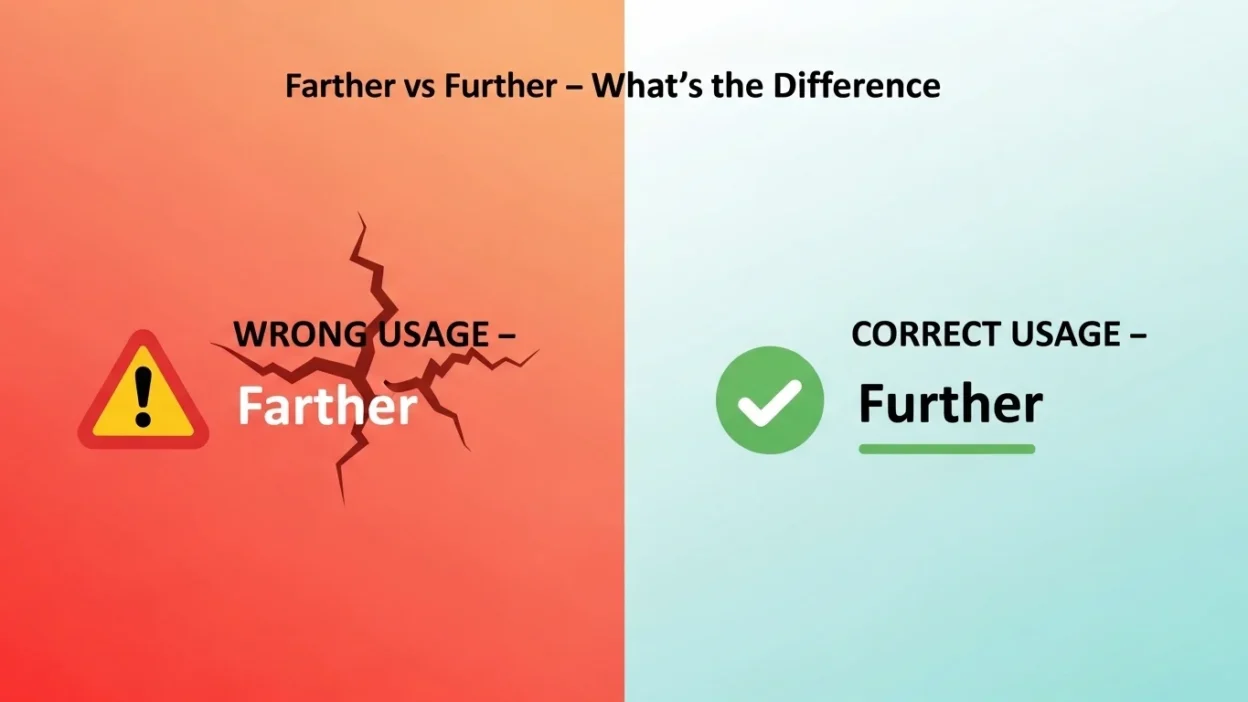
Quick Answer: Farther vs Further
Here’s the simple rule in bullet points:
- Farther → physical distance (how far something is in space)
- Further → metaphorical distance (ideas, time, degree, progress)
- Tip: If you can measure it with a ruler, miles, or steps, use farther. If it is about ideas, time, or extra information, use further.
A Little Background
Both words come from the Old English word “feor” meaning “far.”
- Over time, farther became associated with physical distance.
- Further became associated with figurative distance, like thinking, planning, or extra action.
Today, this is the main difference we follow in modern English.
Clear Explanation of the Difference
Farther: Physical Distance
Use farther when you are talking about something you can touch, see, or measure.
Examples:
- “I ran farther than my brother today.”
- “The gas station is farther down the road.”
- “How much farther is it to the park?”
Think: Can you measure it in miles, meters, or steps? If yes, use farther.
Further: Figurative Distance or Progress
Use further for:
- Ideas or discussions
- Time or events
- Extent, degree, or progress
Examples:
- “We need to discuss this further.”
- “I can’t help you any further.”
- “Do you want to explore this topic further?”
Think: Can you measure it physically? If no, it is probably further.
Comparison Table: Farther vs Further
| Feature | Farther | Further |
| Type | Physical distance | Figurative / metaphorical |
| Measurable | Yes (miles, steps, meters) | No (ideas, progress, degree) |
| Examples | “The store is farther away.” | “Let’s talk further about it.” |
| Common Words | distance, reach, miles | information, discussion, help |
Which One to Use and When
- Farther → When asking about real, physical distance
- “How much farther to the library?”
- “I walked farther than yesterday.”
- Further → When talking about extra or abstract things
- “I need further instructions.”
- “We will investigate this matter further.”
💡 Tip: If you’re unsure, check if it’s about space (farther) or ideas/time (further).
Common Mistakes People Make
- Using farther for ideas or progress.
❌ “We need to walk farther into this topic.”
✅ “We need to go further into this topic.” - Using further for measurable distance.
❌ “The shop is further down the road.”
✅ “The shop is farther down the road.” - Confusing both in emails or formal writing.
- Always ask: is it physical or metaphorical?
Everyday Real-Life Examples
Emails
- “Please let me know if you need further clarification.”
- “I can travel farther if needed for the meeting.”
News or Articles
- “The storm has moved farther inland.”
- “Scientists want to study the effects further.”
Social Media / Messages
- “I ran farther today than yesterday!”
- “Let’s discuss this further in the comments.”
Daily Life
- “How much farther is the grocery store?”
- “I don’t want to worry about this any further.”
Short Learning Section for Students and Beginners
- Farther → physical
- Think: steps, miles, space
- Further → figurative
- Think: talk, ideas, time, progress
- Ask yourself: Can I measure it?
- Yes → farther
- No → further
💡 Practice Tip: Make two columns in a notebook. Write examples for farther and further every day. This will make it stick.
FAQ: Farther vs Further
1. Can I use further for distance?
- Usually no. Farther is better for real distance.
2. Can farther be used for ideas?
- Not really. Ideas are usually further.
3. Is it wrong to say “further down the road”?
- Some people say it, but farther is more correct for physical distance.
4. Are there exceptions?
- In modern English, some people use them interchangeably. But following the rule above is safer.
5. Can I use further in emails?
- Yes, especially when asking for more information or clarification.
6. Does farther sound more formal?
- No, both are correct. Farther just means physical distance.
7. What about “further along”?
- This usually means progress, not physical distance, so further is correct.
8. Quick memory trick?
- Far → physical → farther
- Further → extra → abstract ideas
Conclusion
The difference between farther and further is simple:
- Use farther for physical distance.
- Use further for ideas, time, or progress.
By remembering this rule and practicing a little every day, you will stop confusing these two words. Soon, using farther and further will feel natural in both writing and speaking.
English can be tricky, but breaking it down like this makes it easy, clear, and friendly for everyone to understand.

Andrew Christopher is a passionate visionary who blends creativity with purpose to bring ideas to life. With a focus on innovation and integrity, he inspires growth and lasting impact.