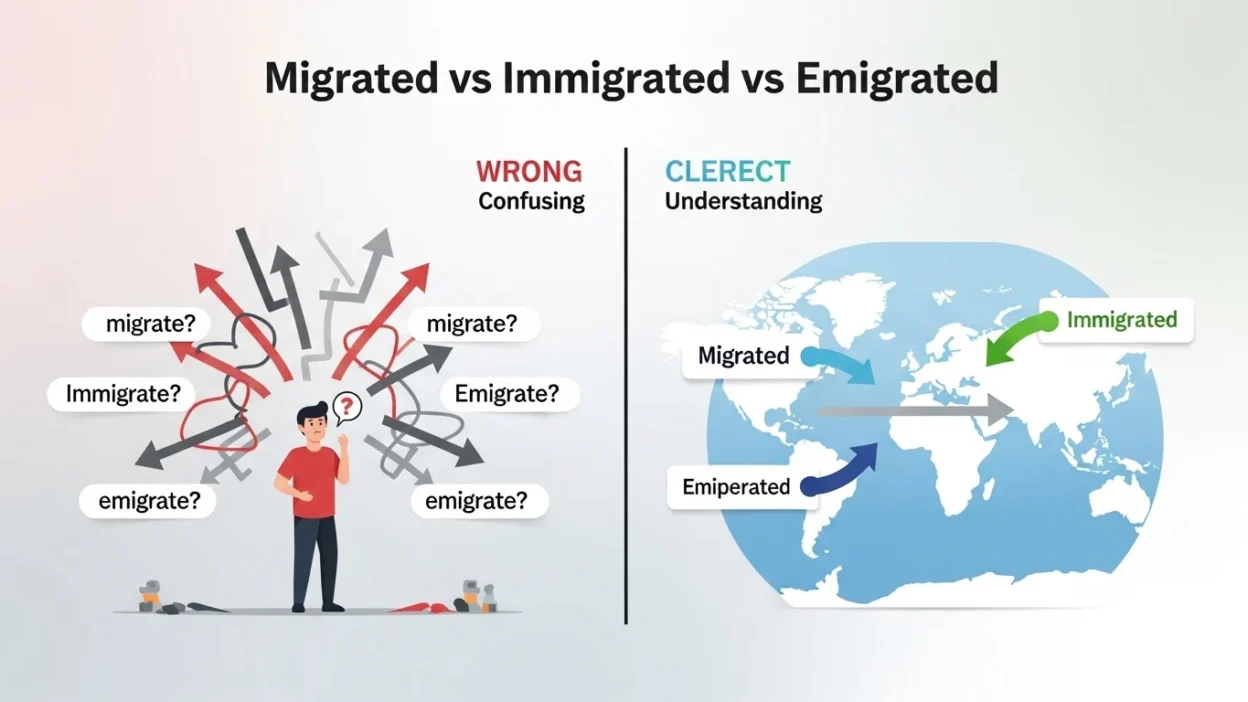
Many students and English learners get confused when they see words like “immigrated,” “migrated,” and sometimes even “emigrated.” These words look similar and all relate to movement, which makes them easy to mix up.
The confusion usually happens because people are not sure about direction (into, out of, or general movement) and context (country vs general place). In simple terms, these words are connected, but each one has a different purpose.
Quick Answer
- Migrated → moving from one place to another (general movement)
- Immigrated → moving into a new country to live there
- Emigrated → leaving your own country to live somewhere else
👉 Migration is the general idea, while immigration and emigration are specific types of migration.
Simple Background Explanation
All three words come from the same idea: movement.
- Migrate = to move
- Immigrate = to move into a place (especially a country)
- Emigrate = to move out of a place (especially a country)
The prefixes help explain the meaning:
- Im means “into”
- E / Em means “out of”
So the direction is the key to understanding the difference.
Clear Explanation of Each Word
1. Migrated (General Movement)
Migrated is the most general word. It means moving from one place to another. It does not always involve crossing a country border.
It can be used for:
- People moving between cities or regions
- Workers relocating for jobs
- Animals moving seasonally
- Groups moving for safety, education, or opportunities
Examples:
- People migrated from villages to cities for jobs.
- Birds migrate to warmer places in winter.
- Families migrated after the flood.
👉 Migration can be temporary or permanent.
2. Immigrated (Moving Into a Country)
Immigrated is used when someone enters a new country to live there.
It focuses on:
- Entering a country
- Settling in a new place
- Living there long term or permanently
Examples:
- She immigrated to Canada last year.
- His family immigrated to Australia for better opportunities.
- Many people immigrate for safety and work.
👉 Immigration always involves a country you are entering.
3. Emigrated (Leaving a Country)
Emigrated is used when someone leaves their own country to live somewhere else.
It focuses on:
- Leaving your home country
- Moving out of a country
- Starting life in another place
Examples:
- He emigrated from Pakistan to Germany.
- They emigrated to find better job opportunities abroad.
- Many families emigrated due to economic problems.
👉 Emigration is the opposite of immigration.
Key Difference Explained Simply
- Migrated = general movement (anywhere)
- Immigrated = moving into a country
- Emigrated = moving out of a country
Think of it as one movement seen from different angles:
- From the destination side → immigrated
- From the departure side → emigrated
- From a general view → migrated
Comparison Table
| Feature | Migrated | Immigrated | Emigrated |
| Meaning | Movement from one place to another | Moving into a new country | Leaving your country |
| Direction | General | Into a country | Out of a country |
| Scope | Broad | Specific (entry) | Specific (exit) |
| Used for | People, animals, groups | Humans only | Humans only |
| Context | Local or international | International (entry) | International (exit) |
| Permanence | Temporary or permanent | Usually long term | Usually long term |
| Example | People migrated to cities | She immigrated to Canada | He emigrated from his country |
When to Use Each Word
Use “migrated” when:
- Talking about general movement
- Movement within a country or region
- Animals or seasonal movement
- No focus on country entry or exit
Use “immigrated” when:
- Someone moves into a new country
- Talking about settling in that country
- Describing relocation across borders
Use “emigrated” when:
- Someone leaves their country
- Talking from the perspective of departure
- Describing exit from a homeland
Simple Decision Rule (Very Important)
Ask yourself these questions:
- Is the movement between countries?
- Yes → continue
- No → use migrated
- Is the person entering a country?
- Yes → use immigrated
- Is the person leaving a country?
- Yes → use emigrated
👉 This simple thinking process removes confusion quickly.
Common Mistakes People Make
- Using immigrated for all movement
- Incorrect: Birds immigrated south
- Correct: Birds migrated south
- Using migrated for country entry
- Incorrect: She migrated to Canada permanently
- Correct: She immigrated to Canada
- Ignoring direction
- Not checking whether the movement is into or out of a country
- Confusing emigrated and immigrated
- Emigrated = leaving
- Immigrated = entering
- Thinking all three words mean the same
- They are related but not interchangeable
Real Life Examples
1. Daily Life
- “My cousin immigrated to the UK last year.”
- “Many people migrated to cities for education.”
2. News Context
- “Thousands of families migrated to safer regions after the disaster.”
- “Several workers immigrated to another country for employment.”
3. Personal Stories
- “He emigrated from his home country to start a new life abroad.”
- “She immigrated with her parents when she was young.”
4. Social Media
- “I recently immigrated and started a new journey.”
- “People are migrating to urban areas for better opportunities.”
Short Learning Section for Beginners
Remember This:
- Migration = movement (general idea)
- Immigration = moving into a country
- Emigration = moving out of a country
Easy Memory Trick:
- Im = Into → Immigrated
- E = Exit → Emigrated
- Migrate = Move (general)
Quick Practice Thinking:
- Moving into a country → immigrated
- Leaving a country → emigrated
- Any other movement → migrated
FAQ Section
1. What is the main difference between migrated and immigrated?
Migrated means general movement, while immigrated means moving into a new country to live.
2. What is emigrate?
Emigrate means leaving your own country to live in another country.
3. Are migrate, immigrate, and emigrate related?
Yes, all three words describe movement, but from different perspectives.
4. Can migrated be used for countries?
Yes, but it is more general. For specific country entry, immigrated is better.
5. What is the difference between immigration and emigration?
Immigration is entering a country, while emigration is leaving a country.
6. Can animals immigrate?
No, animals migrate, not immigrate.
7. Which word is the most general?
“Migrated” is the most general term.
8. How can I remember the difference easily?
Think of direction: into (immigrate), out of (emigrate), general movement (migrate).
Conclusion
The difference between migrated, immigrated, and emigrated becomes simple when you focus on direction and context.
- Migrated is used for general movement from one place to another.
- Immigrated is used when someone enters a new country.
- Emigrated is used when someone leaves their country.
By remembering these simple meanings and using the decision rule, you can easily choose the correct word in any sentence. With practice and real life examples, these terms will become clear and natural in your everyday English use.

Daniel Matthew is a passionate visionary who believes in creativity, purpose, and innovation. With a focus on growth and authenticity, he turns every idea into meaningful impact.