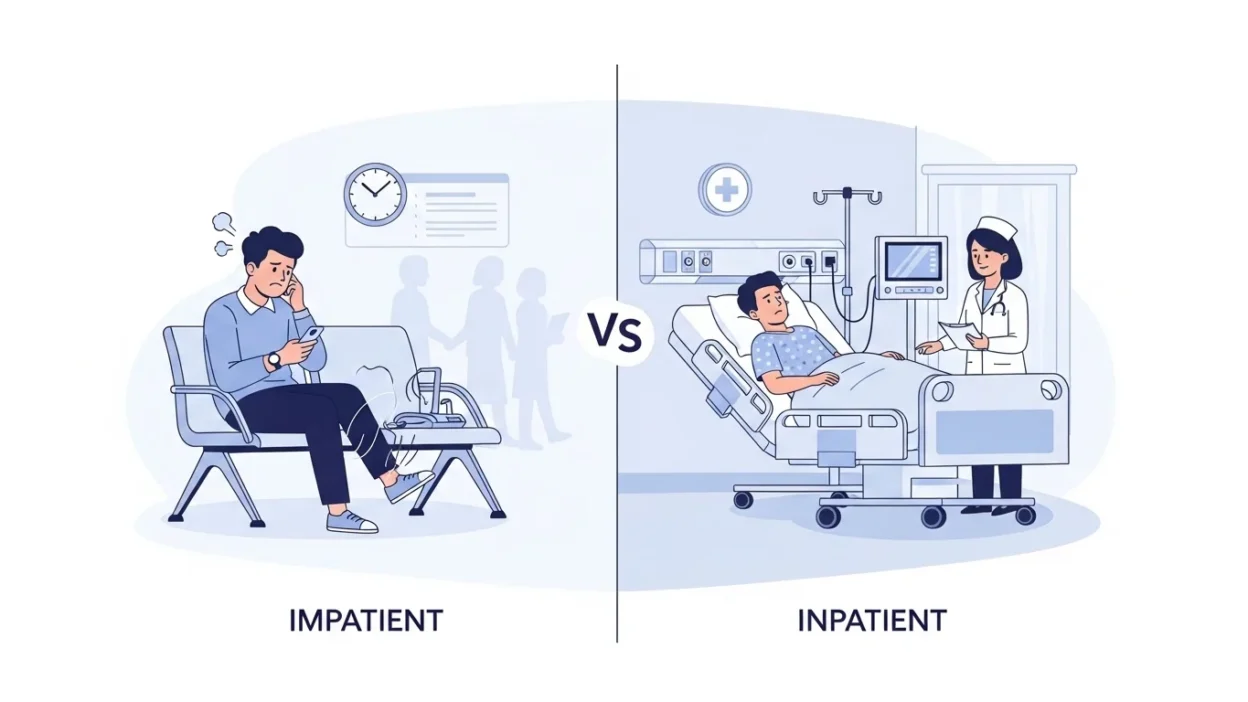
Are you confused about impatient or inpatient? You are not alone. Many students and English learners mix up these two words because they look almost the same.
Just one letter changes but the meaning becomes completely different.
This guide will help you understand the difference between impatient and inpatient in a very simple way. By the end, you will feel confident using both words correctly in real life.
Quick Answer
Here is the simple difference:
- Impatient = feeling annoyed because you have to wait
- Inpatient = a patient who stays in a hospital
👉 Easy memory tip:
- Impatient = “I can’t wait!”
- Inpatient = “In the hospital”
Pronunciation
These words also sound slightly different:
- Impatient → im PAY shunt (/ɪmˈpeɪʃənt/)
- Inpatient → IN pay shunt (/ˈɪnˌpeɪʃənt/)
👉 Notice:
- Impatient → stress on “PAY”
- Inpatient → stress on “IN”
This small sound difference helps in speaking and listening.
Simple Origin or Background
Let’s break the words to understand them easily:
- Impatient
- “im” = not
- “patient” = calm
- → not calm, cannot wait
- Inpatient
- “in” = inside
- “patient” = sick person
- → a patient inside a hospital
👉 Simple idea:
- Impatient = not patient
- Inpatient = inside hospital
Clear Explanation of the Difference
What Does “Impatient” Mean?
The impatient meaning in English is a feeling. It describes a person who does not like waiting.
When someone is impatient:
- They feel annoyed
- They want things quickly
- They lose patience easily
Examples:
- I feel impatient when the bus is late.
- She became impatient during the long meeting.
- Children often get impatient while waiting for food.
What Does “Inpatient” Mean?
The inpatient meaning is a person who stays in a hospital for treatment.
An inpatient:
- Sleeps in the hospital
- Receives care from doctors
- Stays for one or more days
Examples:
- He is an inpatient after his surgery.
- The hospital has many inpatients today.
- Doctors visit inpatients every morning.
Comparison Table
| Feature | Impatient | Inpatient |
| Meaning | Cannot wait | Patient in hospital |
| Type | Adjective | Noun |
| Usage | Feelings | Medical context |
| Pronunciation | im PAY shunt | IN pay shunt |
| Memory Trick | “I can’t wait!” | “In the hospital” |
| Common Mistake | Used for people in hospital ❌ | Used for feelings ❌ |
| Example | She is impatient. | He is an inpatient. |
Which One to Use and When
Knowing when to use impatient and inpatient is simple if you follow this rule:
Use “Impatient” when:
- Talking about waiting
- Expressing feelings
- Describing behavior
👉 Example:
- Customers became impatient due to delays.
Use “Inpatient” when:
- Talking about hospitals
- Describing medical care
- Referring to a patient staying inside
👉 Example:
- She is an inpatient at the city hospital.
Common Mistakes People Make
Here are some common English mistakes with impatient and inpatient:
1. Using the wrong word
❌ He is an impatient in the hospital.
✔ He is an inpatient in the hospital.
2. Confusing meaning in context
❌ The doctor treated impatient people.
✔ The doctor treated inpatient people.
3. Mixing them in exams
Students often make mistakes in writing because:
- Words look similar
- They don’t check context
👉 Tip: Always ask:
- Is it about feeling? → impatient
- Is it about hospital? → inpatient
4. Pronunciation confusion
Many learners say both words the same way.
Practice the stress difference to avoid mistakes.
Everyday Real Life Examples
Here are natural impatient vs inpatient examples from daily life:
At Work
- “The manager became impatient because the report was late.”
At School
- “Students get impatient during long lectures.”
In Hospitals
- “The nurse is taking care of the inpatients.”
In Emails
- “Sorry if I sounded impatient in my last message.”
- “My uncle is an inpatient after his operation.”
On Social Media
- “I’m getting impatient waiting for my order!”
- “Please pray for her, she is an inpatient.”
Short Learning Section for Students and Beginners
Here is an easy explanation of impatient and inpatient you can remember:
Step 1: Look at the first part
- Im = not
- In = inside
Step 2: Ask one question
- Waiting problem? → impatient
- Hospital situation? → inpatient
Step 3: Practice
Fill in the blanks:
- I feel ______ when the internet is slow.
- He is an ______ at the hospital.
Answers:
- impatient
- inpatient
FAQ Section
1. What is the difference between impatient and inpatient?
Impatient is a feeling, while inpatient is a hospital patient.
2. Can impatient and inpatient be used interchangeably?
No, they have completely different meanings.
3. What is impatient meaning?
It means feeling annoyed because you have to wait.
4. What is inpatient meaning?
It means a person who stays in a hospital for treatment.
5. What is inpatient vs outpatient difference?
- Inpatient = stays in hospital
- Outpatient = visits but does not stay
6. Is inpatient always a noun?
Yes, it is mainly used as a noun (a person).
7. Why do students confuse these words?
Because they look and sound very similar.
8. How can I remember the difference easily?
- Impatient = can’t wait
- Inpatient = in hospital
Conclusion
Understanding impatient or inpatient becomes very easy when you focus on meaning and context.
- Impatient is about feelings and waiting
- Inpatient is about a person in a hospital
Next time you see these words, just ask yourself one question:
👉 Is this about waiting or a hospital?
If you answer that, you will always choose the correct word. With a little practice, you can use both words confidently in speaking and writing.

Andrew Christopher is a passionate visionary who blends creativity with purpose to bring ideas to life. With a focus on innovation and integrity, he inspires growth and lasting impact.