Imagine this: you are at a restaurant, looking at the menu for 10 minutes. You still cannot choose what to eat. Your friend laughs and says, “You’re so indecisive!”
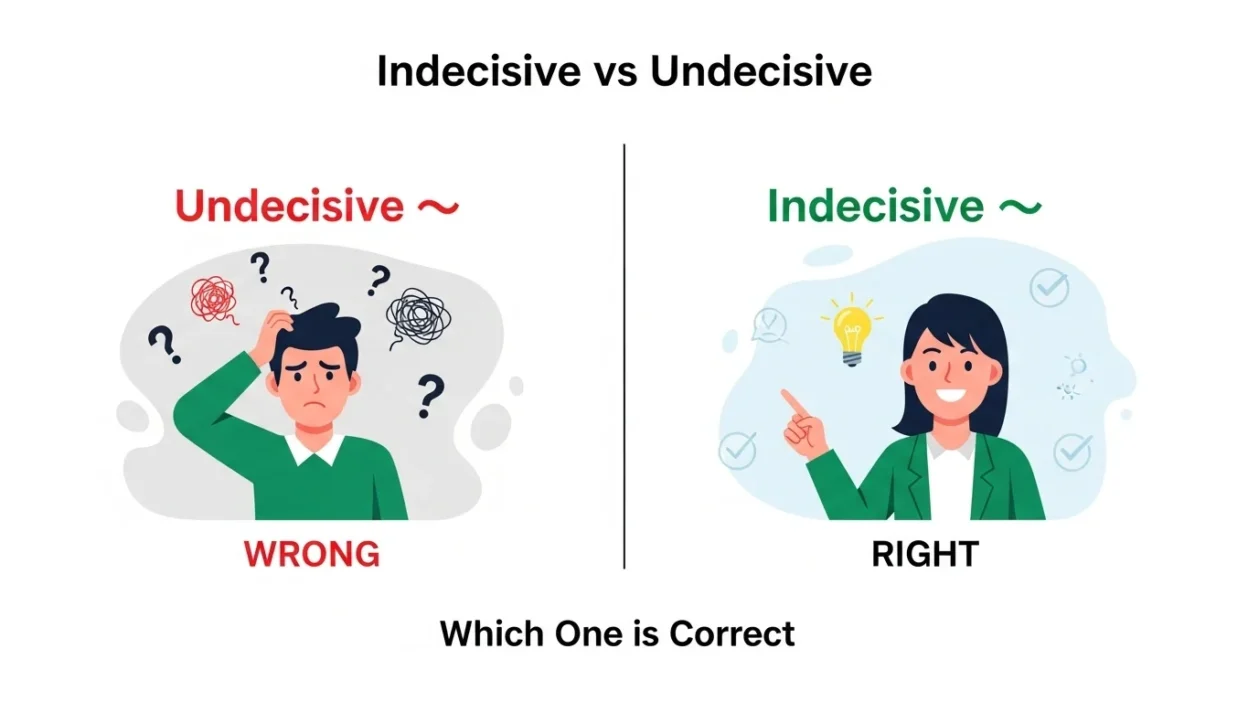
But then you wonder… should it be indecisive or undecisive?
This is a very common confusion. These two words look similar, sound similar, and seem to mean the same thing. But in real English, only one is correct.
Let’s make it simple and clear so you never get confused again.
Quick Answer
- Indecisive = correct word ✅
- Undecisive = incorrect word ❌
- Always use indecisive in speaking and writing
- Avoid undecisive completely
👉 If you remember just one thing: “indecisive” is always correct
Simple Origin and Background
Let’s break the word into parts:
- Decide = to make a choice
- -ive = turns it into a describing word (adjective)
Now add a prefix:
- in- = not
So:
- Indecisive = not able to decide
You might think:
- “un- also means not, so why not undecisive?”
Good question! But English does not always follow perfect rules. Over time, people accepted indecisive as the correct form.
👉 That’s why people ask, “Is undecisive a word?”
The answer is: it may sound possible, but it is not correct in standard English.
Clear Explanation of the Difference
Indecisive (Correct and Natural)
Meaning: A person who cannot make decisions easily
Examples:
- She is indecisive about her future.
- I feel indecisive when buying clothes.
This word describes someone who:
- Feels unsure
- Takes a long time to decide
- Changes their mind often
Undecisive (Incorrect and Unnatural)
This word is sometimes used by mistake.
But:
- It is not accepted in proper English
- Native speakers usually avoid it
- It can make your writing look incorrect
❌ Wrong: He is undecisive
✅ Correct: He is indecisive
Comparison Table
| Feature | Indecisive ✅ | Undecisive ❌ |
| Correct word | Yes | No |
| Common usage | Very common | Very rare |
| Accepted in English | Yes | No |
| Meaning | Not able to decide | Same idea (but incorrect) |
| Use in exams or writing | Always use | Avoid completely |
Which One to Use and When
If you are thinking about the correct choice, the answer is simple:
👉 Always use indecisive
Use it when:
- Describing a person
- Talking about behavior
- Writing emails or essays
- Speaking in daily life
Examples:
- He is very indecisive in meetings.
- I’m too indecisive to choose quickly.
Indecisive vs Unsure vs Hesitant
Many learners also confuse similar words. Let’s make it clear:
| Word | Meaning | Example |
| Indecisive | Cannot decide | She is indecisive about the plan |
| Unsure | Not certain | I am unsure about the answer |
| Hesitant | Slow because of doubt or fear | He was hesitant to speak |
👉 Simple idea:
- Indecisive = cannot choose
- Unsure = not certain
- Hesitant = afraid or nervous to act
Why Being Indecisive Can Be a Problem
This word is not just about grammar it describes real behavior.
Being indecisive can:
- Waste time
- Create stress
- Make others frustrated
Example:
- A manager who is indecisive may delay important decisions
But don’t worry everyone feels indecisive sometimes!
Common Mistakes People Make
Mistake 1: Using “undecisive”
❌ Incorrect
✔ Always use indecisive
Mistake 2: Overthinking prefixes
Just because “un-” means “not” doesn’t mean it works everywhere.
Mistake 3: Spelling errors
Wrong:
- indecesive
- indecisiv
Correct:
- indecisive
Mistake 4: Confusing similar words
Mixing indecisive with unsure or hesitant
✔ Learn small differences (see section above)
Everyday Real Life Examples
1. Daily Conversation
- I’m indecisive you decide!
- She is too indecisive to choose a movie
2. Emails
- I am still indecisive about the final plan
- He seemed indecisive in his response
3. Social Media
- Why am I so indecisive today? 😅
- Feeling indecisive about everything
4. School or Exams
- The student was indecisive during the test
- Don’t be indecisive manage your time
5. Work or News
- The leader was called indecisive
- The company appeared indecisive during the crisis
Short Learning Section for Students
Step 1: Learn the meaning
Indecisive = not able to decide
Step 2: Practice simple sentences
- I am indecisive
- She is indecisive
- They are indecisive
Step 3: Learn similar words
- unsure
- hesitant
- uncertain
Step 4: Avoid the wrong word
👉 Never use undecisive
Easy Memory Tricks
- “IN English, use INdecisive”
- “IN = correct, UN = wrong (in this case)”
FAQ Section
1. What is the difference between indecisive and undecisive?
Indecisive is correct and widely used.
Undecisive is incorrect and should be avoided.
2. Is undecisive a word?
It may appear sometimes, but it is not accepted in standard English.
3. What does indecisive mean?
It means a person cannot make decisions easily.
4. How do I use indecisive in a sentence?
Example:
- She is indecisive about her career.
5. Is indecisive positive or negative?
Usually slightly negative, because it shows difficulty in making decisions.
6. What are simple synonyms of indecisive?
- unsure
- hesitant
- uncertain
7. Can indecisive describe a situation?
Yes.
Example:
- The discussion was indecisive (no clear result)
8. How can I stop making this mistake?
Practice using indecisive and remember that undecisive is incorrect.
Conclusion
The confusion between indecisive and undecisive is very common because both words look similar and seem logical. But real English usage is simple:
👉 Indecisive is correct
👉 Undecisive is incorrect
If you remember this one rule and practice using indecisive in real sentences, you will avoid this mistake forever.
Next time you can’t make a choice, you’ll know exactly what to say:
“I’m feeling a bit indecisive today.”

Andrew Christopher is a passionate visionary who blends creativity with purpose to bring ideas to life. With a focus on innovation and integrity, he inspires growth and lasting impact.