Many students and learners search for inpatient vs impatient because the words look almost the same.
They:
- Have almost the same spelling
- Sound very similar
- Both contain the word “patient”
But the meanings are completely different.
One word is about medical care.
The other word is about feelings.
Quick Answer: Inpatient vs Impatient
Here is the simple difference:
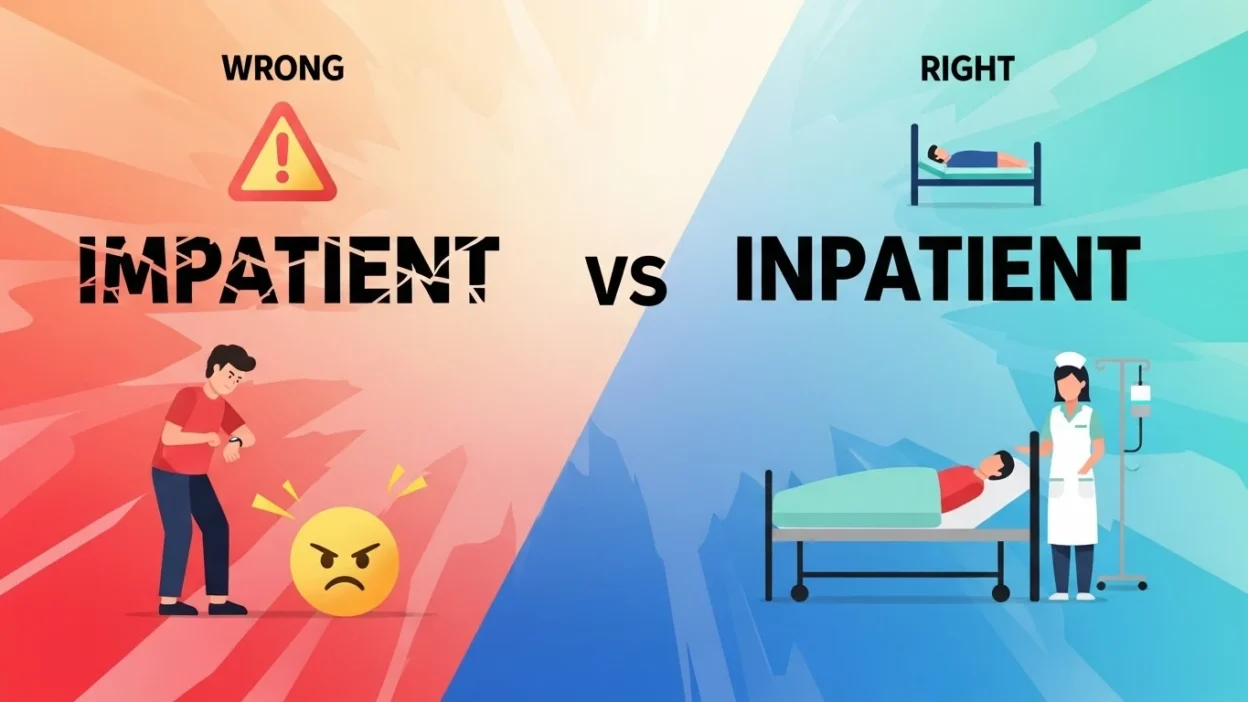
- Inpatient = a hospital patient who stays overnight for treatment
- Impatient = feeling annoyed or frustrated because something is slow
Example:
- My grandfather is an inpatient after surgery.
- I am impatient when the internet is slow.
Hospital → Inpatient
Feeling → Impatient
Inpatient Meaning (Medical Explanation)
What Does Inpatient Mean?
The inpatient definition is:
A person who is admitted to a hospital and stays there for at least one night to receive treatment.
This word is a noun (it names a person).
Inpatient in a Sentence
- The hospital admitted 25 inpatients this week.
- She became an inpatient after her accident.
- The doctor checked all the inpatients in the ward.
What Is Inpatient Care?
Inpatient care means medical treatment that requires staying in a hospital.
Examples:
- Surgery
- Serious illness treatment
- Recovery after a major accident
Inpatient vs Outpatient (Important Difference)
Many learners also confuse this.
- Inpatient → stays overnight in hospital
- Outpatient → visits hospital but does NOT stay overnight
Example:
- He is an outpatient for regular checkups.
- She is an inpatient after surgery.
This adds more clarity to the inpatient meaning.
Is Inpatient One Word or Two?
“Inpatient” is written as one word.
Correct:
- He is an inpatient.
Incorrect:
- He is an in patient. ❌
Can Inpatient Be an Adjective?
Yes, sometimes.
Example:
- She received inpatient treatment.
- The hospital offers inpatient services.
Here it describes the type of care.
Impatient Meaning (Clear Emotional Explanation)
Now let’s understand the impatient definition.
Impatient means:
Feeling annoyed, restless, or frustrated because you must wait or because something is slow.
It is an adjective (it describes a feeling or personality).
Impatient in a Sentence
- I became impatient while waiting in line.
- The teacher was impatient with noisy students.
- He gets impatient in traffic.
Grammar Patterns With Impatient
This is very important for students.
Be impatient with (a person)
- She was impatient with her children.
- The manager became impatient with the staff.
Be impatient for (something)
- I am impatient for the holidays.
- He is impatient for the results.
Be impatient to (do something)
- She is impatient to start her new job.
- They are impatient to see the movie.
These patterns help you use the word correctly in real life.
Clear Explanation: Difference Between Inpatient and Impatient
Let’s simplify everything.
Inpatient
- A person
- Medical word
- Related to hospital
- Noun (sometimes adjective)
Impatient
- A feeling
- Emotional word
- Used in daily life
- Adjective only
The inpatient and impatient difference is about context:
Medical situation → Inpatient
Emotional situation → Impatient
Comparison Table (Detailed and Easy to Scan)
| Feature | Inpatient | Impatient |
| Meaning | A hospital patient staying overnight | Feeling annoyed or unable to wait |
| Word type | Noun (sometimes adjective) | Adjective |
| Related to | Medical treatment | Emotions |
| Used in hospitals? | Yes | No |
| Used in daily conversation? | Rarely | Very common |
| Opposite | Outpatient | Patient |
| Example | He is an inpatient. | She is impatient. |
This table clearly shows the difference between inpatient and impatient.
Pronunciation: Inpatient vs Impatient
Many learners search for inpatient vs impatient pronunciation.
Here is the difference:
- Inpatient → IN-pay-shunt
- Impatient → IM-pay-shunt
The stress is on the first syllable:
INpatient
IMpatient
The sound difference is small, but the meaning is very different.
Real Life Examples
📧 In Emails
- I apologize for being impatient earlier.
- My mother is currently an inpatient at the hospital.
🏥 In Medical Reports
- The inpatient requires close monitoring.
- The hospital increased inpatient services this year.
🛒 In Daily Life
- Customers became impatient after waiting for 30 minutes.
- He is an inpatient recovering from surgery.
📱 On Social Media
- “Why is this app so slow? I’m getting impatient!”
- “Please pray for my uncle. He is an inpatient after heart surgery.”
These inpatient vs impatient examples show how different the meanings are.
Common Mistakes and How to Avoid Them
❌ Wrong:
I was inpatient while waiting for my exam results.
✅ Correct:
I was impatient while waiting for my exam results.
❌ Wrong:
My brother is impatient in the hospital.
✅ Correct:
My brother is an inpatient in the hospital.
❌ Wrong:
Don’t be inpatient.
✅ Correct:
Don’t be impatient.
Remember:
If no hospital is involved, do NOT use inpatient.
Why Do People Confuse Inpatient and Impatient?
There are three main reasons:
- Very similar spelling
- Very similar pronunciation
- Both contain the word “patient”
But the prefix changes everything:
- “In-” in inpatient relates to being inside (in hospital)
- “Im-” in impatient means “not” (not patient, not calm)
Understanding this removes the confusion.
Short Practice Section for Students
Choose the correct word:
- She became ______ while waiting for the bus.
- The hospital admitted 10 new ______.
- He is ______ with slow service.
- After surgery, she became an ______.
Answers:
- impatient
- inpatients
- impatient
- inpatient
Practice makes the difference clear.
FAQ: Inpatient vs Impatient
What is the main difference between inpatient and impatient?
Inpatient is a hospital patient staying overnight.
Impatient describes a feeling of frustration.
Is inpatient a medical term?
Yes. It is mainly used in hospitals and healthcare.
Can an inpatient describe a person’s personality?
No.
Can impatient describe a personality?
Yes. Someone can generally be an impatient person.
Is inpatient one word?
Yes, always one word.
What is inpatient care?
Medical treatment that requires staying in a hospital overnight.
What is the opposite of impatient?
Patient (calm and able to wait).
Can someone be both inpatient and impatient?
Yes.
Example:
- The inpatient became impatient while waiting for the nurse.
Conclusion
Now you fully understand the inpatient vs impatient difference.
Let’s review clearly:
- Inpatient meaning → A hospital patient who stays overnight
- Impatient meaning → Feeling annoyed because you must wait
One word belongs to medical vocabulary.
The other belongs to emotional vocabulary.
Just one letter changes the meaning completely.
From now on, when you see inpatient and impatient, you will know exactly which word to use in exams, writing, emails, and everyday conversation.
No more confusion.