If you’re learning English, you may have wondered: what’s the difference between lay and lie? Many students, learners and even native speakers get confused.
This guide will explain lay vs lie meaning, how to use lay and lie correctly, and common mistakes.
You’ll also get tables, memory tips, and real-life examples so you can remember everything easily.
Why People Get Confused
The confusion happens because:
- Both verbs involve putting something down or resting.
- Their past tense forms are tricky: the past tense of lie looks like the present of lay.
- Beginners often mix up lay vs lie past tense, making sentences incorrect.
Quick Tip: Ask yourself: “Am I placing something down or resting myself?”
Quick Answer: Lay vs Lie
- Lay – ✅ To put or place something on a surface.
- Lie – ✅ To recline or rest yourself.
Examples:
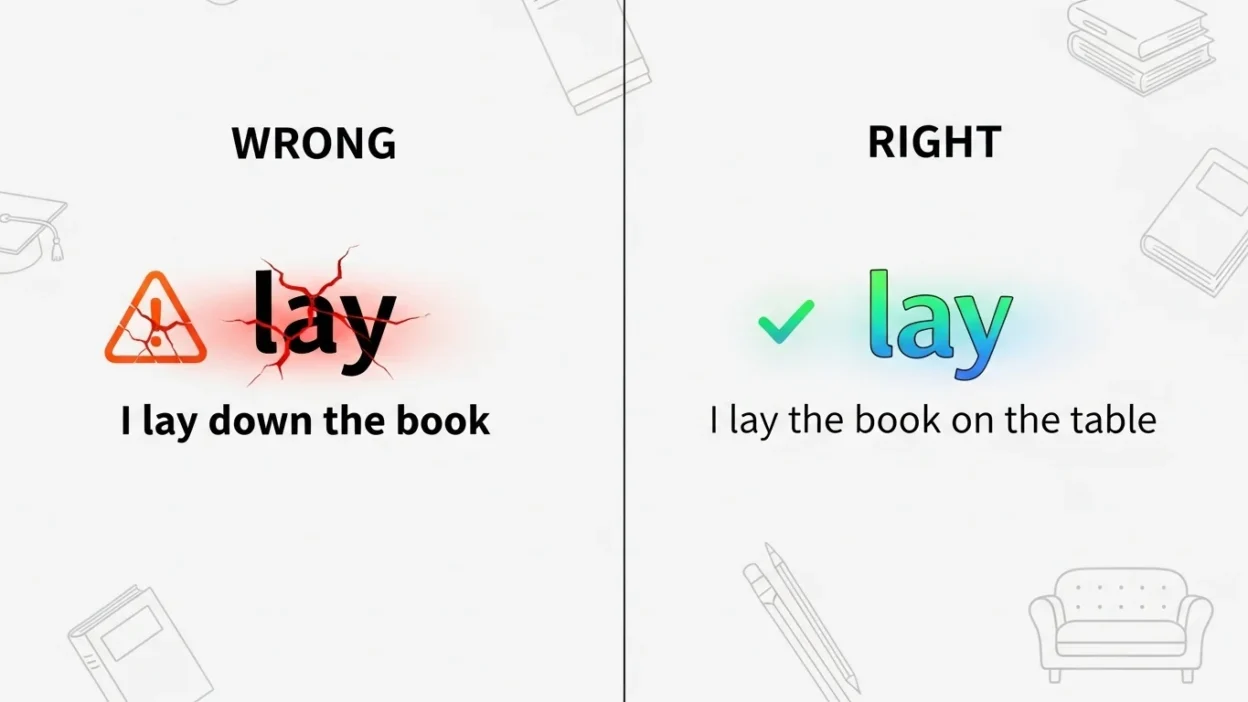
- Lay: “I will lay the book on the table.” ✅
- Lie: “I want to lie down for a short nap.” ✅
Memory Trick:
- Lay = place something
- Lie = recline yourself
Lay vs Lie Explained with a Table
Here’s a simple visual to help you understand lay vs lie quickly:
| Verb | Meaning | Present | Past | Past Participle | Example Sentence |
| Lay | To put or place something down | lay | laid | laid | I lay the keys on the table. |
| Lie | To recline or rest yourself | lie | lay | lain | Yesterday I lay on the sofa all afternoon. |
Tip: Always check if there’s an object. If yes → lay. If no → lie.
When to Use Lay vs Lie
Use Lay
- When placing something on a surface.
- Example: “She laid the plates on the table.”
Use Lie
- When reclining or resting yourself.
- Example: “He lay down on the bed after work.”
Step-by-Step:
- Is there an object? → use lay
- No object? → use lie
Common Mistakes with Lay vs Lie
- Using lay instead of lie
- ❌ “I need to lay down for a while.”
- ✅ “I need to lie down for a while.”
- ❌ “I need to lay down for a while.”
- Confusing past tense
- ❌ “Yesterday I laid on the bed.”
- ✅ “Yesterday I lay on the bed.”
- ❌ “Yesterday I laid on the bed.”
- Forgetting the object
- Lay always needs an object → “I lay the book.”
- Lie does not need an object → “I lie down.”
- Lay always needs an object → “I lay the book.”
Mini Exercise:
- Fill in the blank: “Yesterday, I ___ on the grass and relaxed.” → lay
Everyday Real Life Examples
Emails:
- “Please lay the documents on my desk.” ✅
- “I need to lie down for a short break.” ✅
News Headlines:
- “Workers laid bricks for the new building.” ✅
- “The cat lay in the sun all afternoon.” ✅
Social Media:
- “I just laid out my notes for studying.” ✅
- “After the long run, I lay on the grass.” ✅
Daily Use / Classroom:
- “Can you lay the plates on the table?” ✅
- “I want to lie on the sofa and relax.” ✅
Pro Tip: Drawing a small arrow → object = lay, no object = lie. A simple visual cue helps beginners remember faster.
Short Learning Section for Beginners
- Step 1: Is there an object? → Lay
- Step 2: No object, just reclining → Lie
- Step 3: Remember past tense forms:
- Lay → laid → laid
- Lie → lay → lain
- Lay → laid → laid
- Step 4: Practice:
- “I lay the book.”
- “I lie on the bed.”
- “I lay the book.”
Mnemonic: L-P = Lay → Place object, L-R = Lie → Recline yourself
FAQ: Lay vs Lie
1. What’s the difference between lay and lie?
- Lay = put/place something down
- Lie = recline/rest
2. Can I say “I lay down now”?
- ✅ Yes, if past tense of lie.
- Present tense → “I lie down now.”
3. What is the past tense of lie?
- Past tense of lie is lay.
4. Does lay always need an object?
- ✅ Yes. Example: “I lay the book.”
- ❌ Wrong: “I lay down” → use lie down.
5. Are lay and lie confusing for native speakers too?
- ✅ Yes, even native speakers mix them up, especially in past tense.
6. How can beginners practice lay vs lie?
- Use real-life examples, write emails, social media posts, and short daily exercises.
Conclusion
- Lay → To place an object on a surface.
- Lie → To recline or rest yourself.
- Past tense tricky part: Lie → lay; Lay → laid.
Quick Tip: Ask: “Am I placing something down or resting?”
- Object → Lay
- No object → Lie
By practicing these examples in emails, social media, classroom, and daily life, beginners and learners can confidently use lay vs lie correctly.
Key Takeaway:
- Lay = place object
- Lie = recline yourself