Many English learners get confused between laying vs lying. Both words involve position or placement, but their meanings, grammar, and usage are different.
In this article, you will learn laying vs lying meaning, see easy examples, understand past and present tenses, and practice correct usage for school, work, or daily life.
Quick Answer: Laying vs Lying
Laying vs lying explained in simple terms:
- Laying → present participle of lay (to put or place something down)
- Lying → present participle of lie (to rest or recline yourself)
Examples:
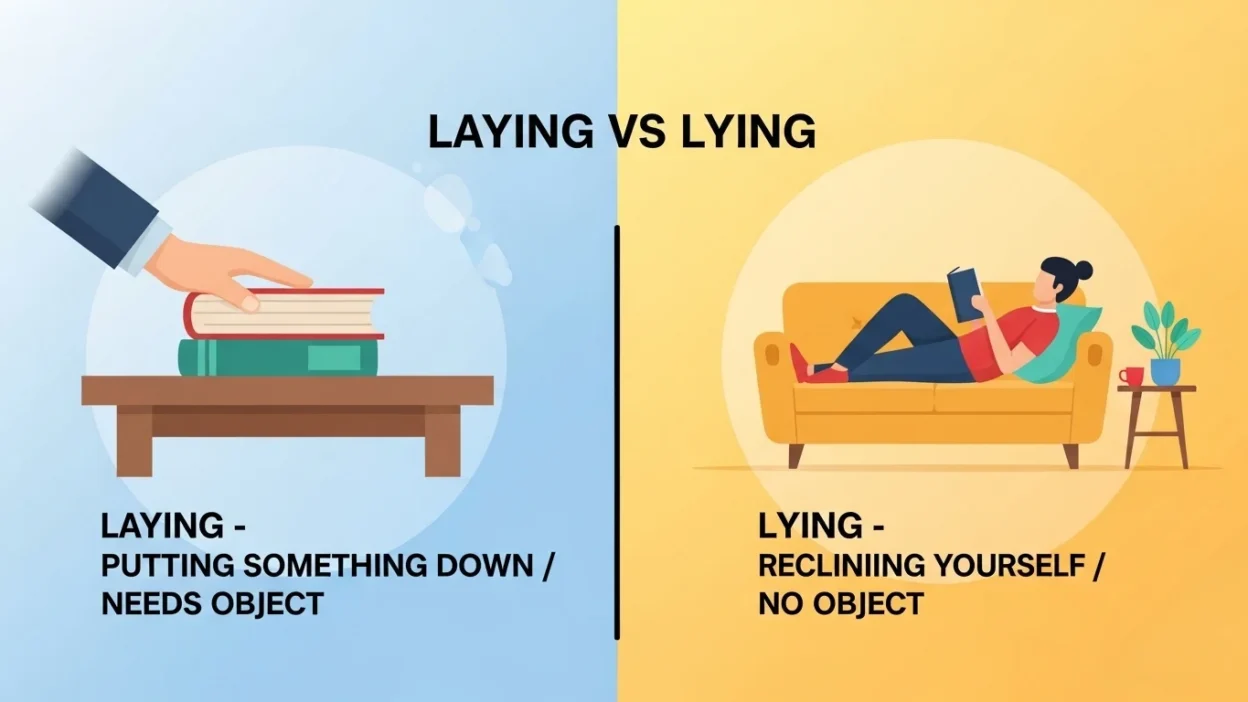
- She is laying the book on the table.
- He is lying on the sofa reading.
Tip for ESL learners:
- If something is being placed, use laying.
- If someone is reclining, use lying.
✅ This quick answer is snippet-friendly for Google searches like “laying vs lying meaning.”
Pronunciation
- Laying: /ˈleɪ.ɪŋ/
- Lying: /ˈlaɪ.ɪŋ/
Note: They sound different, but learners often confuse them in writing. Remember, “lay” puts something down, “lie” reclines yourself.
Laying vs Lying: Main Difference
| Feature | Laying | Lying |
| Verb | Lay | Lie |
| Meaning | To put or place something down | To recline or rest yourself |
| Present Participle | Laying | Lying |
| Past Tense | Laid | Lay |
| Past Participle | Laid | Lain |
| Object | Needs an object (something is being placed) | No object (person or animal reclines) |
| Example | She is laying a towel on the bed | He is lying on the couch |
Summary:
- Laying = putting something down
- Lying = reclining yourself
When to Use Laying
Use laying when you place an object down.
Examples (Laying vs lying examples included):
- She is laying her phone on the desk.
- They are laying the carpet in the living room.
- He is laying the baby in the crib.
- I am laying the cards on the table.
Tip: Always ask yourself: “Is there an object being placed?” If yes → laying.
When to Use Lying
Use lying when someone or something is resting or reclining.
Examples (Laying vs lying examples included):
- I am lying on the bed after a long day.
- The cat is lying in the sun.
- He was lying on the grass, looking at the sky.
- She is lying on the sofa, reading.
Tip: If no object is involved → lying.
Past Tense & Related Words
| Verb | Present | Past | Past Participle | Example |
| Lay (put) | lay / laying | laid | laid | I laid the book on the desk yesterday. |
| Lie (recline) | lie / lying | lay | lain | Yesterday I lay on the bed. |
Related words: lay, lie, laid, lain.
Knowing these forms ensures you never confuse laying vs lying in any tense.
Common Mistakes Learners Make
- Using laying instead of lying for resting:
- ❌ Incorrect: I am laying on the bed.
- ✅ Correct: I am lying on the bed.
- ❌ Incorrect: I am laying on the bed.
- Confusing past tense:
- ❌ Incorrect: I laid on the sofa yesterday.
- ✅ Correct: I lay on the sofa yesterday.
- ❌ Incorrect: I laid on the sofa yesterday.
- Forgetting object rule:
- ❌ Incorrect: I am lying the book on the table.
- ✅ Correct: I am laying the book on the table.
- ❌ Incorrect: I am lying the book on the table.
Real Life Examples
Home
- She is laying the dishes on the counter.
- He is lying on the sofa watching TV.
School
- Students are laying their papers on the teacher’s desk.
- Kids are lying on the floor during storytime.
Workplace / Emails
- Please ensure you are laying your documents on the table before leaving.
- He is lying on the lounge chair during break.
Social Media
- I’m lying on my bed, scrolling Instagram.
- She is laying flowers on the memorial.
Learning Tips for Students
Memory Trick
- Laying = placing something down (object)
- Lying = reclining yourself (no object)
Think: “I lay something → laying, I lie down → lying.”
Practice Sentences
- I am laying my backpack on the table.
- The dog is lying on the carpet.
- She is laying the cards on the table.
- He is lying in the hammock, relaxing.
Frequently Asked Questions (FAQ)
- What is the difference between laying and lying?
- Laying = putting something down, lying = reclining yourself.
- Laying = putting something down, lying = reclining yourself.
- Does lying need an object?
- No. Lying never takes an object.
- No. Lying never takes an object.
- Does laying need an object?
- Yes. Laying always has an object.
- Yes. Laying always has an object.
- What is the past tense of lying?
- Past tense of lie = lay. Example: Yesterday I lay on the bed.
- Past tense of lie = lay. Example: Yesterday I lay on the bed.
- What is the past tense of laying?
- Past tense of lay = laid. Example: Yesterday I laid the book on the desk.
- Past tense of lay = laid. Example: Yesterday I laid the book on the desk.
- Can I say “I am laying on the bed”?
- No. Correct: I am lying on the bed.
- No. Correct: I am lying on the bed.
- Why do people confuse laying and lying?
- Because the words look and sound similar. The object rule is the key.
- Because the words look and sound similar. The object rule is the key.
- When should I use laying vs lying?
- Use laying for objects.
- Use lying for reclining yourself.
- Use laying for objects.
Conclusion
Understanding laying vs lying is simple if you remember the object rule:
- Laying → putting something down (needs object)
- Lying → reclining or resting (no object)
Check if there is an object in the sentence, and you will never confuse laying vs lying again.