Even simple English words can confuse learners. One common example is leaf vs leaves.
Beginners often ask: “Which one is correct?” or “Is it leafs or leaves?”
This guide explains the difference between leaf and leaves, the plural of leaf, and the proper use of leafs in very simple English. By the end, even learners and beginners will understand clearly.
Quick Answer: Leaf vs Leaves
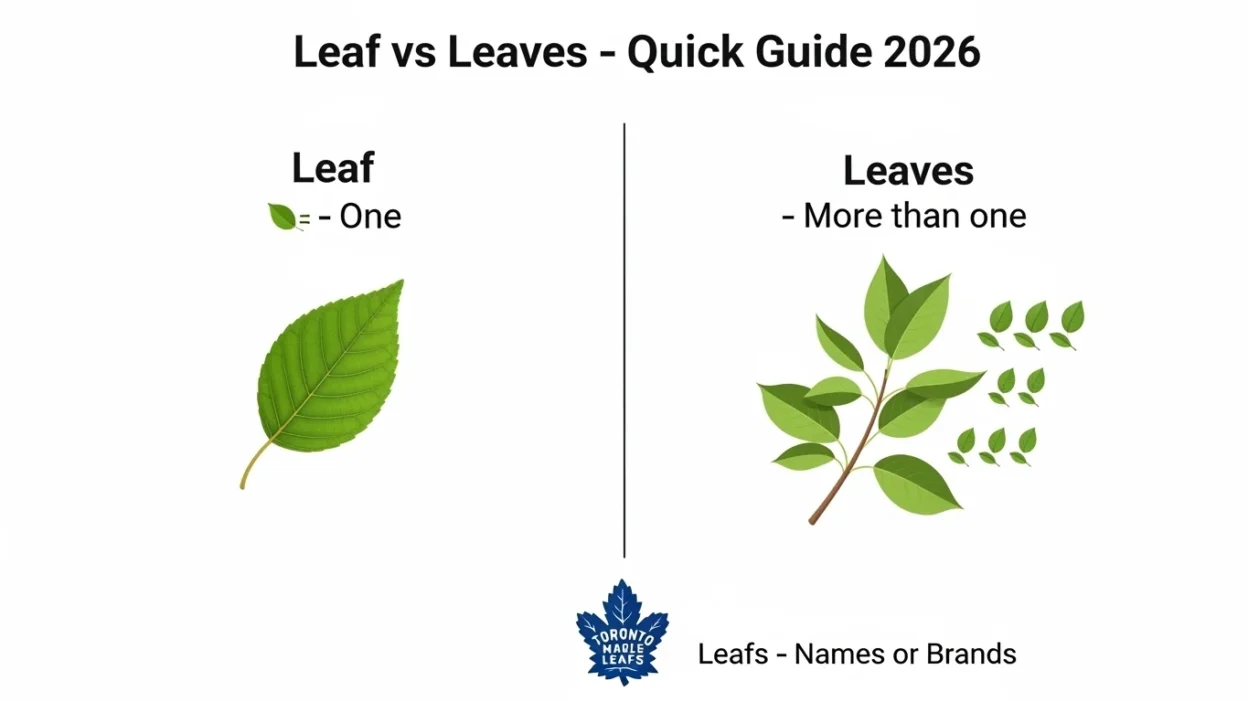
- Leaf → One part of a plant.
- Leaves → More than one leaf (plural of leaf).
- Leafs → Rarely correct; mainly used for sports team names or brands.
Memory Tip:
- 🍂 Leaf = 1
- 🍃 Leaves = Many
- 🏒 Leafs = Names or brands
Simple Background
- The word leaf comes from Old English “lēaf.”
- To make it plural, English changes f → ves, so leaf → leaves.
- Leafs is mostly used in proper nouns, like the Toronto Maple Leafs.
Example:
- Correct: “The tree has a green leaf.”
- Correct plural: “The tree has many leaves.”
- Name: “The Toronto Maple Leafs won their game.”
Clear Differences Between Leaf and Leaves
Plant Usage
| Word | Meaning | Use Today |
| Leaf | Single part of a plant | Always correct for plants |
| Leaves | More than one leaf (plural of leaf) | Correct plural for plants |
| Leafs | Names, brands, or sports teams | Rarely correct for plants |
How to Remember
- Leaf → One leaf
- Leaves → Many leaves
- Leafs → Only for names/brands
Tip for Beginners: Think Leaf = 1 leaf on the ground, Leaves = many leaves on a tree, Leafs = hockey team or brand name.
Which One to Use and When
- Leaf: Use for a single plant part.
- Leaves: Use for more than one plant part (plural of leaf).
- Leafs: Only use in proper nouns, sports teams, or brand names.
Everyday Examples:
- “The tree has a yellow leaf.”
- “Collect the leaves for a craft project.”
- “The Toronto Maple Leafs won the hockey game.”
Common English Mistakes
Mistake 1 – Using “leafs” for plants
- Incorrect: “I picked up many leafs.”
- Correct: “I picked up many leaves.”
Mistake 2 – Forgetting singular vs plural
- Remember: Leaf → Leaves follows f → ves rule.
Mistake 3 – Confusing names with plurals
- Proper names like the Toronto Maple Leafs are exceptions.
Everyday Real Life Examples
- Emails: “Please remove the fallen leaves from the garden.”
- Social Media: “Look at the beautiful leaf I found today!”
- Classroom: “Draw a leaf and then show its leaves.”
Visual Memory Aid:
- 🍂 Leaf = 1
- 🍃 Leaves = Many
- 🏒 Leafs = Team name
Short Learning Section for Students and Beginners
- Leaf → 1 leaf
- Leaves → 2 or more leaves (plural of leaf)
- Leafs → Rare, usually names or brands
Memory Trick:
- Leaf → Leaves (f → ves rule)
- Leafs → Only for names/brands
FAQ Section
Q: Can I write “leafs” for plants?
A: No, always use leaves for more than one leaf.
Q: Why do some sports teams use “Leafs”?
A: It is part of their official name, like Toronto Maple Leafs.
Q: How do you pronounce “leaves”?
A: It sounds like /liːvz/.
Q: Can “leaf” be used for artificial plants?
A: Yes, singular and plural rules are the same.
Q: What is the plural of leaf?
A: Leaves. Always.
Q: Is “leaf’s” ever correct?
A: Only for singular possessive: “The leaf’s color is red.”
Conclusion
The rule is simple:
- Leaf → One
- Leaves → More than one (plural of leaf)
- Leafs → Usually proper names or sports teams
Now you can confidently read, write, and speak about leaf and leaves.
Remember: For plants, always use leaves as the plural of leaf.

David Robert is a passionate innovator driven by creativity, vision, and purpose. He turns bold ideas into impactful realities through focus, leadership, and dedication.