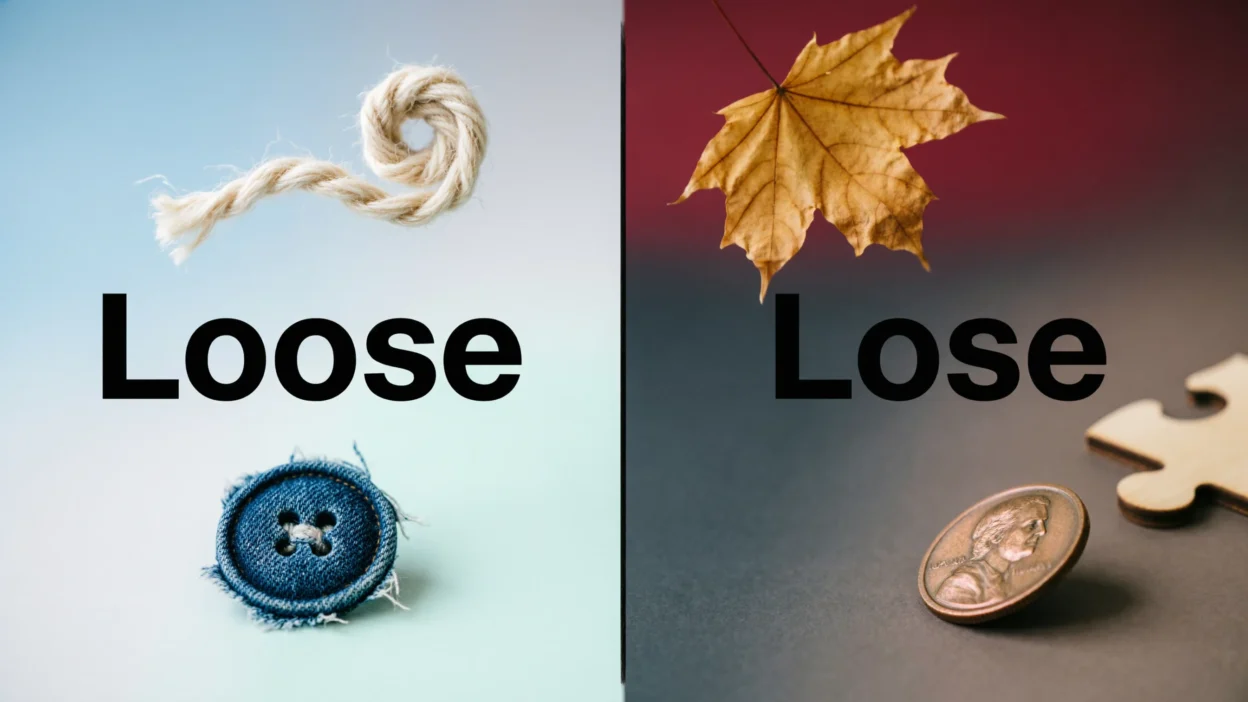
Many people feel confused about loose and lose because they look similar and sound almost the same.
Even native English speakers sometimes mix them up. For students and beginners, this confusion can feel frustrating.
The good news is that the difference is actually simple once you understand the meanings and how to use them.
In this guide, we will explain everything in very easy English, using simple words, clear examples, and helpful tips. By the end, you will never confuse loose and lose again.
Quick Answer: Loose vs Lose
Here is the fast and simple difference:
- Loose → means not tight or free
- Lose → means to not win or to not have something anymore
Simple examples:
- My shirt is loose. (not tight)
- I don’t want to lose my phone. (not have it anymore)
That’s it! Now let’s understand them deeply.
Simple Origin and Background
The confusion between loose and lose happens because:
- They look similar.
- They sound similar when spoken fast.
- They have very different meanings.
Over time, English spelling changed, but pronunciation stayed close. This made these two words easy to mix up.
Clear Explanation of the Difference
Let’s look at both words carefully.
What Does “Loose” Mean?
Loose means not tight, not fixed, or free to move.
If something is loose, it is:
- Not tight
- Not firm
- Not strongly held
Examples of “Loose”:
- My shoes are loose.
- This screw is loose.
- The dog is loose in the yard.
Loose is mostly used as an adjective, which means it describes a noun (thing or person).
What Does “Lose” Mean?
Lose means to fail to win, to misplace something, or to no longer have something.
If you lose, you:
- Do not win
- Cannot find something
- Stop having something
Examples of “Lose”:
- I don’t want to lose my keys.
- Our team may lose the match.
- Be careful not to lose your money.
Lose is a verb, which means it shows an action.
Comparison Table: Loose vs Lose
| Feature | Loose | Lose |
| Part of speech | Adjective | Verb |
| Meaning | Not tight, free | Not win, not have |
| Example | My shirt is loose | I may lose my phone |
| Easy trick | Think: loose clothes | Think: lose a game |
| Common use | Describing things | Showing action |
Which One to Use and When
Use LOOSE when:
- Something is not tight
- Something is free to move
- Something is not fixed properly
Examples:
- This wire is loose.
- My jeans feel loose.
- The lid is loose.
Use LOSE when:
- Someone does not win
- Something cannot be found
- Something is no longer owned
Examples:
- I don’t want to lose my wallet.
- We may lose the match.
- Try not to lose hope.
Common Mistakes People Make
Many learners make these mistakes:
Mistake 1: Writing “loose” when they mean “lose”
❌ I don’t want to loose my phone.
✅ I don’t want to lose my phone.
Mistake 2: Writing “lose” when they mean “loose”
❌ My shoes are lose.
✅ My shoes are loose.
Mistake 3: Mixing pronunciation
People sometimes pronounce loose and lose the same way. This causes confusion when writing.
Easy Memory Trick
- Loose → has two O’s, just like big and loose clothes
- Lose → has one O, like losing one thing
Everyday Real-Life Examples
Let’s see how loose and lose are used in daily life.
In Emails
- Please tighten the handle. It is loose.
- I don’t want to lose important files.
On Social Media
- My pants are too loose after weight loss.
- Don’t lose hope. Better days are coming.
In News
- The team did not want to lose the final match.
- A loose cable caused the power cut.
In Daily Conversation
- These shoes feel loose.
- Be careful or you might lose your keys.
Short Learning Section for Students and Beginners
Let’s make learning very easy.
Step 1: Understand the Meanings
- Loose = not tight
- Lose = not have or not win
Step 2: Learn with Simple Sentences
- The rope is loose.
- I may lose the game.
Step 3: Practice Daily
Try to write two sentences every day using both words.
Step 4: Use the Memory Trick
Loose → loose clothes → two O’s
Lose → lose something → one O
Frequently Asked Questions (FAQ)
1. Are “loose” and “lose” pronounced the same?
They sound similar, but not exactly the same.
Loose has a longer “oo” sound.
Lose has a softer “oo” sound.
2. Can “loose” be a verb?
Sometimes, but very rarely. For beginners, it is best to remember loose as an adjective only.
3. Which one means “not tight”?
Loose means not tight.
4. Which one means “not win”?
Lose means not win.
5. Is it okay to mix them in casual writing?
No. Even in casual writing, using the wrong word can change the meaning and cause confusion.
6. How can I remember the spelling easily?
Remember:
- Loose → two O’s → loose clothes
- Lose → one O → lose something
7. Can I say “I loose weight”?
No. The correct sentence is:
I lose weight.
8. Which one is more common in daily life?
Both are common, but lose is used more often because we talk a lot about losing things, games, and chances.
Simple and Clear Conclusion
The difference between loose and lose is simple once you understand it:
- Loose means not tight or free
- Lose means not win or not have
By remembering:
- Loose → clothes → two O’s
- Lose → losing something → one O
you can avoid mistakes easily.
With practice and simple examples, you will master these two words quickly. Keep reading, writing, and using them in daily life, and the confusion will disappear forever.
Now you know the difference and you will never mix them up again!

Michael is a passionate thinker and visionary creator who turns ideas into action. With focus and integrity, he strives to make every project purposeful and inspiring.