English learners, especially beginners and students, often mix up “me either” and “me neither.” Both phrases are used to agree with negative sentences, but using the wrong one can sound odd or incorrect.
Some learners hear native speakers say “me either” and wonder if it is correct.
This article explains the difference between me neither and me either, shows when to use each, and gives easy real life examples so you can use them confidently in conversations, emails, social media, and writing.
Quick Answer: Me Either vs Me Neither
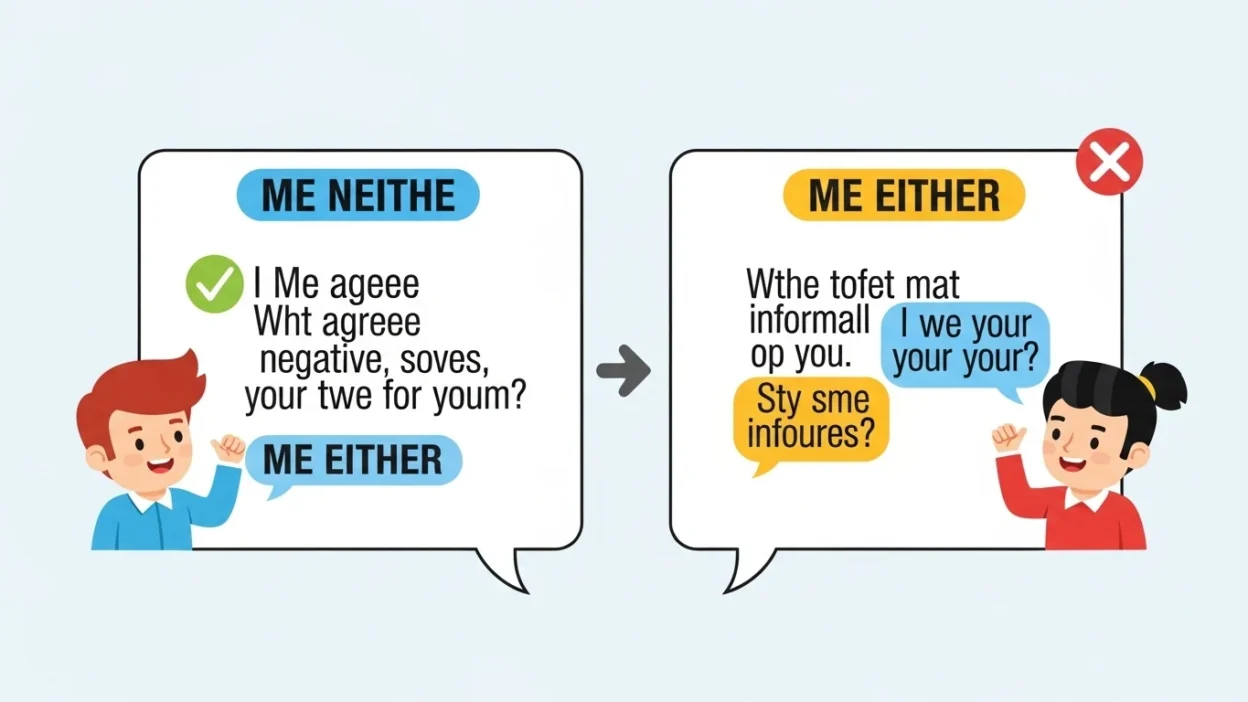
- ✅ Me neither → Correct way to agree with a negative sentence.
- ❌ Me either → Informal, casual speech; not recommended in writing or formal situations.
- Remember: Negative sentence → Me neither | Positive sentence → Me too
Examples:
- “I don’t like coffee.” → “Me neither.” ✅
- “I like coffee.” → “Me too.” ✅
- Informal speech: “I don’t like coffee.” → “Me either.” ❌ (only casual, spoken English)
Origin / Background
The confusion comes from the word either, which originally means “one or the other.”
- Some native speakers began saying “me either” instead of “me neither” in casual conversations.
- Traditional English grammar keeps “me neither” as the correct standard response.
Key tip for learners: Always use me neither when you are unsure.
The Difference Between Me Either and Me Neither
| Phrase | Correct Use | Meaning | Notes & Tips |
| Me neither | ✅ Correct | I also do not / agree with a negative | Standard in writing, speech, emails, social media |
| Me either | ❌ Usually incorrect | Informal use in casual speech | Avoid in ESL learning, exams, or formal writing |
| Me too | ✅ Correct | I also do / agree with a positive | Used for positive sentences |
| Neither do I | ✅ Correct | Formal version of “me neither” | Good for essays, reports, and advanced learners |
Which One to Use and When
Use “me neither”:
- Formal writing, emails, essays
- Classroom or work conversations
- Any time you want to be correct in English grammar
“Me either” is only informal:
- Casual chats with friends
- Text messages, casual social media comments
- Dialectal usage (more common in American English)
Advanced tip: You can also use “neither do I” to sound more formal:
- “I don’t like sushi.” → “Neither do I.”
Common Mistakes to Avoid
- Using me either in writing
- ❌ “I don’t like pizza.” → “Me either.”
- ✅ Correct: “I don’t like pizza.” → “Me neither.”
- ❌ “I don’t like pizza.” → “Me either.”
- Agreeing with positive sentences using me neither
- ❌ “I like chocolate.” → “Me neither.”
- ✅ Correct: “I like chocolate.” → “Me too.”
- ❌ “I like chocolate.” → “Me neither.”
- Mixing positive/negative responses
- Remember: Negative → Me neither | Positive → Me too
- Remember: Negative → Me neither | Positive → Me too
Everyday Real Life Examples
Emails / Work:
- “I’m not available for the meeting tomorrow.” → “Me neither. I have another appointment.”
Social Media / Casual Posts:
- Tweet: “I hate traffic jams!” → Reply: “Me neither! They are the worst.”
Daily Conversations:
- Friend: “I can’t swim.” → “Me neither.”
- Colleague: “I haven’t finished the report.” → “Me neither.”
Incorrect examples to avoid:
- “I don’t like spicy food.” → “Me either.” ❌
- “I like ice cream.” → “Me neither.” ❌
Short Learning Section: Step-by-Step for Students
Step 1: Check if the sentence is negative.
- Example: “I don’t like apples.” → Negative ✔
Step 2: Respond with me neither
- “Me neither.” → Correct
Step 3: Positive sentence → respond with me too
- “I like apples.” → “Me too.” → Correct
Mini Exercise: Fill in the blank:
- “I don’t watch TV.” → “_____ neither.”
- “I love pizza.” → “_____ too.”
- “I haven’t finished my homework.” → “_____ neither.”
Answers: 1) Me 2) Me 3) Me
FAQ: People Also Ask
1. Can I say “me either” in English?
- Yes, in informal, casual conversations, but it is not standard or correct in writing.
2. When do I use “me neither”?
- When agreeing with negative sentences. Example: “I don’t eat meat.” → “Me neither.”
3. Can “me neither” be used in emails?
- Yes! It is correct in emails, social media, and formal writing.
4. What is the difference between “me neither” and “neither do I”?
- “Me neither” → casual/formal spoken English
- “Neither do I” → formal, written, or advanced usage
5. Should I use “me too” for negative sentences?
- No. Me too is only for positive sentences. Negative sentences need me neither.
6. Why do some people say “me either”?
- It is a casual, regional form mainly in American English. Avoid in formal writing.
7. Can beginners use “me neither” safely?
- Yes! Me neither works in almost all situations for negative agreement.
8. Are there other alternatives to “me neither”?
- Yes: “Neither do I,” or simply repeating the negative verb: “I don’t either.”
Advanced Notes for Learners
- Regional differences: “Me either” is more common in American informal speech. British English usually sticks to me neither.
- Mixing with positive sentences: Never use me neither for positive statements. Instead, use me too.
- Alternative phrasing: You can also say “I don’t either” for casual conversation.
Conclusion
Me neither is the safe, correct, and standard choice when agreeing with a negative sentence. Me either exists only in casual speech and should be avoided in formal writing, exams, and learning English as a second language.
Quick Rule:
- Negative sentence → Me neither
- Positive sentence → Me too
By following this rule, you’ll confidently use everyday English expressions, avoid common mistakes, and sound natural in spoken and written English.