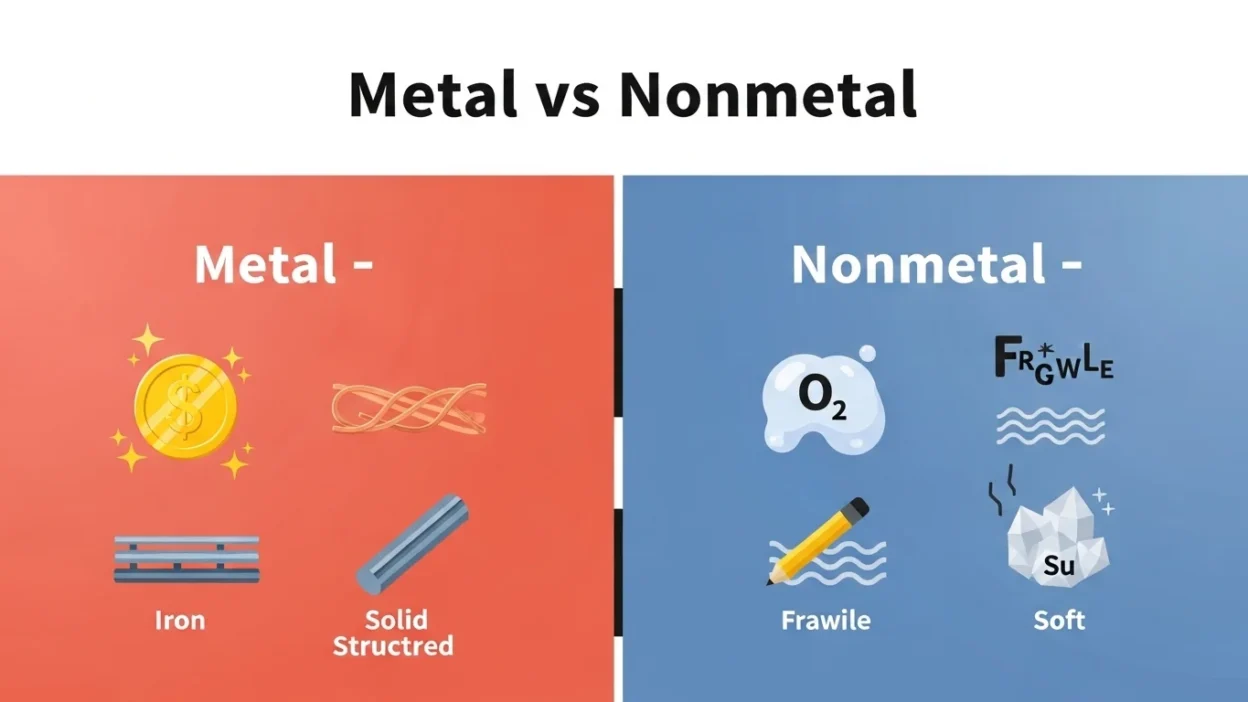
Many students get confused about metal vs nonmetal. They see elements like iron, gold, oxygen, and carbon and wonder:
“What makes metals different from nonmetals?”
Understanding the difference between metal and nonmetal is important in science and everyday life. In this guide, you will learn their properties, examples, uses, and simple rules to remember them.
Quick Answer
- Metals: Shiny, strong, conduct heat and electricity, malleable
- Nonmetals: Dull, weak or brittle, poor conductors, often gases
👉 Simple idea:
- Metals = strong and shiny
- Nonmetals = fragile or dull
Simple Background
All elements are divided into groups on the periodic table:
- Metals are mostly on the left and center
- Nonmetals are on the right
Knowing this helps you quickly identify if an element is a metal or nonmetal.
Metals vs nonmetals examples in real life:
- Metals: Iron in buildings, gold in jewelry, copper in wires
- Nonmetals: Oxygen in air, carbon in pencils, sulfur in chemicals
Clear Explanation of the Difference
What Are Metals?
Metals are elements that are:
- Shiny (reflect light)
- Strong and hard
- Malleable (can be shaped)
- Ductile (can be stretched into wires)
- Good conductors of heat and electricity
Examples of Metals
- Iron
- Copper
- Gold
- Silver
Why metals conduct electricity:
Metals have free-moving electrons, which carry electricity easily.
Uses of metals:
- Electric wires (copper)
- Machines and buildings (iron)
- Jewelry (gold and silver)
What Are Nonmetals?
Nonmetals are elements that are:
- Not shiny
- Weak or brittle
- Often gases or soft solids
- Poor conductors of heat and electricity
Examples of Nonmetals
- Oxygen (gas)
- Carbon (solid)
- Sulfur (solid)
- Nitrogen (gas)
Why nonmetals don’t conduct electricity:
Their electrons are tightly bound, so they cannot move freely.
Uses of nonmetals:
- Oxygen for breathing
- Carbon in pencils, fuels, and life forms
- Sulfur in chemicals
Comparison Table
| Feature | Metals | Nonmetals |
| Appearance | Shiny | Dull |
| Strength | Strong | Weak or brittle |
| Malleability | Yes (can be shaped) | No |
| Ductility | Yes (can be stretched into wires) | No |
| Conductivity | Good (heat & electricity) | Poor |
| State at room temp | Mostly solid (except mercury) | Solid, liquid, or gas |
| Examples | Iron, Copper, Gold | Oxygen, Carbon, Sulfur |
| Periodic Table | Left/Center | Right |
Quick Decision Guide (Memory Trick)
Step 1: Look at the element’s location
- Left or center → likely metal
- Right → likely nonmetal
Step 2: Ask yourself about the properties
- Shiny, strong, conducts electricity → metal
- Dull, brittle, poor conductor → nonmetal
Step 3: Use a simple sentence to remember
“Metals shine and bend, nonmetals break and don’t send (electricity).”
Common Mistakes Students Make
- Thinking all solids are metals → ❌ Some solids are nonmetals (carbon, sulfur)
- Thinking all nonmetals are gases → ❌ Some nonmetals are solid (carbon, sulfur)
- Mixing properties → ❌ Metals conduct electricity, nonmetals usually don’t
Everyday Real Life Examples
At Home
- Cooking pot → metal
- Air → nonmetal
In School
- Pencil (carbon) → nonmetal
- Desk (metal parts) → metal
In Daily Life
- Jewelry → metal
- Oxygen for breathing → nonmetal
In Technology
- Wires → metal
- Batteries (chemicals) → nonmetals
Practice Questions
Fill in the blanks:
- Iron is a ______
- Oxygen is a ______
- Metals are ______ conductors
- Nonmetals are ______ conductors
- Metals can be shaped → ______
- Nonmetals break easily → ______
Answers:
- metal
- nonmetal
- good
- poor
- yes
- yes
FAQ (Simple Questions & Answers)
1. What is the difference between metal and nonmetal?
Metals are shiny, strong, and conduct electricity. Nonmetals are dull, weak, and poor conductors.
2. Are all metals solid?
No, mercury is a liquid at room temperature.
3. Are all nonmetals gases?
No, some nonmetals like carbon and sulfur are solids.
4. Why are metals shiny?
Metals reflect light due to their structure.
5. Why do nonmetals not conduct electricity?
Their electrons are tightly bound and cannot move freely.
6. Can an element be both metal and nonmetal?
Yes, these are called metalloids (like silicon), which have properties of both.
7. Where are metals and nonmetals on the periodic table?
Metals → left and center, Nonmetals → right
8. What are some real life uses of metals and nonmetals?
Metals → wires, buildings, jewelry
Nonmetals → breathing (oxygen), pencils (carbon), chemicals (sulfur)
Conclusion
Now you understand metal vs nonmetal and their key differences.
Final Rule to Remember:
- Metals = shiny, strong, malleable, ductile, conduct electricity
- Nonmetals = dull, weak, brittle, poor conductors
With this guide, you can easily identify elements and remember the difference between metal and nonmetal for school, exams, and real life.

David Robert is a passionate innovator driven by creativity, vision, and purpose. He turns bold ideas into impactful realities through focus, leadership, and dedication.