Many learners get confused about midday vs mid day. Are they the same? Which one is correct?
This guide explains the difference between midday and mid day, shows midday vs mid day meaning, teaches the correct spelling of midday, and gives real life examples, tips, and exercises.
By the end, you’ll confidently use midday in any situation.
Why People Get Confused About Midday vs Mid Day
- Both sound similar when spoken.
- Beginners often wonder about midday vs mid day meaning.
- Some casual texts use mid day with a space, creating confusion.
Quick Tip: Always write it as midday, because it’s the standard English spelling.
Quick Answer: Midday vs Mid Day
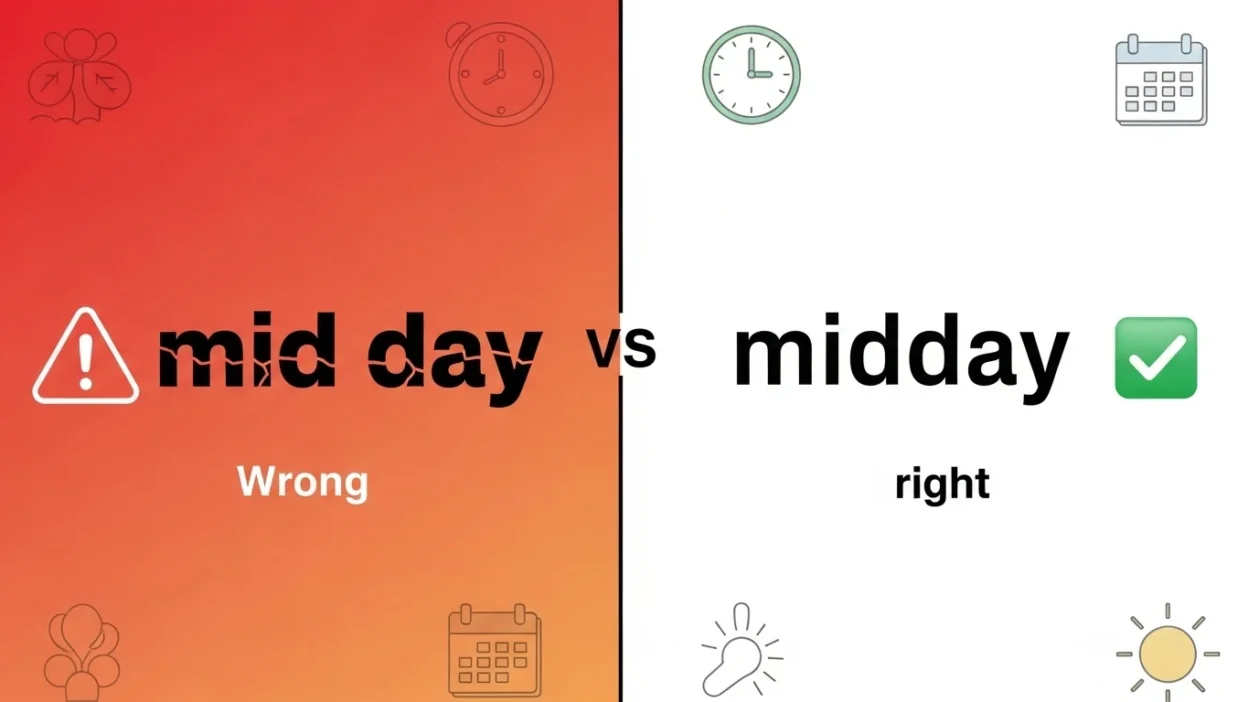
- Midday – ✅ Correct spelling for 12:00 PM, noon, or the middle of the day.
- Mid day – ❌ Incorrect spelling. Avoid it.
Examples:
- Correct: “We will meet at midday.” ✅
- Wrong: “We will meet at mid day.” ❌
Memory Trick: Think “middle of the day → one word → midday”.
Midday vs Mid Day Meaning and Background
- Midday comes from Old English “mid dæg”, meaning middle of the day.
- Over time, the two words merged into the standard spelling midday.
- Using mid day is common in casual writing, but it’s incorrect in formal English.
Correct spelling tip: Always use midday in emails, schedules, reports, and invitations.
Midday vs Mid Day Table: Quick Visual Guide
| Word | Correct? | Meaning | Example Sentence |
| Midday | ✅ Yes | 12:00 PM, middle of the day | “The train leaves at midday.” ✅ |
| Mid day | ❌ No | Incorrect spelling | “The train leaves at mid day.” ❌ |
Visual Cue: ✅ = green (correct), ❌ = red (incorrect)
When to Use Midday
Use midday whenever you refer to noon or the middle of the day.
Examples:
- Formal: “Please submit the report by midday tomorrow.” ✅
- Classroom: “The teacher will check homework at midday.” ✅
- Social media: “Lunch break at midday! 🍴” ✅
Tip: Think of midday as one block of time → one word.
Common Mistakes Learners Make
- Using a space incorrectly
- ❌ “We will leave at mid day.”
- ✅ “We will leave at midday.”
- ❌ “We will leave at mid day.”
- Confusing with morning or afternoon
- ❌ “I woke up at midday in the morning.” (redundant)
- ✅ “I woke up at 7:00 AM. We met at midday.”
- ❌ “I woke up at midday in the morning.” (redundant)
- Mixing styles in a document
- Avoid using both “midday” and “mid day” in the same text.
- Avoid using both “midday” and “mid day” in the same text.
Mini Practice Exercise:
- Fill in the blank: “The meeting starts at ______.” → midday
Everyday Real Life Examples of Midday vs Mid Day
Emails:
- “Please submit your assignment by midday today.” ✅
News Headlines:
- “The ceremony will begin at midday.” ✅
Social Media Posts:
- “Lunch break at midday! 🍔” ✅
Classroom / Daily Use:
- “The teacher will check homework at midday.” ✅
Pro Tip: Always write midday as one word in schedules, invitations, and notices.
Short Learning Section for Beginners
Step 1: Think of 12:00 PM or noon → one block of time
Step 2: Write it as midday
Step 3: Avoid mid day (two words)
Step 4: Practice sentences:
- “We eat lunch at midday.”
- “The meeting starts at midday.”
Mnemonic: Middle of the day → one word → midday ⏰
FAQs: Midday vs Mid Day
1. Are “midday” and “mid day” the same?
- ✅ Meaning is the same, but midday is the correct spelling.
2. Can I use “mid day” in casual writing?
- ❌ It’s better to always use midday to avoid mistakes.
3. Is “midday” formal English?
- ✅ Yes, it works in emails, news, schedules, and school writing.
4. Does “midday” refer exactly to 12:00 PM?
- Usually yes, but it can also mean around noon or the middle of the day.
5. Can I split “midday” in a sentence?
- ❌ No. Always write as one word.
6. How do I remember the correct spelling?
- Think: middle of the day → one block → one word → midday
7. Can “midday” be used instead of “mid-afternoon”?
- ✅ Not exactly. Midday = 12:00 PM, while mid-afternoon = ~2–3 PM.
8. Can beginners confuse “midday vs noon”?
- ✅ Yes, but noon and midday are often interchangeable for 12:00 PM.
Conclusion
- Midday → ✅ Correct spelling for noon or the middle of the day
- Mid day → ❌ Incorrect, avoid it
Always remember: one block of time = one word → midday. Practice using it in emails, schedules, classroom instructions, and social media posts to never get it wrong.
Key Takeaway:
- Noon or middle of the day → midday (one word)
- Never split it → no “mid day”

Michael is a passionate thinker and visionary creator who turns ideas into action. With focus and integrity, he strives to make every project purposeful and inspiring.