Many people feel confused when they see the words minuscule and miniscule. They look almost the same, sound almost the same, and seem to mean the same thing.
Because of this, students, learners and even native English speakers often use them in the wrong way.
The good news is that the difference is very simple. Once you understand it, you will never feel confused again.
This guide explains everything in easy English, step by step, so you can understand it clearly on the first read.
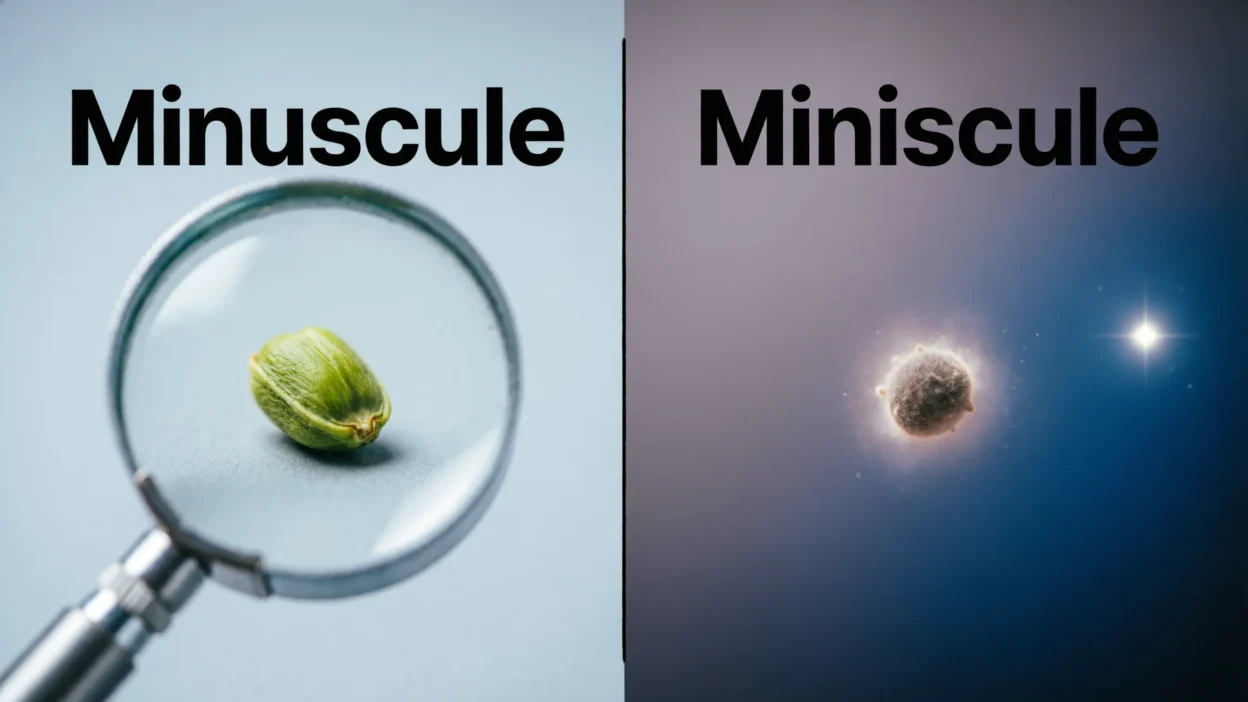
Quick Answer:
- Minuscule → Correct word
It means very small. - Miniscule → Incorrect spelling
It is a common mistake and should not be used.
In short:
✔ Use minuscule
❌ Do not use miniscule
Simple Origin and Background
To understand why minuscule is correct, it helps to know a little about its history.
The word minuscule comes from Latin and originally meant small letter. In old writing, minuscule letters were the small letters, while majuscule letters were the capital letters.
Over time, the meaning became broader, and minuscule started to mean very tiny or extremely small.
The word miniscule came from confusion. People mixed up minuscule with words like:
- minimum
- mini
- minute
Because of this mix-up, the incorrect spelling miniscule became common in everyday writing.
Clear Explanation of the Difference
Let’s explain the difference in the simplest way:
Minuscule (Correct)
- Meaning: Very small
- Example:
- There is a minuscule chance of rain today.
Miniscule (Incorrect)
- Meaning: None — it is a spelling mistake
- Example:
- ❌ There is a miniscule chance of rain today.
Even though miniscule looks logical, it is not correct English.
Comparison Table: Easy to Scan
| Feature | Minuscule | Miniscule |
| Correct spelling | Yes | No |
| Meaning | Very small | No real meaning |
| Used in formal writing | Yes | No |
| Accepted in dictionaries | Yes | No |
| Safe to use | Yes | No |
Which One to Use and When
You should always use “minuscule” when you want to describe something very small.
Use “minuscule” when:
- Talking about tiny amounts
- Describing small chances
- Talking about very small sizes
- Writing formal or informal English
Examples:
- She made a minuscule mistake.
- There is a minuscule amount of sugar left.
- His chances of winning are minuscule.
Never use “miniscule”
Even though many people use miniscule, it is still wrong. In exams, academic writing, business emails, and professional documents, it can lower your writing quality.
Common Mistakes People Make
Here are some common mistakes people make with these words:
1. Spelling Based on Sound
Many people spell words based on how they sound. Since minuscule sounds like mini, people write miniscule by mistake.
2. Confusing with Other Words
People confuse minuscule with:
- minimum
- mini
- minute
This leads to incorrect spelling.
3. Trusting Autocorrect
Some older systems and casual writing platforms allow miniscule, making people think it is correct.
4. Learning from Social Media
Many posts online contain spelling mistakes, which spreads the wrong form.
Everyday Real-Life Examples
Here are simple examples from daily life to help you understand how minuscule is used correctly.
Emails
- There is a minuscule delay in delivery.
- Only a minuscule change is needed in the report.
News
- Experts say the risk is minuscule.
- A minuscule error caused the system to stop.
Social Media
- That detail is so minuscule, no one will notice.
- There is a minuscule chance of snow today.
Daily Conversations
- The insect was minuscule in size.
- He added a minuscule amount of salt.
Short Learning Section for Students and Beginners
If you are learning English, remember this simple rule:
Minuscule = very small (correct)
Miniscule = wrong spelling
Memory Trick
Think of mini + small = minuscule
Even though it looks tricky, the spelling is minuscule, not miniscule.
Simple Practice
Fill in the blanks:
- There is a _______ chance of rain.
- She added a _______ amount of sugar.
- The text was written in _______ letters.
Correct answer for all: minuscule
FAQ Section
1. Is “miniscule” a real word?
No. Miniscule is a spelling mistake. The correct word is minuscule.
2. Why do people write “miniscule”?
Because it sounds similar to mini and minimum, people think miniscule is correct, but it is not.
3. Is “miniscule” ever accepted?
No. In standard English, only “minuscule” is correct.
4. What does “minuscule” mean in simple words?
It means very small, tiny, or almost nothing.
5. Can “minuscule” describe chances or risks?
Yes.
Example: There is a minuscule risk of error.
6. Does “minuscule” only mean small size?
No. It can describe:
- Size
- Amount
- Chance
- Importance
Example: His role was minuscule in the project.
7. Is “minuscule” formal or informal?
It works in both formal and informal English.
8. How can I avoid this mistake forever?
Just remember:
Mini = small idea, but spelling is minuscule.
Conclusion
The difference between minuscule and miniscule is very simple:
- Minuscule → correct → means very small
- Miniscule → incorrect → spelling mistake
Many people use miniscule, but that does not make it right. In good English writing, only “minuscule” should be used.
Once you remember this, you will never feel confused again.
Keep practicing, reading, and writing, and your English will continue to improve. Small steps, even minuscule ones can lead to big learning progress.

David Robert is a passionate innovator driven by creativity, vision, and purpose. He turns bold ideas into impactful realities through focus, leadership, and dedication.