Quick Answer
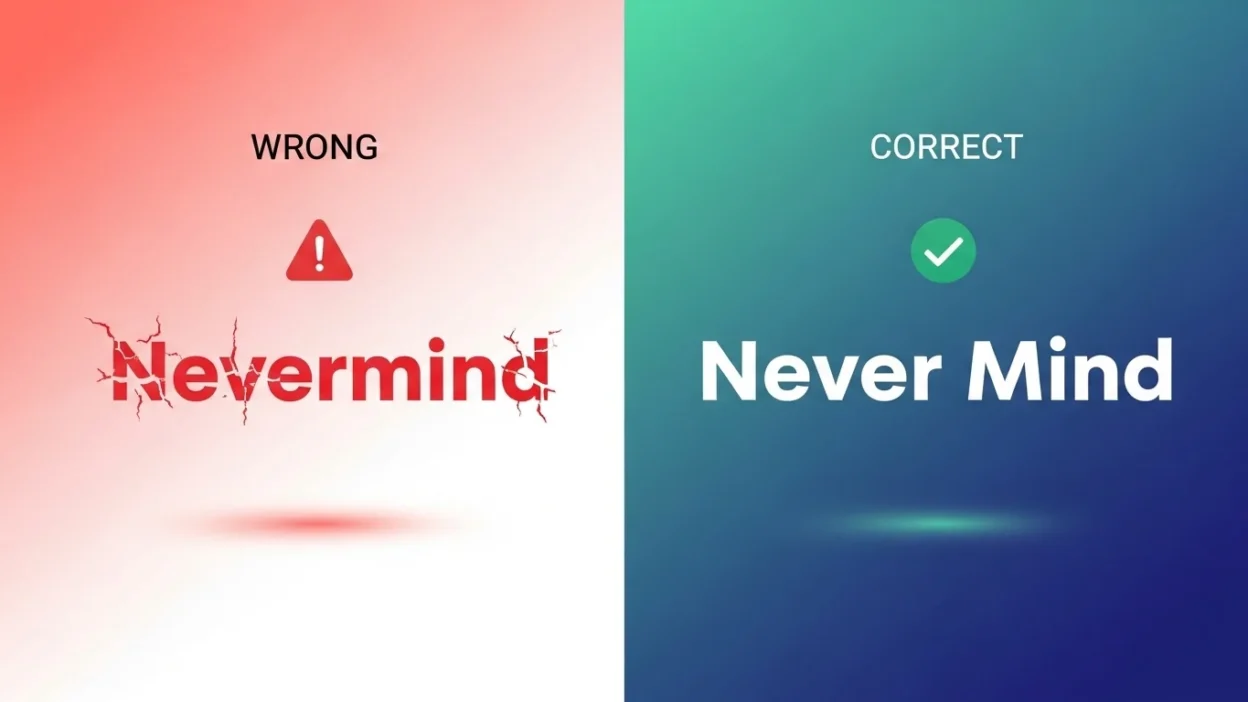
Never mind is the correct spelling in standard English.
Nevermind (one word) is considered nonstandard and incorrect in formal writing.
Always write never mind as two separate words.
Why Is There Confusion?
Many people search:
- Is nevermind one word?
- Is never mind two words?
- Should I write never mind or nevermind?
- Is nevermind correct in English?
The confusion happens because:
- Compound words in English sometimes merge (e.g., “nonetheless”).
- Texting culture shortens spellings.
- Autocorrect doesn’t always flag informal forms.
- Social media often spreads incorrect spellings.
However, grammar authorities agree on one standard form.
What Does “Never Mind” Mean?
Never Mind Meaning
Never mind is an interjection or imperative phrase that means:
- Forget it
- It doesn’t matter
- Don’t worry about it
- Ignore that
It is made of two words:
- Never (adverb)
- Mind (verb)
Together, they form an idiomatic phrase.
How to Use “Never Mind” in a Sentence
Informal Conversation
- “Never mind, I found my phone.”
- “Oh, never mind.”
Formal Writing
- “Please never mind my previous email.”
- “Never mind the earlier version of the document.”
Academic Use
- “Students should never mind minor formatting errors and focus on content clarity.”
The phrase works in:
- Exams
- Business emails
- Academic essays
- Professional communication
- Everyday speech
Is “Nevermind” Correct?
Nevermind Meaning
In standard English grammar, nevermind (one word) is not correct.
You may see it:
- In text messages
- On social media
- In casual chats
Example (informal and incorrect):
- “Nevermind, it’s fine.”
In exams, academic writing, and professional settings, this spelling would be marked wrong.
Difference Between Never Mind and Nevermind
| Feature | Never Mind | Nevermind |
| Number of words | Two | One |
| Grammatically correct? | Yes | No |
| Accepted in formal writing? | Yes | No |
| Used in exams? | Yes | No |
| Common in texting? | Yes | Sometimes |
The correct spelling of never mind is always two words.
Grammar Explanation (Why It’s Two Words)
“Never mind” functions as:
- An imperative phrase (command form)
- An interjection (expressing dismissal or correction)
Example structure:
- “Never” (adverb) modifies
- “Mind” (verb)
Because it is a phrase — not a compound noun or adjective — it stays separate.
Unlike true compound words (e.g., “notebook” or “however”), this phrase has not merged in standard English dictionaries.
What Do Dictionaries Say?
Major English dictionaries list never mind as two words.
It is not recognized as a standard single-word form in formal English usage.
This confirms that “nevermind” is considered nonstandard or informal spelling.
Never Mind vs Nevermind in Formal Writing
If you’re writing:
- Academic essays
- IELTS or TOEFL exams
- Business communication
- Research papers
- Official emails
Always use:
✔ Never mind
Never use:
✘ Nevermind
Teachers and grammar checkers will flag it as incorrect.
Is Nevermind Acceptable in Texting?
In casual texting, people sometimes write:
- “nevermind”
While common online, it remains grammatically incorrect in standard English.
If you want correct English — even in texting — use:
✔ never mind
Common Mistakes With Never Mind
❌ “Nevermind about it.”
✔ “Never mind about it.”
❌ “Please nevermind my earlier message.”
✔ “Please never mind my earlier message.”
❌ “Nevermind, I understand now.”
✔ “Never mind, I understand now.”
These are typical learner mistakes caused by compound word confusion.
Related Confusions in English
English learners often confuse:
- Compound words vs open compounds
- Informal vs formal spelling
- Texting language vs academic English
“Never mind vs nevermind” is similar to other spelling confusion topics like:
- Sneaked vs snuck
- Segway vs segue
- Gases vs gasses
Understanding grammar structure helps avoid these errors.
When Should You Use “Never Mind”?
Use it when you want to:
✔ Cancel a request
✔ Correct yourself
✔ Tell someone not to worry
✔ Dismiss something unimportant
Examples:
- “Never mind, I solved the issue.”
- “Never mind the background noise.”
- “Never mind what others think.”
FAQ Section
Is nevermind one word?
No. The correct form is two words: never mind.
Is never mind two words?
Yes, always.
Should I write never mind or nevermind?
Write never mind in all formal and standard English contexts.
Is nevermind correct in English?
It is considered nonstandard and incorrect in formal grammar.
Can you write nevermind in exams?
No. It may reduce your marks.
Final Verdict
The difference between never mind and nevermind is simple:
- Never mind → Correct, standard English
- Nevermind → Informal, nonstandard spelling
If you want correct grammar in writing, exams, or professional communication:
👉 Always use never mind (two words).

Daniel Matthew is a passionate visionary who believes in creativity, purpose, and innovation. With a focus on growth and authenticity, he turns every idea into meaningful impact.