Many people feel confused when they see on to and onto. They look almost the same, sound the same, and are often used in similar sentences. Because of this, students, learners and even native English speakers sometimes mix them up.
But the good news is this: the difference between on to and onto is actually very simple. Once you understand a few easy rules and examples, you will be able to use both of them correctly without stress.
In this guide, we will explain everything in very simple English, with clear examples and easy rules. By the end, you will feel confident and relaxed when using on to and onto.
Quick Answer: The Simple Difference
Here is the short and clear answer:
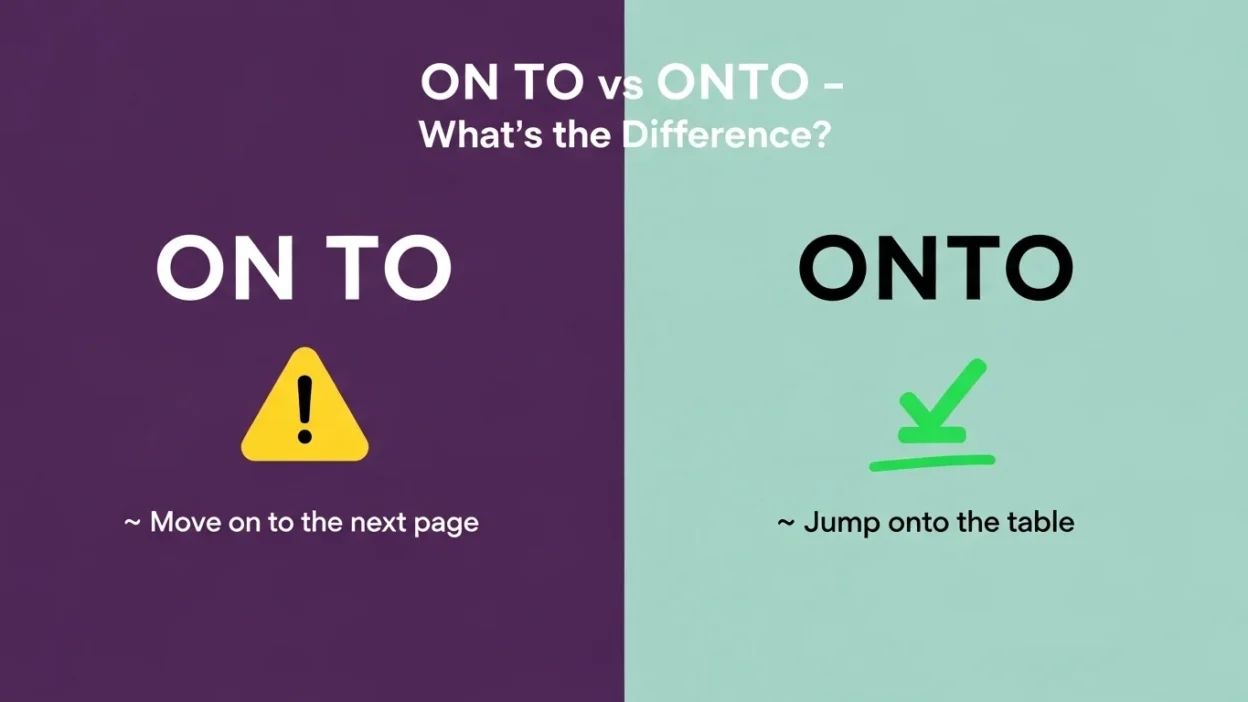
- Onto = movement to a surface
- On to = moving forward to the next step, topic, or action
In simple words:
- Use onto when something moves and lands on a surface.
- Use on to when you move forward to another activity, idea, or part.
Examples:
- The cat jumped onto the table.
- Let’s move on to the next question.
That’s it! Now let’s understand this more deeply.
Simple Background: Where Do These Words Come From?
Long ago, English had many short words that slowly joined together over time. The word onto is a combination of:
- on + to
At first, people wrote them as two separate words: on to. Later, when the meaning became clear and fixed, onto became one word.
But even today, both forms are still correct, depending on the meaning of the sentence.
So, onto became a single word for physical movement, while on to stayed as two words for progress or transition.
Clear Explanation of the Difference
Let’s explain both words in very simple terms.
What Does “Onto” Mean?
Onto is used when something moves from one place and lands on a surface.
Think about:
- jumping
- climbing
- stepping
- falling
If there is movement toward a surface, use onto.
Examples:
- The boy climbed onto the roof.
- She dropped the keys onto the floor.
- The baby crawled onto the bed.
Here, something moves and touches a surface.
What Does “On To” Mean?
On to is used when you move forward to the next thing. It is about progress, change, or next steps, not physical movement.
Think about:
- changing topics
- moving to the next step
- continuing a process
- finishing one thing and starting another
Examples:
- Let’s move on to the next chapter.
- He went on to explain his idea.
- After lunch, we moved on to our homework.
Here, there is no physical surface involved. It is about progress or change.
Comparison Table: On To vs Onto
| Feature | Onto | On to |
| Meaning | Movement to a surface | Moving to the next step |
| Type | One word | Two words |
| Physical movement | Yes | No |
| Used for ideas or topics | No | Yes |
| Example | Jumped onto the bed | Move on to the next task |
Which One Should You Use and When?
Use this simple test:
Ask yourself: Is there movement onto a surface?
- If yes → use onto
- If no → use on to
More Simple Rules
Use onto when:
- Someone or something moves and touches a surface.
- There is clear physical action.
Use on to when:
- You change topics.
- You continue to the next step.
- You talk about progress or plans.
Examples:
- The bird flew onto the tree branch.
- Now let’s move on to today’s lesson.
Common Mistakes People Make
Let’s look at some common mistakes and how to fix them.
Mistake 1: Using “onto” for ideas or topics
❌ Let’s move onto the next topic.
✅ Let’s move on to the next topic.
Why? There is no physical movement. It is a topic change.
Mistake 2: Using “on to” for physical movement
❌ The cat jumped on to the table.
✅ The cat jumped onto the table.
Why? The cat moves and lands on a surface.
Mistake 3: Thinking they are always the same
They are not always the same. The meaning changes based on movement or progress.
Everyday Real Life Examples
Here are examples from daily life to help you understand better.
Emails
- Let’s move on to the next point in the meeting.
- Please upload the files onto the shared folder.
School and Study
- After reading this page, move on to the next lesson.
- The student climbed onto the stage to receive his award.
Social Media
- Let’s move on to happier news.
- He posted the photo onto his profile.
Daily Life
- The child jumped onto the sofa.
- She went on to finish her homework.
News Style
- The leader moved on to discuss future plans.
- Protesters climbed onto the building.
Short Learning Section for Students and Beginners
Here is a very easy way to remember:
Memory Trick
- Onto = On + Surface
- On to = On + Next Step
Practice Exercise
Choose the correct word:
- The frog jumped ___ the leaf.
- Let’s move ___ the next question.
- He stepped ___ the bus.
- After the break, we went ___ our work.
Answers:
- onto
- on to
- onto
- on to
FAQ: Simple Questions and Clear Answers
1. Are “on to” and “onto” always different?
No. They look similar, but they have different meanings. The meaning depends on movement or progress.
2. Can I always replace “onto” with “on to”?
No. If there is physical movement to a surface, use onto only.
3. Is “onto” one word or two?
Onto is one word.
On to is two separate words.
4. Which one is more common?
Both are common. It depends on the sentence and meaning.
5. How can I check which one is correct?
Ask:
Is something moving onto a surface?
If yes → onto
If no → on to
6. Can both ever be correct in one sentence?
In some rare cases, yes, but the meaning changes. Usually, one is clearly better.
7. Is this rule easy for beginners?
Yes! With simple practice and examples, anyone can learn it easily.
Conclusion: Simple and Clear Final Thought
The difference between on to and onto may seem confusing at first, but it is actually very easy once you understand the idea.
Just remember:
- Onto = movement to a surface
- On to = moving forward to the next step or idea
With this simple rule, you can use both forms correctly in writing, speaking, school work, emails, and daily conversation.
Practice a little every day, and soon, using on to and onto will feel natural and easy. 😊

Daniel Matthew is a passionate visionary who believes in creativity, purpose, and innovation. With a focus on growth and authenticity, he turns every idea into meaningful impact.