Many people feel confused about the words patient and patience. They look and sound very similar.
They also come from the same root word, which makes the confusion even bigger. Students, learners, and even native speakers sometimes mix them up.
But the good news is this: once you understand the simple difference, you will never feel confused again.
This guide explains everything in very easy English, with clear examples, short sentences, and real-life situations. By the end, you will know exactly when to use patient and when to use patience.
Quick Answer: Patient vs Patience
Here is the simple answer in bullet points:
- Patient is usually a person or a description of a person.
- Patience is a quality, feeling, or ability.
More simply:
- Patient = a person OR how a person behaves
- Patience = the ability to stay calm and wait
Examples:
- She is a patient teacher.
- He has a lot of patience.
Simple Origin and Background
Both words come from the same old root word that means to suffer, endure, or wait calmly.
Over time, this root word created two different forms:
- Patient became a noun and an adjective
- Patience became a noun
This is why they look similar but have different jobs in sentences.
You do not need to remember history to use them correctly. Just remember their simple meanings.
Clear Explanation of the Difference
Let us understand each word separately.
What Does “Patient” Mean?
The word patient has two main meanings:
1. A Person Receiving Medical Care (Noun)
A patient is someone who is sick or injured and gets help from a doctor or nurse.
Examples:
- The patient is waiting to see the doctor.
- The hospital has many patients today.
2. A Calm and Understanding Person (Adjective)
When we say someone is patient, we mean they can wait calmly without getting angry or upset.
Examples:
- She is very patient with children.
- Please be patient while I finish my work.
What Does “Patience” Mean?
The word patience is a noun. It means the ability to wait calmly, even when something is slow, difficult, or annoying.
Examples:
- You need patience to learn a new language.
- His patience helped him solve the problem.
In simple words:
- Patience is the power to stay calm and wait.
The Real Difference in Simple Terms
Here is the easiest way to remember:
- Patient = a person OR how someone behaves
- Patience = the ability or quality of staying calm
Think like this:
- A patient person has patience.
Comparison Table: Patient vs Patience
| Feature | Patient | Patience |
| Part of speech | Noun / Adjective | Noun |
| Meaning | A sick person OR calm person | Ability to wait calmly |
| Refers to | A person | A quality |
| Example | She is a patient nurse. | She has great patience. |
| Medical meaning | Yes | No |
Which One to Use and When
Use “Patient” When:
- You talk about a sick person
- You describe someone as calm and understanding
Examples:
- The patient is resting.
- Please be patient.
Use “Patience” When:
- You talk about the ability to wait calmly
- You talk about self-control and calm behavior
Examples:
- Thank you for your patience.
- Learning needs patience.
Common Mistakes People Make
Here are some mistakes people often make, with corrections.
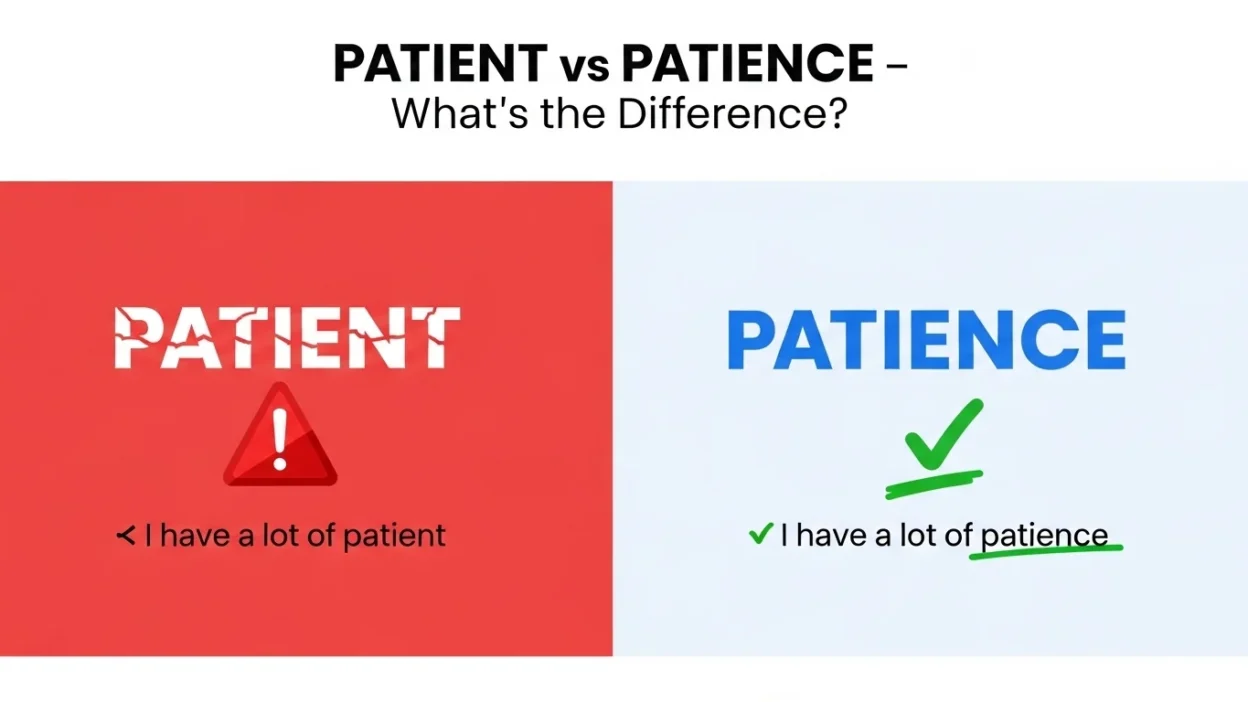
❌ Wrong:
She has a lot of patient.
✅ Correct:
She has a lot of patience.
❌ Wrong:
Thank you for being patience.
✅ Correct:
Thank you for being patient.
❌ Wrong:
The doctor talked to the patience.
✅ Correct:
The doctor talked to the patient.
❌ Wrong:
Please show patient.
✅ Correct:
Please show patience.
Everyday Real-Life Examples
1. In Emails
- Thank you for your patience while we check your order.
- Please be patient. We will reply soon.
2. In News
- The hospital treated many patients after the accident.
- The teacher showed great patience with slow learners.
3. On Social Media
- Be patient. Good things take time.
- Success needs patience and hard work.
4. In Daily Life
- Parents need patience when teaching children.
- A patient driver stays calm in traffic.
5. At School
- The teacher is very patient.
- Students must have patience while learning.
Short Learning Section for Students and Beginners
Here is a simple way to practice:
Remember This Easy Rule
- Patient = person
- Patience = power to wait
Mini Practice
Fill in the blanks:
- The doctor helped the __________.
- Thank you for your __________.
- Please be __________.
- Learning English needs __________.
Answers:
- patient
- patience
- patient
- patience
FAQ Section: Simple Questions and Answers
1. Is patient a noun or an adjective?
It is both.
- Noun: a sick person
- Adjective: calm and understanding
2. Is patience a person?
No. Patience is a quality or ability, not a person.
3. Can we say “very patience”?
No. You should say “a lot of patience” or “great patience.”
4. Can we say “patient person”?
Yes. This is correct and very common.
5. Which one means waiting calmly?
Patience means the ability to wait calmly.
6. Which one is used in hospitals?
Patient is used for people getting medical care.
7. Can both words be in one sentence?
Yes.
Example: A patient person has patience.
8. How can I remember the difference easily?
Remember:
- Patient = person
- Patience = power to wait
Conclusion
The difference between patient and patience is easy once you understand their basic meanings.
- Patient is about a person or how someone behaves.
- Patience is about the ability to stay calm and wait.
If you remember this simple rule, you will never confuse these two words again.
Language becomes easy when learning is simple, calm, and clear. Keep practicing, stay patient, and build your patience step by step.

David Robert is a passionate innovator driven by creativity, vision, and purpose. He turns bold ideas into impactful realities through focus, leadership, and dedication.