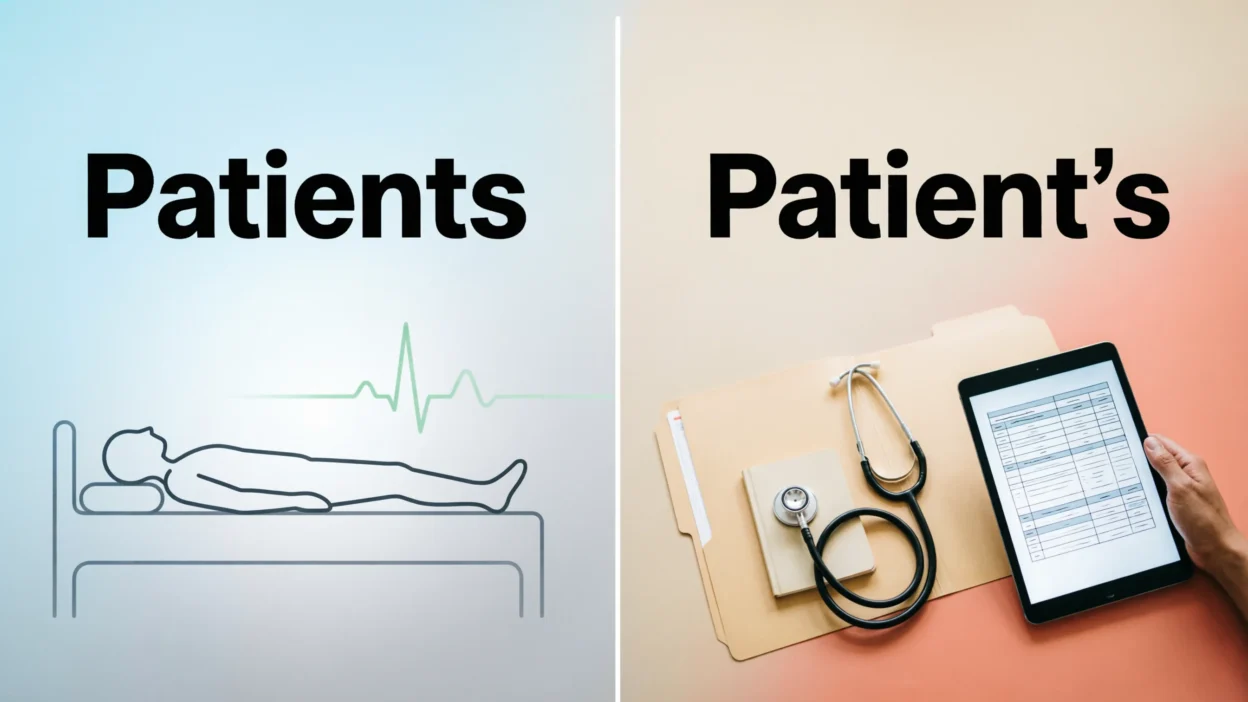
Many students, English learners, and even native speakers feel confused when they see patients and patient’s.
These two forms look very similar, but they have very different meanings. The main reason for confusion is the apostrophe (’).
A small mark like this can completely change the meaning of a word.
In simple words:
- patients means more than one patient
- patient’s shows belonging or ownership by one patient
This article explains the difference in very easy English, using clear examples and simple rules. By the end, you will fully understand when to use each form without confusion.
Quick Answer – Simple and Clear
- patients → plural form → means many patients
- Example: The hospital treats many patients.
- patient’s → possessive form → means something belongs to one patient
- Example: The patient’s report is ready.
Simple rule:
- No apostrophe → more than one person
- Apostrophe + s → ownership or belonging
Simple Origin and Background Explanation
To understand the difference, we need to know two simple grammar ideas:
1. Plural Form
This means more than one.
- One patient → patient
- More than one → patients
We add s to make most English words plural.
2. Possessive Form
This shows belonging or ownership.
- The bag of the patient → the patient’s bag
- The room of the patient → the patient’s room
We add ’s to show that something belongs to someone.
This is why patients and patient’s look similar but mean different things.
Clear Explanation of the Difference
Let’s explain both forms one by one.
Patients (Plural Form)
Meaning:
More than one patient.
Used when:
You are talking about two or more people who receive medical care.
Examples:
- The doctor sees many patients every day.
- The hospital is full of patients.
- Nurses help patients feel better.
Simple idea:
No apostrophe → more than one person
Patient’s (Possessive Form)
Meaning:
Something belongs to one patient.
Used when:
You want to show ownership, relationship, or connection.
Examples:
- The patient’s medicine is on the table.
(The medicine belongs to the patient.) - The patient’s family arrived.
(The family of the patient.) - The patient’s report is ready.
Simple idea:
Apostrophe + s → shows belonging
Comparison Table – Easy to Understand
| Form | Meaning | Use | Example |
| patients | More than one patient | Plural form | Many patients are waiting. |
| patient’s | Belonging to one patient | Possessive form | The patient’s file is here. |
Which One to Use and When
Here is a simple way to decide:
Use “patients” when:
- You are talking about two or more people
- You are counting or describing a group
Examples:
- The clinic helps patients every day.
- Many patients are waiting outside.
- The nurse talks to patients kindly.
Use “patient’s” when:
- You want to show ownership or belonging
- You are talking about something connected to one patient
Examples:
- The patient’s room is clean.
- The patient’s test result is good.
- The patient’s pain is less now.
Common Mistakes People Make
Many learners make small but common mistakes. Let’s fix them.
Mistake 1: Using apostrophe for plural
❌ The doctor saw many patient’s today.
✅ The doctor saw many patients today.
Why?
Because you are talking about many people, not ownership.
Mistake 2: Forgetting apostrophe for possession
❌ The patients report is missing.
✅ The patient’s report is missing.
Why?
Because the report belongs to one patient.
Mistake 3: Mixing up meaning
❌ The nurse checked the patients temperature.
✅ The nurse checked the patient’s temperature.
Why?
Because the temperature belongs to one patient.
Everyday Real-Life Examples
Let’s see how these words are used in daily life.
Emails
- The doctor emailed about patients waiting for results.
- Please send the patient’s file by evening.
News
- Hospitals are treating more patients this winter.
- The patient’s condition is improving.
Social Media
- Nurses work hard to help patients.
- Praying for the patient’s recovery.
Daily Use
- Many patients visit this clinic.
- The patient’s medicine is ready.
Short Learning Section for Students and Beginners
Here is a simple learning trick:
Ask yourself two questions:
- Am I talking about more than one person?
→ Use patients - Am I talking about something belonging to one patient?
→ Use patient’s
Easy Practice
Fill in the blanks:
- The nurse helped three __________.
→ patients - The __________ bag is on the chair.
→ patient’s - Many __________ are waiting outside.
→ patients - The __________ report is ready.
→ patient’s
FAQ – Simple Questions and Clear Answers
1. What does “patients” mean?
Answer:
It means more than one patient.
Example:
Many patients are in the hospital.
2. What does “patient’s” mean?
Answer:
It shows something belongs to one patient.
Example:
The patient’s room is clean.
3. Is “patients’” also correct?
Answer:
Yes. patients’ shows something belongs to many patients.
Example:
The patients’ rooms are clean.
(Rooms of many patients)
4. How do I know when to use apostrophe?
Answer:
Use apostrophe when you want to show belonging or ownership.
5. Can “patients” ever show ownership?
Answer:
No. Without an apostrophe, it only means more than one patient.
6. Why does English use apostrophes for possession?
Answer:
To make sentences shorter and clearer.
Instead of:
The bag of the patient
We say:
The patient’s bag
7. Is this rule only for “patient”?
Answer:
No. This rule works for all nouns.
Examples:
- student → students / student’s
- doctor → doctors / doctor’s
- teacher → teachers / teacher’s
Conclusion
The difference between patients and patient’s is simple when you understand the basic rule.
- patients → more than one patient
- patient’s → something belongs to one patient
Always remember:
- No apostrophe = plural (many people)
- Apostrophe + s = possession (belonging)
With this simple rule, you can now use patients and patient’s correctly in writing, speaking, emails, exams, and daily life.
Practice a little every day, and soon this difference will feel easy and natural.

Daniel Matthew is a passionate visionary who believes in creativity, purpose, and innovation. With a focus on growth and authenticity, he turns every idea into meaningful impact.