English can be tricky sometimes. One common confusion is between “payed” and “paid.” Many learners, and even native speakers, mix these words up.
They look similar, but their meanings are very different. Don’t worry after reading this, you will understand exactly when to use each word.
Why People Get Confused
- Both words sound almost the same.
- They are both past tense forms of verbs.
- People often assume that “payed” is a spelling mistake for “paid.”
- English learners see “pay” and try to add “-ed” to make the past tense without knowing the rule.
Understanding the difference is simple once you know the history and the correct usage.
Quick Answer: Payed vs Paid
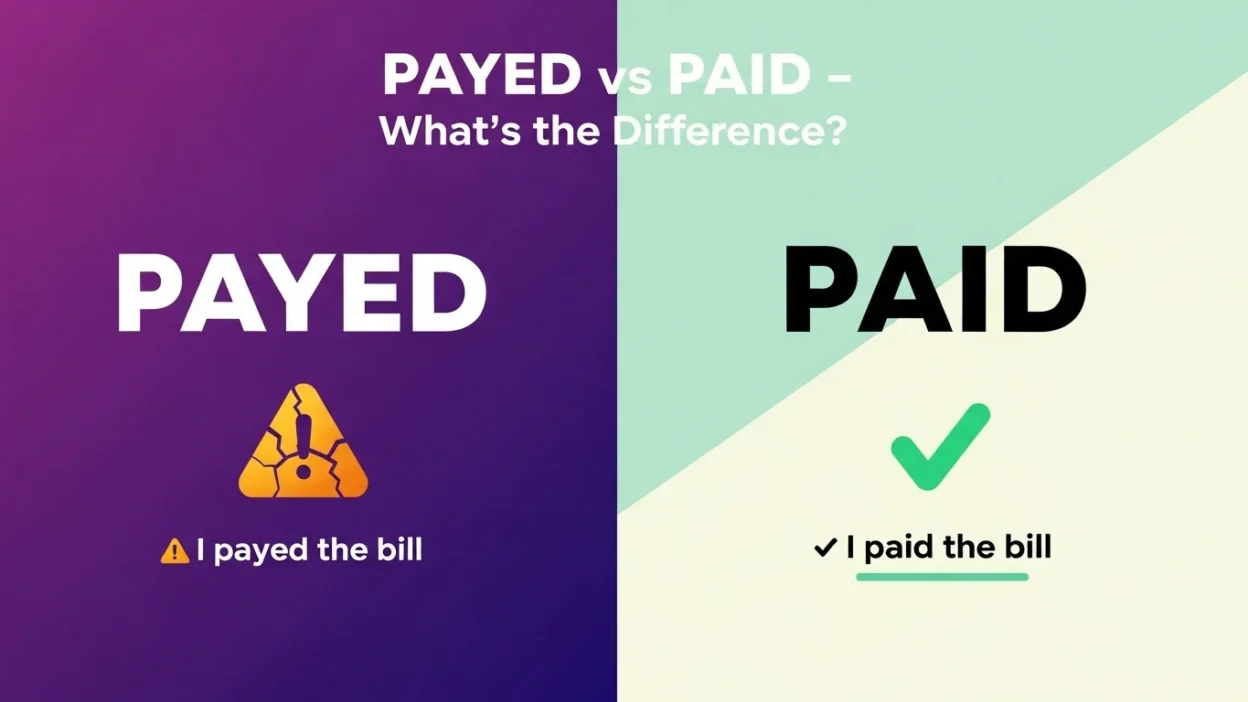
- Paid – the correct past tense of pay when talking about giving money.
Example: I paid the bill yesterday. - Payed – used in a special context in sailing, meaning to let out a rope or cord.
Example: The sailors payed out the rope slowly.
✅ Remember: Most of the time, when you talk about money, paid is correct.
Origin / Background
- Paid comes from the verb pay, which is very old in English and comes from Latin pacare, meaning “to settle a debt.” Over time, the past tense became “paid.”
- Payed comes from the verb to pay out in nautical English, meaning to let a rope slide or to coat a ship with tar. This use is very rare today, mostly in old books or sailing contexts.
This explains why you almost always see paid in everyday English.
Clear Explanation of the Difference
| Word | Use | Example Sentence |
| Paid | Past tense of “pay” (money) | I paid my rent on time. |
| Payed | Past tense of “pay” (rope, tar) | The crew payed the rope carefully. |
Paid = money ✅- Payed = rope, sailing, coating ⚓
- If you are talking about money, bills, salaries, or shopping, use paid.
- If you are reading old stories about ships or ropes, it might be payed.
Which One to Use and When
Use “paid” when:
- Talking about money.
- Referring to bills, salaries, shopping, fees, or debts.
Examples:
- I paid for my coffee.
- She paid her phone bill yesterday.
- They paid the teacher for extra lessons.
Use “payed” when:
- Talking about ropes, lines, or nautical actions.
- Rarely used in modern English outside sailing.
Example:
- The sailor payed the rope slowly into the water.
Tip: If it’s about money, always choose paid.
Common Mistakes People Make
- Writing payed instead of paid for money. ❌
Example wrong: I payed the electricity bill.
Correct: I paid the electricity bill. ✅ - Confusing past tense in casual writing. ❌
Example wrong: He payed me back.
Correct: He paid me back. ✅ - Overthinking “payed” for money situations – it is almost always wrong.
Everyday Real Life Examples
Emails:
- Correct: I paid the invoice yesterday.
- Wrong: I payed the invoice yesterday.
News headlines:
- “City paid millions for new park renovation.”
Social media:
- “Finally paid off my student loan! 🎉”
Daily conversation:
- “Did you pay the rent?” – “Yes, I paid it this morning.”
See how paid is the one you use almost everywhere except for special rope or nautical cases.
Short Learning Section for Students and Beginners
- Step 1: Remember, paid = money.
- Step 2: Remember, payed = rope / ship.
- Step 3: If unsure, think: “Am I talking about money?” → Use paid.
- Step 4: Practice: Write 3 sentences about money using paid.
Practice Examples:
- I paid my lunch bill today.
- She paid her phone subscription.
- They paid the teacher for tutoring.
After practicing, you’ll never confuse them again!
FAQ: Payed vs Paid
1. Can I use “payed” for money?
No. For money, bills, salaries, and debts, always use paid.
2. Why does “payed” exist?
It comes from old nautical English, meaning to let out a rope or coat a ship.
3. Is “paid” correct in all modern writing?
Yes, for almost every situation related to money.
4. How do I remember the difference?
Think: Money = paid, Rope/Ship = payed.
5. Do native speakers ever use “payed” incorrectly?
Sometimes in casual writing, but it is considered a mistake.
6. Can “paid” be used for other meanings?
Yes, it can also mean “settled” in non-money contexts, like “He paid the price for his mistake.”
7. Is “payed” ever used today?
Very rarely, mostly in historical or nautical contexts.
8. How do I write it in an email?
Always use paid for bills, invoices, and money-related matters.
Conclusion
The difference between payed and paid is simple once you remember the rule:
- Paid → almost always use this for money, bills, salaries, shopping, and debts.
- Payed → only for ropes, ships, or very rare nautical situations.
By sticking to paid in your daily English, emails, schoolwork, and social conversations, you will never make a mistake. It’s one of the easiest past tense rules to master!

Andrew Christopher is a passionate visionary who blends creativity with purpose to bring ideas to life. With a focus on innovation and integrity, he inspires growth and lasting impact.