Many students, learners and beginners often get confused about peices vs pieces. It’s a common spelling mistake, but don’t worry by the end of this guide, you’ll never confuse them again!
This article uses simple English, real life examples, and memory tips to make learning easy.
Why People Get Confused
People mix up peices and pieces because the letters are in the wrong order. Spelling in English can be tricky, especially for beginners. Some also confuse pieces with peace, which is a completely different word.
Don’t worry this is normal. Once you understand the rules, you can spell pieces correctly every time.
Quick Answer: Peices vs Pieces
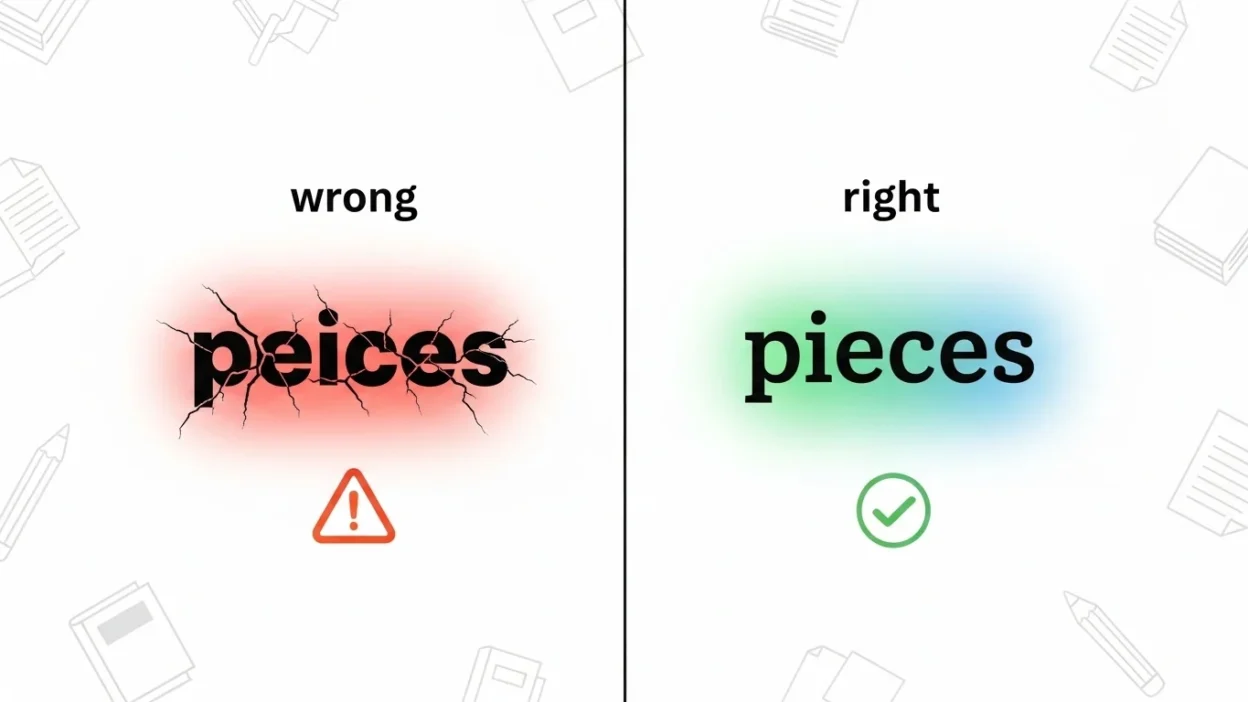
- Pieces – ✅ Correct spelling. Means parts of something.
- Peices – ❌ Incorrect spelling. Never use it.
Examples:
- Correct: I ate three pieces of chocolate.
- Wrong: I ate three peices of chocolate.
Memory Trick: Remember the rule “i before e except after c”. That will help you write pieces correctly.
Simple Origin of “Pieces”
- Comes from Old French “piece”, meaning a part of something.
- English adopted it for small parts, portions, or sections.
- Following English spelling rules, pieces has i before e, unlike peices, which is wrong.
The Difference Explained
| Word | Correct? | Meaning/Use | Example Sentence |
| Pieces | ✅ Yes | Parts of something, sections, or items | I need two pieces of paper. |
| Peices | ❌ No | Wrong spelling | I need two peices of paper. ❌ |
Key Point: Always use pieces, never peices.
Piece vs Pieces: When to Use
- Piece – Singular, for one part.
- Example: I want a piece of cake.
- Example: I want a piece of cake.
- Pieces – Plural, for more than one part.
- Example: She bought three pieces of jewelry.
- Example: She bought three pieces of jewelry.
Tip: Think of piece vs pieces like one part vs many parts.
Common Mistakes Learners Make
- Writing peices instead of pieces.
- Using singular piece incorrectly.
- Confusing pieces with peace.
Examples:
- ❌ I bought five peices of cake.
- ❌ Can I have one peice of chocolate?
- ✅ I bought five pieces of cake.
- ✅ Can I have one piece of chocolate?
Everyday Real Life Examples
Emails:
- “Please send me the pieces of the report by Monday.” ✅
News Headlines:
- “The statue broke into several pieces after the storm.” ✅
Social Media Posts:
- “Just finished a puzzle! All 500 pieces complete.” ✅
Classroom / Daily Use:
- “Can I borrow a piece of paper?” ✅
- “The pizza is cut into eight pieces.” ✅
- “Take two pieces of candy, please.” ✅
Fun Tip: When writing texts or social posts, check if it sounds like “peace”—if it does, it’s probably the wrong word!
Short Learning Section for Beginners
- Step 1: Always write pieces. Avoid “peices.”
- Step 2: Say it slowly: “pi-ces”, like “peace + s”.
- Step 3: Remember the i before e rule.
- Step 4: Use in simple sentences: “I want one piece of chocolate” or “I have three pieces of paper.”
Extra Memory Trick: Think of a chocolate bar. You can break it into many pieces, never “peices.” Visualizing it helps you remember.
FAQ: Peices vs Pieces
1. Is “peices” a word?
No. Always use pieces.
2. Can I write “one peice”?
No. Correct is one piece.
3. How do I remember the spelling?
Think i before e. Pieces = correct.
4. Can “pieces” be for objects, not just food?
Yes. Use it for anything with parts: paper, jewelry, puzzle, furniture, etc.
5. What is the singular form?
Piece. Example: “I want a piece of cake.”
6. Is “pieces” the same as “peace”?
No. Peace means calm. Pieces means parts.
7. What if I type “peices” in my homework?
It will be marked wrong. Always check!
8. Does British or American English spell it differently?
No. Both use pieces.
Tips to Avoid Mistakes
- Always visualize what you are talking about: a chocolate bar, a puzzle, a sheet of paper.
- Say the word aloud: “pieces” sounds like “peace + s.”
- Practice writing piece vs pieces in short sentences.
- Use bullet points or tables in notes for easy memorization.
Conclusion
- Pieces – ✅ Correct spelling, used for parts or items.
- Peices – ❌ Incorrect, never use it.
Remember: Singular = piece, plural = pieces. Use the i before e rule and simple visual examples like chocolate or paper to make spelling easy.
By practicing with real life examples, emails, social posts, and classroom exercises, you will confidently write pieces without confusion.
Key Takeaway: Always write pieces, never peices, and remember piece vs pieces.

Daniel Matthew is a passionate visionary who believes in creativity, purpose, and innovation. With a focus on growth and authenticity, he turns every idea into meaningful impact.