Many students and English learners get confused about proof or prove. Both words are about showing that something is true, but they are used differently in sentences.
For example:
- “I have proof that he is right.”
- “Can you prove that you finished your homework?”
This article explains the difference between proof and prove, provides proof or prove examples, and teaches how to use proof and prove correctly in writing, speaking, emails, social media, and daily English.
Quick Answer
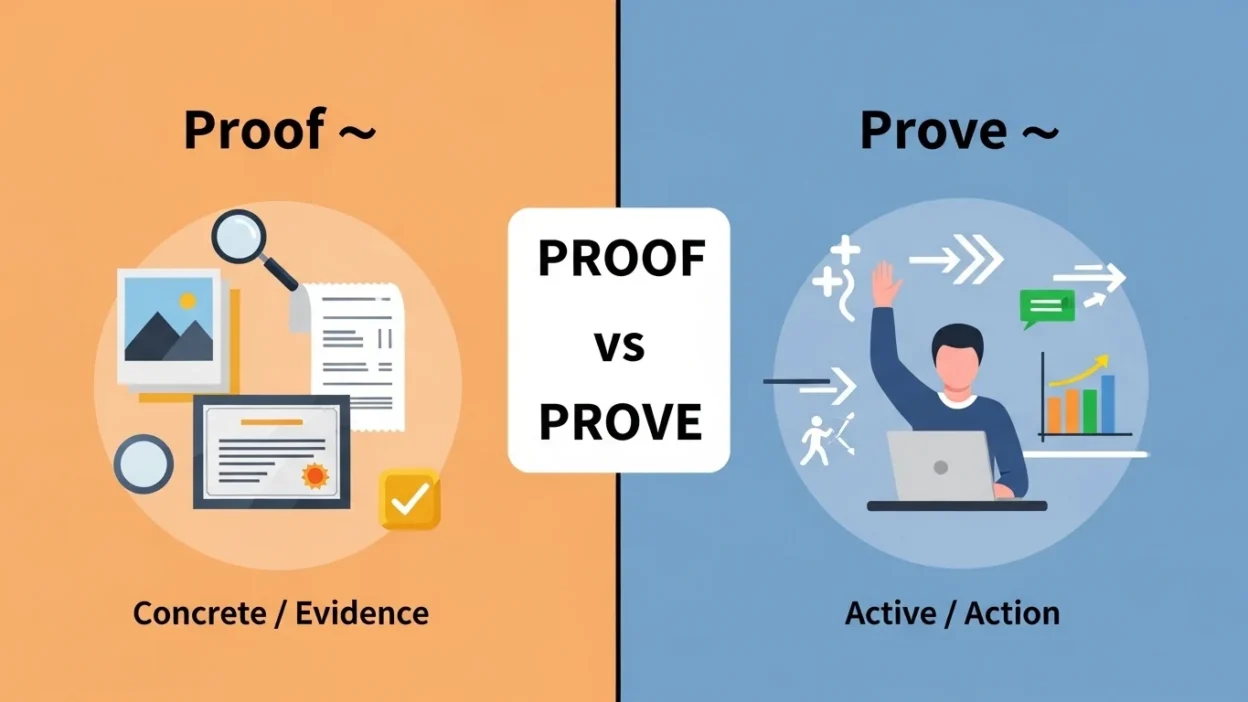
- Proof → a noun; evidence or facts that show something is true
- Prove → a verb; the action of showing something is true
Memory Trick:
- Proof = thing/evidence
- Prove = action
Background and Origin
- Proof comes from Latin proba, meaning “test” or “trial.”
- Prove comes from the verb form of the same root, meaning “to show or test.”
In modern English:
- Proof is the evidence you have (a document, photo, or fact)
- Prove is what you do to show it is true
Tip for ESL learners:
Ask yourself: “Am I holding it, or am I showing it?” → Holding = proof, Showing = prove
Clear Explanation of the Difference
| Feature | Proof | Prove |
| Part of speech | Noun | Verb |
| Meaning | Evidence that something is true | To show that something is true |
| Examples | I have proof of your work. | You must prove your point. |
| Usage tip | Something you can hold or show | Action you perform |
| Common mistakes | Saying “I have prove” | Saying “I will proof my idea” |
| Real-life example | Photo, receipt, document | Demonstrate skills, test an answer |
How to Use Them
Using Proof (Noun)
- Correct: “I have proof that she completed the test.”
- Correct: “The receipt is proof of payment.”
- Tip: Think proof = thing/evidence.
Using Prove (Verb)
- Correct: “Can you prove your answer is correct?”
- Correct: “He wants to prove his skills in the competition.”
- Tip: Think prove = action to show something is true.
Everyday Real Life Examples
Emails / School Work
- “Please attach proof of your assignment submission.”
- “You need to prove your solution in the math test.”
Social Media
- “Here’s proof that the challenge worked!”
- “She wants to prove she can run a marathon.”
Daily Conversation
- “Do you have proof of that?”
- “I can prove I was at the meeting.”
Formal / Professional Context
- “Submit proof of payment for verification.”
- “The scientist will prove the experiment’s results.”
These are clear proof or prove examples across different situations.
Short Learning Section (For Students & Beginners)
Easy Memory Trick
- Proof = noun → thing/evidence
- Prove = verb → action to show truth
Practice Sentences
Fill in the blanks:
- I need ______ that you finished your homework.
- Can you ______ that your answer is correct?
- The photo is ______ that the event happened.
- She wants to ______ her skills in the competition.
- Please send ______ of your payment.
- You must ______ your claim with facts.
Answers:
- proof
- prove
- proof
- prove
- proof
- prove
FAQ (Simple Questions & Answers)
1. Are proof and prove the same?
No. Proof is a noun (evidence), prove is a verb (action to show something is true).
2. Can I use proof as a verb?
No. Always use prove for the action.
3. Can I use prove as a noun?
No. Always use proof as the noun.
4. How do I remember the difference?
Think: Proof = thing/evidence, Prove = action.
5. Can proof be physical or abstract?
Yes, it can be a document, photo, fact, or demonstration.
6. Can I use prove in all tenses?
Yes. Examples: proves, proved, proven
7. Examples in daily life?
- Proof: receipt, photo, document
- Prove: show your skills, demonstrate your answer
8. Can I use these words in casual conversation?
Yes. For example:
- “I have proof!”
- “I can prove it to you.”
Conclusion
Now you understand proof or prove and the difference between proof and prove.
Final Rule to Remember:
- Proof = noun → evidence, thing you can show
- Prove = verb → action to show something is true
Memory trick:
“Proof = thing you hold, Prove = action you do to show it’s true.”
With this guide, examples, exercises, and memory tricks, you can confidently use proof or prove in writing, speaking, emails, social media, exams, and daily English.

David Robert is a passionate innovator driven by creativity, vision, and purpose. He turns bold ideas into impactful realities through focus, leadership, and dedication.