Many learners of English get confused between quite or quiet. Although they sound similar, their meanings and uses are very different.
This article explains the difference between quite and quiet, gives quite meaning and quiet meaning, provides common phrases and collocations, shows quite or quiet examples, includes pronunciation tips, and offers interactive exercises and visual cheat sheets.
By the end, you will know how to use quite and quiet correctly in writing, speaking, emails, and daily English.
Why People Get Confused
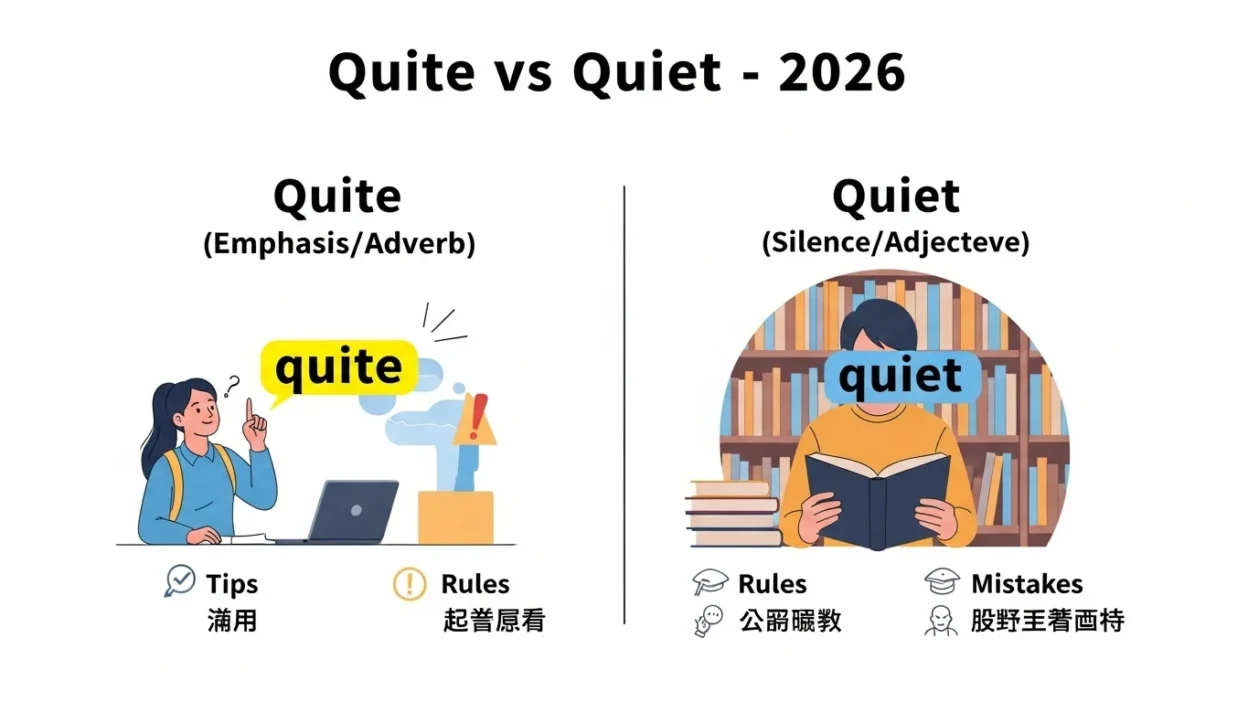
- Quite → an adverb meaning “very,” “completely,” or “fairly”
- Quiet → an adjective meaning “silent” or “not noisy”
Because they sound similar, learners often mix them up in writing and speaking.
💡 Tip: Ask yourself: “Am I describing silence, or am I emphasizing something?”
Quick Answer: Simple Difference
| Word | Part of Speech | Meaning / Use | Example |
| Quite | Adverb | Very, completely, fairly | She is quite tall for her age. |
| Quiet | Adjective | Silent, calm, not noisy | The library is very quiet today. |
Easy Trick:
- Quite = adverb → emphasizes
- Quiet = adjective → describes silence
How to Use Quite or Quiet
✅ Use Quite When:
- Emphasizing or strengthening an adjective or adverb
- Talking about degree, intensity, or extent
- Using common phrases like “quite a few,” “quite enough,” “quite sure”
Examples (quite or quiet examples):
- This book is quite interesting.
- She is quite happy with her results.
- There are quite a few people at the park.
- I am quite sure about the answer.
✅ Use Quiet When:
- Describing silence or calmness
- Talking about places, people, or situations
- Using common phrases like “keep quiet,” “quiet as a mouse”
Examples (quite or quiet examples):
- Please keep the classroom quiet.
- He is a quiet student.
- The library is very quiet today.
- The baby is sleeping quietly.
Collocations and Context Tips 💡
- Quite + adjective/adverb → emphasizes: “quite good,” “quite amazing,” “quite fast”
- Quiet + noun → describes silence: “quiet room,” “quiet neighborhood”
- Idiomatic phrases:
- “Quite a few” = many
- “Keep quiet” = stay silent
- “Quiet as a mouse” = very silent
- “Quite a few” = many
Scenario Based Practice ✏️
- The room is ______ (quite/quiet) after the lecture.
- I am ______ sure about the answer.
- The baby is sleeping; it’s very ______ (quite/quiet).
- She is ______ excited about the trip.
- The library is ______ during the exam.
✅ Answers: 1. quiet 2. quite 3. quiet 4. quite 5. quiet
Pronunciation Tips 🎤
Both words sound similar, but the pronunciation differs slightly:
- Quite → /kwaɪt/
- Quiet → /ˈkwaɪ.ət/
💡 Say it slowly and practice with examples:
- “quite tall,” “quite strong,” “quiet library,” “quiet student”
Common Mistakes to Avoid ⚠️
- Using quite when you mean silent or calm
- ❌ The library is quite.
- ✅ The library is quiet.
- ❌ The library is quite.
- Using quiet when you mean emphasize something
- ❌ She is very quiet happy.
- ✅ She is quite happy.
- ❌ She is very quiet happy.
- Forgetting context phrases like “keep quiet” or “quite a few”
💡 Mnemonic Trick:
- “Quiet → silence; Quite → emphasizes.” ✅
Everyday Real Life Examples 💡
School / Homework:
- The classroom is quiet during the exam.
- She is quite clever with numbers.
Daily Life / Decisions:
- I like a quiet morning with tea.
- This coffee is quite strong.
Emails / Messages:
- “Please be quiet during the meeting.”
- “I am quite impressed with your work.”
Social Media / Conversations:
- “The park is quite crowded today.”
- “Keep quiet while the baby sleeps.”
FAQ Section
1. Which is correct: quite or quiet?
Both are correct words, but they mean different things. Use quite to emphasize and quiet to describe silence.
2. Can I use quite to mean silent?
No, quite emphasizes something; it does not mean silent.
3. Can I use quiet to mean very?
No, quiet describes calmness or lack of noise, not degree.
4. Are quite and quiet common in daily English?
Yes, they are used in conversations, emails, school, and social situations.
5. How do I remember which to use?
Remember: Quiet → silence; Quite → emphasizes.
6. Can quiet describe a person?
Yes, e.g., “He is a quiet student.”
7. Can quite modify adjectives?
Yes, e.g., “She is quite talented.”
8. What are common phrases with quite and quiet?
Quite: “quite a few,” “quite enough,” “quite sure”
Quiet: “keep quiet,” “quiet as a mouse,” “quiet neighborhood”
Cheat Sheet: Quite vs Quiet ✅
| Word | Part of Speech | Use | Example |
| Quite | Adverb | Emphasizes degree | This cake is quite sweet. |
| Quiet | Adjective | Describes silence or calm | The office is quiet now. |
| Common Phrases | — | — | Quite a few, keep quiet, quiet as a mouse |
Quick Takeaway Box:
👉 Describing silence → quiet
👉 Emphasizing or strengthening → quite
Conclusion
Now you clearly understand quite or quiet and how to use them correctly:
- Use quiet to describe silence or calmness
- Use quite to emphasize or strengthen an adjective
By practicing with scenario exercises, cheat sheets, pronunciation tips, collocations, phrases, and real life examples, beginners can confidently use quite and quiet in writing, speaking, and daily English.

Daniel Matthew is a passionate visionary who believes in creativity, purpose, and innovation. With a focus on growth and authenticity, he turns every idea into meaningful impact.