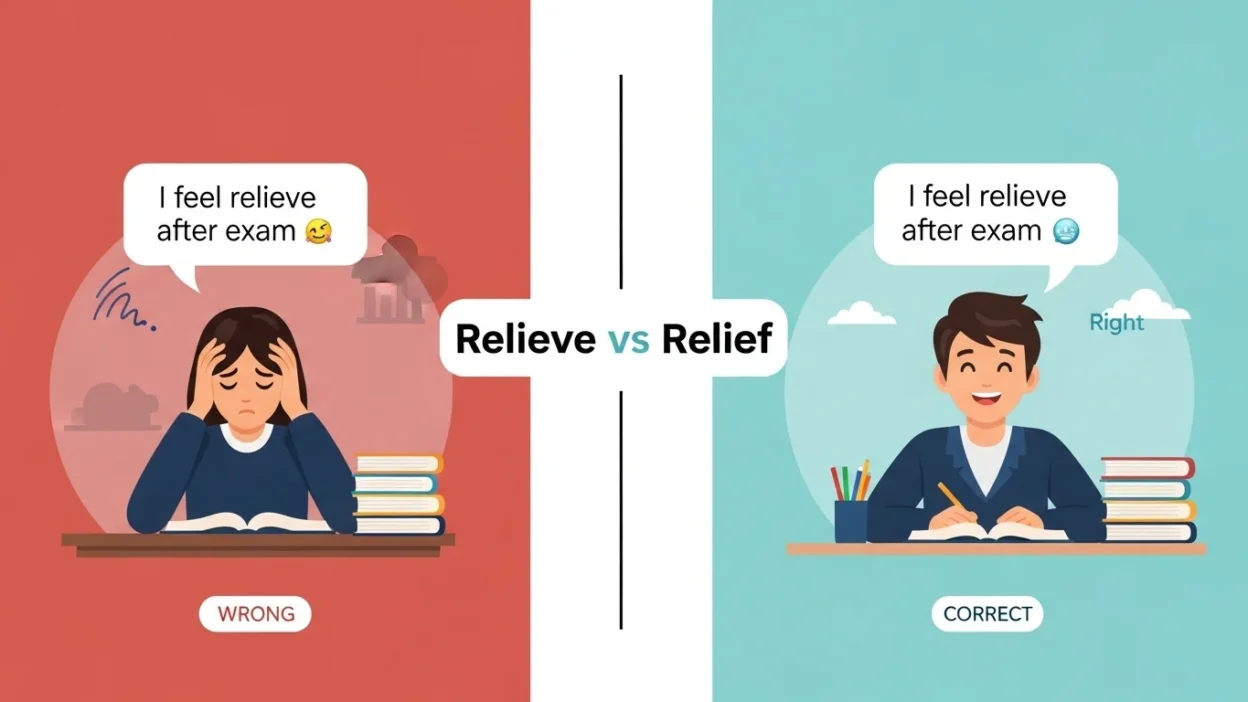
Many learners make this mistake:
❌ I feel relieve after the exam.
✅ I feel relief after the exam.
Both words look almost the same, so it’s easy to get confused. But the difference is actually very simple once you understand one key idea.
In this guide, you will learn the difference clearly, with easy rules, real life examples, and simple practice so you never make this mistake again.
Quick Answer
Here is the simplest way to understand:
- Relieve = an action (verb)
→ to reduce pain, stress, or a problem - Relief = a feeling (noun)
→ the good feeling after pain or stress is gone
Quick examples:
- This medicine will relieve your pain.
- I felt relief after the test.
Simple Background
Both words come from the same idea: making something easier or lighter.
- Relieve is what happens (the action)
- Relief is what you feel after it happens
Think of it like this:
- Action first → relieve
- Feeling after → relief
The Real Difference
1. Relieve = Action (Verb)
Use relieve when something is doing the job of reducing pain, stress, or pressure.
👉 Structure:
- relieve + problem
- relieve + someone
Examples:
- This tablet will relieve your headache.
- Talking to a friend can relieve stress.
- The teacher tried to relieve students’ pressure.
2. Relief = Feeling (Noun)
Use relief when you talk about the result or feeling after the problem is reduced.
👉 Common patterns:
- feel relief
- a sense of relief
- bring relief
- give relief
Examples:
- I felt relief after finishing my work.
- There was a sense of relief in the room.
- The news brought relief to everyone.
Comparison Table
| Feature | Relieve | Relief |
| Type | Verb (action) | Noun (feeling/result) |
| Meaning | Reduce pain or stress | Feeling after pain is gone |
| Use in sentence | Before the result | After the result |
| Example | This will relieve pain | This gave me relief |
Which One to Use (Simple Rules)
Use this quick guide every time:
Use Relieve when:
- Something is removing a problem
- You need a verb
✔ This will relieve your stress.
✔ Music helps relieve anxiety.
Use Relief when:
- You are talking about a feeling
- The problem is already reduced
✔ I felt relief after the exam.
✔ The results brought relief.
Common Patterns You Should Know
These patterns help you sound natural:
With “Relieve”
- relieve pain
- relieve stress
- relieve pressure
- relieve someone of something
Example:
- The medicine relieved him of pain.
With “Relief”
- feel relief
- a sense of relief
- sigh of relief
- pain relief
Example:
- She gave a sigh of relief.
Common Mistakes (Very Important)
Mistake 1
❌ I feel relieve
✅ I feel relief
👉 Rule: After “feel,” use a noun → relief
Mistake 2
❌ This medicine will relief pain
✅ This medicine will relieve pain
👉 Rule: After “will,” use a verb → relieve
Mistake 3
❌ He gave me relieve
✅ He gave me relief
👉 “Give” needs a noun → relief
Mistake 4
❌ I am very relief
✅ I am very relieved
👉 Use relieved (adjective) for feelings
Pronunciation Help
These words sound similar but are slightly different:
- Relieve → ri LEEV (/rɪˈliːv/)
- Relief → ri LEEF (/rɪˈliːf/)
👉 The only difference is the last sound:
- V sound → relieve
- F sound → relief
Everyday Real Life Examples
Daily Life
- A short nap can relieve tiredness.
- I felt relief after sleeping.
At School
- Revision helps relieve exam stress.
- Students felt relief after exams ended.
In Emails
- We hope this solution will relieve your concerns.
- Your reply brought great relief.
On Social Media
- “Finally done! What a relief!”
- “Exercise helps relieve stress.”
In News
- The plan aims to relieve financial pressure.
- People expressed relief after the announcement.
Quick Practice (Test Yourself)
Fill in the blanks:
- This medicine will ______ your pain.
- I felt a sense of ______ after the test.
- Talking helps ______ stress.
- She gave a sigh of ______.
Answers:
- relieve
- relief
- relieve
- relief
Easy Learning Tips for Beginners
Remember this forever:
👉 Relieve = Do (Action)
👉 Relief = Feel (Feeling)
Simple memory trick:
- RelieVe → V = Verb
- RelieF → F = Feeling
One line rule:
If something is happening → use relieve
If something is felt → use relief
FAQ (Frequently Asked Questions)
1. Why can’t I say “I feel relieve”?
Because “feel” needs a noun, and “relieve” is a verb. Use relief.
2. Can I use “relief” as a verb?
No, “relief” is only a noun.
3. Can both words be used in one sentence?
Yes:
“This medicine will relieve pain and give relief.”
4. What is the adjective form?
Use relieved:
- I am relieved now.
5. Is this mistake common?
Yes, many learners confuse these words because they look similar.
6. Which one comes first: relieve or relief?
Usually:
- First → relieve (action)
- Then → relief (feeling)
7. Can “relief” be used with “pain”?
Yes:
- pain relief
- headache relief
8. What is the easiest way to remember?
Think:
- Action → relieve
- Feeling → relief
Conclusion
The difference between relieve and relief is simple when you focus on one idea:
- Relieve = action (reducing a problem)
- Relief = feeling (after the problem is reduced)
Final example to remember:
- This medicine will relieve your pain.
- After taking it, you will feel relief.
Keep practicing with real sentences, and soon you will use these words correctly without even thinking about it.

Michael is a passionate thinker and visionary creator who turns ideas into action. With focus and integrity, he strives to make every project purposeful and inspiring.