Many students, job seekers, and beginners often get confused between a resume vs CV.
Both are documents that show your skills, experience, and education, but they have different purposes, lengths, and contents.
If you’ve ever asked “CV vs resume – which one should I use?” or “resume vs CV for students”, this guide will make it simple. By the end, you will understand:
Quick Answer: Resume vs CV
| Document | Length | Content | Use |
| Resume | 1–2 pages | Summary of skills, achievements, and work experience | Job applications, short and targeted |
| CV (Curriculum Vitae) | 2+ pages, sometimes several pages | Detailed career history including education, research, publications | Academic, research, or international jobs |
Simple Rule:
- Resume = short, concise, highlights your skills
- CV = long, detailed, full career history
Tip: Always check the job description and country requirements for resume vs CV expectations.
Origin and Background
- Resume comes from the French word résumé, meaning summary.
- CV stands for Curriculum Vitae, Latin for “course of life.”
- In the US, resumes are standard for most jobs, while CVs are for academic or research positions.
- In Europe, UK, and Canada, CVs are often expected for all job applications.
Always consider the industry and location when deciding between a resume vs CV.
Clear Explanation: Resume vs CV
| Feature | Resume | CV |
| Length | 1–2 pages | 2+ pages (sometimes several pages) |
| Purpose | Quick overview of skills and achievements | Detailed career history, education, research, publications, projects |
| Content | Work experience, skills, achievements, education | Everything in resume + publications, awards, projects, conferences |
| Customization | Tailored for each job | Usually stays the same, updated over time |
| Common Users | Professionals, job seekers, students | Academics, researchers, students applying abroad |
Comparison: Wrong vs Right
| ❌ Wrong Usage | ✅ Correct Usage | Why |
| Sent a CV for a US corporate job | Sent a resume for a US corporate job | Resumes are short and targeted |
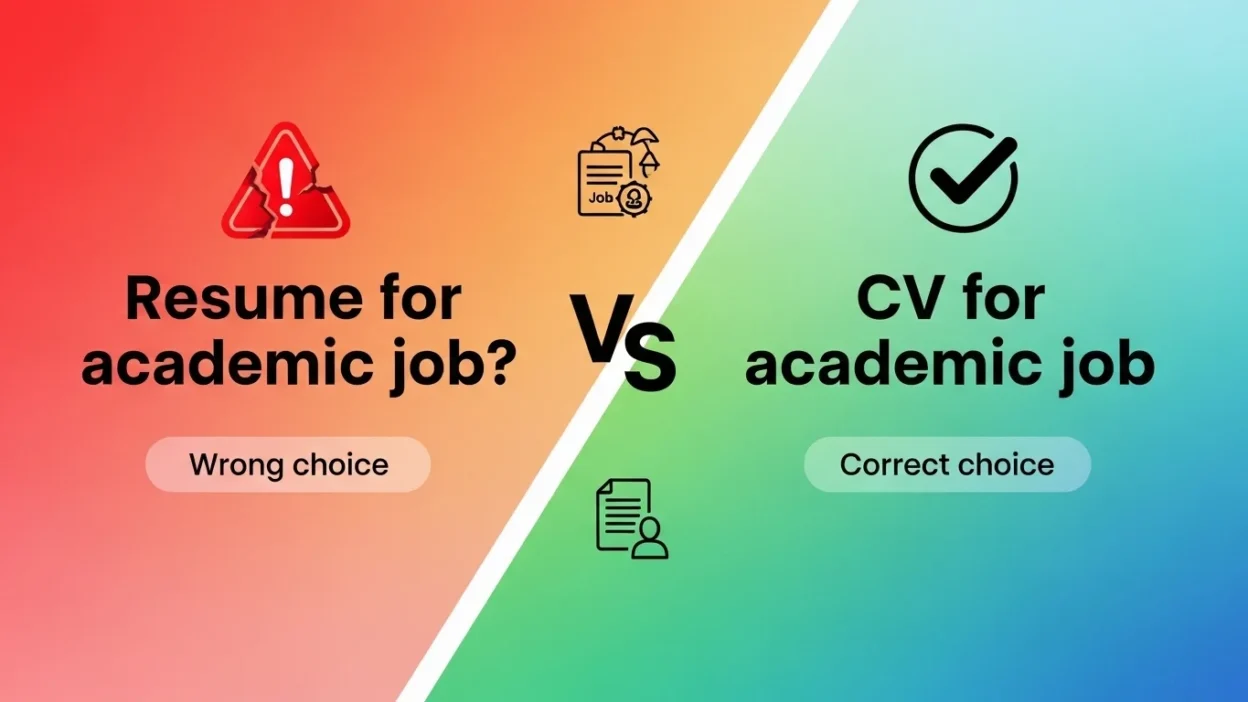
| Sent a resume for an academic research position | Sent a CV for academic research | CVs include full career history |
| Using same resume for all jobs | Tailored resume for each job | Resumes should highlight relevant skills |
This table helps beginners quickly understand the correct document for each situation.
When to Use Resume vs CV
Use a Resume:
- Applying to private companies or businesses
- Short, targeted applications
- US-based jobs or internships
Use a CV:
- Applying for academic positions, research roles, or international jobs
- When a full career overview is required
- For students or beginners applying abroad
Bonus Tip: You can convert a CV to a resume by shortening and tailoring it for a specific job.
What to Include in Each Document
Resume:
- Contact information
- Professional summary
- Work experience
- Skills relevant to the job
- Education
- Optional: projects, volunteer work
CV:
- Everything in a resume
- Publications, presentations, or conferences
- Awards and honors
- Detailed research or academic experience
- Professional memberships or certifications
Interactive Exercises for Students
Fill in the blank with resume or CV:
- She applied to the marketing manager position with her ___ .
- He sent his ___ to the university for the research assistant job.
- The UK company requested a detailed ___ from all applicants.
Answers:
- resume
- CV
- CV
Tip: Highlight answers in a box or bold text for easier scanning.
Common Mistakes to Avoid
- Using the wrong document – Always check whether the job expects a resume vs CV.
- Making the CV too short – Include all publications, projects, and awards.
- Not customizing a resume – Tailor each resume to highlight relevant skills.
- Using informal language – Avoid slang or casual terms in both resumes and CVs.
- Confusing international conventions – US vs UK vs Europe can have different expectations.
Everyday Examples
Emails / Job Applications:
- “Please find attached my resume for the marketing position.”
- “Attached is my CV for the research fellowship.”
LinkedIn / Social Media:
- “Update your LinkedIn profile to reflect your resume highlights.”
- “Academic LinkedIn users often link to their CV.”
Daily Conversations:
- “Do you have a resume ready for the internship?”
- “I need to update my CV before submitting it to the university.”
Learning Section for Beginners
Step 1: Understand the purpose
- Resume = short, job-focused
- CV = long, detailed, academic-focused
Step 2: Know the length
- Resume = 1–2 pages
- CV = 2+ pages
Step 3: Include the right content
- Resume = work experience, education, skills, achievements
- CV = all resume content + publications, awards, projects
Step 4: Check the job location and industry
- US / private jobs → Resume
- Academic / international → CV
FAQs
1. What is the main difference between a resume and a CV?
A resume is short and focused on skills; a CV is long and detailed with full career history.
2. Which one should students use for internships?
Use a resume unless the internship specifically requests a CV.
3. Are CV and resume the same in Europe?
No. In Europe, CVs are standard for job applications, while in the US, resumes are preferred.
4. How long should a resume be?
1–2 pages.
5. How long should a CV be?
2+ pages, sometimes several pages for academics or researchers.
6. Can I use my resume for academic jobs?
No. Academic positions usually require a CV.
7. How often should I update my CV?
Add new publications, projects, awards, or positions regularly.
8. Can a resume include projects?
Yes, but only projects relevant to the specific job.
Conclusion
The difference between resume vs CV is simple:
- Resume = short, concise, tailored for private companies or internships
- CV = long, detailed, used for academic, research, or international positions
Rule of thumb: Always check the job description and country requirements before submitting your document.
Practice creating both your resume and CV to be ready for any job or academic application.

David Robert is a passionate innovator driven by creativity, vision, and purpose. He turns bold ideas into impactful realities through focus, leadership, and dedication.