Many English learners often get confused with ruff vs rough. These words look alike, and sometimes sound similar, but their meanings are completely different.
Understanding the difference between ruff and rough is important for writing clearly in emails, school assignments, social media, and everyday conversations.
This guide explains the meaning, usage, and examples of ruff and rough in simple English, with tips that make it easy to remember.
Quick Answer: Ruff vs Rough
Here’s the easiest way to remember:
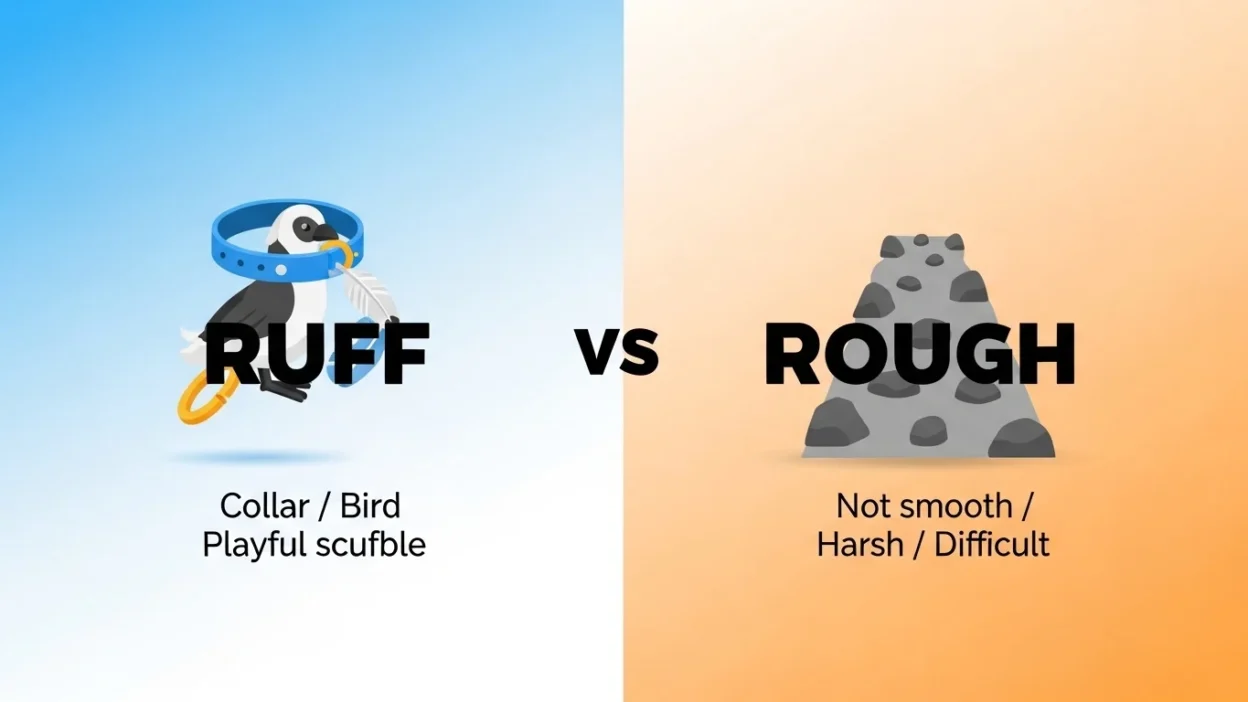
- Ruff → A noun or verb; refers to a collar, a ring of feathers on a bird, or a playful scuffle
- Rough → An adjective, noun, or verb; means not smooth, harsh, difficult, or uneven
| Word | Meaning | Example |
| Ruff | Collar, bird feather ring, playful scuffle | The dog had a white ruff around its neck. |
| Rough | Not smooth, harsh, uneven, difficult | The trail was very rough after the rain. |
Tip Box:
If it describes texture or difficulty, use rough. If it’s about a collar or bird feathers, use ruff.
Why Ruff vs Rough Is Confusing
The confusion comes from spelling similarity and pronunciation. Both words can sound like /rʌf/ in casual speech, especially in accents.
- Ruff is rarely used today except in historical fashion, birds, or playful scuffles.
- Rough is very common in daily life, work, and school writing.
Origin of Ruff and Rough
- Ruff: Comes from 16th-century fashion, referring to the pleated collar worn by people. Also used for birds with a ring of feathers around the neck. In rare cases, it can be a verb meaning to scuffle.
- Rough: From Old English “ruh”, meaning coarse, harsh, or uneven. Over time, it expanded to describe hard surfaces, difficult situations, or unpleasant experiences.
Clear Explanation of the Difference
Ruff
- Noun (Collar): A fashion accessory around the neck
- Example: The Elizabethan actor wore a white ruff.
- Example: The Elizabethan actor wore a white ruff.
- Noun (Bird): A ring of feathers around a bird’s neck
- Example: The ruff is a migratory bird with a distinctive feather collar.
- Example: The ruff is a migratory bird with a distinctive feather collar.
- Verb (Rare): To play-fight or scuffle
- Example: The puppies began to ruff with each other playfully.
- Example: The puppies began to ruff with each other playfully.
Rough
- Adjective: Not smooth, uneven, harsh, or difficult
- Example: The table surface was rough.
- Example: He had a rough day at work.
- Example: The table surface was rough.
- Noun: Coarse part of something
- Example: Sandpaper has a rough side.
- Example: Sandpaper has a rough side.
- Verb (Less Common): To handle roughly
- Example: The movers roughed up the furniture.
- Example: The movers roughed up the furniture.
Ruff vs Rough: Comparison Table
| Feature | Ruff | Rough |
| Part of Speech | Noun / Verb | Adjective / Noun / Verb |
| Meaning | Collar, bird feathers, playful scuffle | Not smooth, harsh, uneven, difficult |
| Common Usage | Fashion, birds, playful scuffles | Texture, surfaces, difficulty, rough behavior |
| Example | The puppy has a fluffy ruff. | The road is very rough after the rain. |
When to Use Ruff and Rough
Use Ruff When:
- Talking about fashion collars or historical ruffs
- Describing a bird’s feather ring
- Referring to a playful scuffle
Use Rough When:
- Talking about texture or surfaces: rough wall, rough path
- Talking about difficulty or challenges: rough day, rough week
- Talking about behavior or handling: rough handling, rough play
Common Mistakes
- Mixing Ruff and Rough
- Incorrect: The dog’s coat was rough around its neck.
- Correct: The dog’s coat had a ruff around its neck.
- Incorrect: The dog’s coat was rough around its neck.
- Using Ruff for surfaces
- Remember: ruff is rarely used for texture; rough is correct.
- Remember: ruff is rarely used for texture; rough is correct.
- Pronunciation Confusion
- Ruff → /rʌf/
- Rough → /rʌf/
- Ruff → /rʌf/
Real Life Examples
Emails:
- The project had a rough start but finished on time.
Social Media:
- Look at the bird’s colorful ruff around its neck!
Daily Use / Conversations:
- Be careful; the path is rough.
- The puppy likes to ruff with its toy.
News / Articles:
- The actor wore a traditional ruff during the historical performance.
Learning Tips for Students
Tip 1: Texture / Difficulty → Rough
- Example: The wall is rough.
Tip 2: Collar / Bird → Ruff
- Example: The bird’s ruff was beautiful.
Tip 3: Mnemonic
- Ruff → Royal collar or bird feathers
- Rough → Road or surface that’s uneven / harsh
Tip 4: Practice
- Write 3 sentences each day using ruff and rough.
Frequently Asked Questions
Q1: Are ruff and rough pronounced the same?
- Often yes, /rʌf/, especially in casual speech.
Q2: Can ruff be used like rough?
- No. Ruff is almost never used for surfaces or difficulty.
Q3: What is a ruff on a bird?
- A ring of feathers around the bird’s neck.
Q4: Can rough be a verb?
- Yes, it can mean to handle roughly. Example: They roughed the furniture.
Q5: Is ruff common today?
- Only in historical fashion, birdwatching, or playful scuffles.
Q6: How to remember rough?
- Rough → Road → Uneven, harsh, or difficult.
Q7: Are ruff and rough spelling mistakes of each other?
- No. They are different words with different meanings.
Q8: How to use ruff and rough correctly in exams?
- Remember: texture/difficulty = rough, collar/bird = ruff, and check the context carefully.
Conclusion
The difference between ruff vs rough is clear:
- Ruff → Collar, bird feather ring, or playful scuffle
- Rough → Not smooth, harsh, uneven, or difficult
Even though they sound similar, their meanings are completely different.
Using tables, mnemonics, and real life examples, you can confidently use ruff and rough correctly in writing and speaking.

David Robert is a passionate innovator driven by creativity, vision, and purpose. He turns bold ideas into impactful realities through focus, leadership, and dedication.