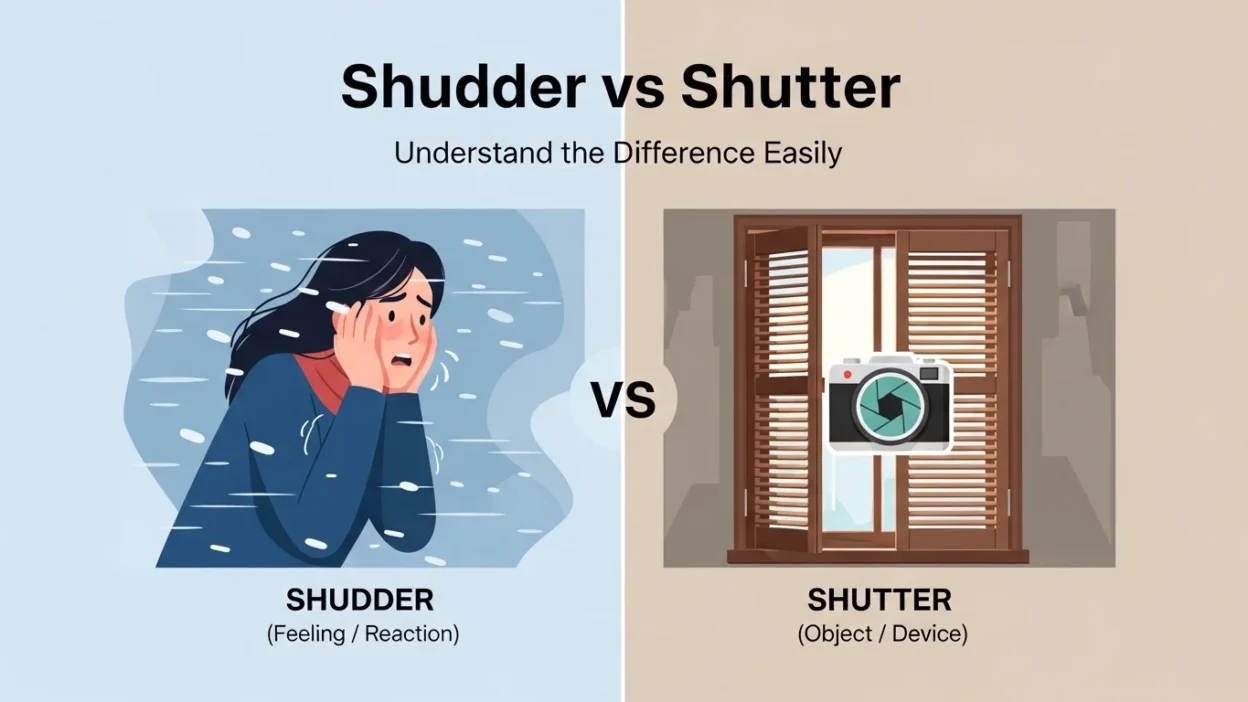
Many English learners feel confused when they see the words “shudder” and “shutter.”
These words look very similar, and when spoken quickly, they can also sound alike. Because of this, people often mix them up in writing and speaking.
If you are wondering about the difference between shudder and shutter, you are not alone. This guide will explain both words in very simple English.
You will learn their meanings, usage, examples, and easy tricks to remember them without confusion.
Quick Understanding
Here is the simplest way to understand shudder vs shutter:
- Shudder → a feeling or action (shaking due to fear, cold, or emotion)
- Shutter → a physical object (used to close windows or control light in cameras)
👉 One is about how you feel.
👉 The other is about something you can touch.
Why People Confuse Shudder and Shutter
Before learning the meanings, it helps to understand why confusion happens:
- The words have very similar spelling
- The pronunciation is close
- Both words are not commonly explained together in basic lessons
- People rely on guessing instead of learning the context
This is why many learners search for shudder meaning in English and shutter meaning in English to clear their doubts.
What Does “Shudder” Mean?
Simple Definition
Shudder means to shake slightly because of fear, cold, shock, or strong emotion.
It describes a body reaction or feeling, not a physical object.
Key Points About Shudder
- It is usually used as a verb
- It describes something happening inside a person
- It is often linked to emotions
Examples of Shudder
- I shuddered when I heard a loud noise.
- She shuddered in the cold weather.
- He shuddered at the thought of failing the exam.
- The child shuddered during the scary story.
👉 These are clear examples of shudder sentence examples used in daily life.
What Does “Shutter” Mean?
Simple Definition
Shutter refers to a physical object used to cover or close something, such as a window or a camera opening.
It is something tangible that you can see and touch.
Key Points About Shutter
- It is usually a noun
- It refers to objects like window covers or camera parts
- It can also be used as a verb in some cases (to close something completely)
Examples of Shutter
- The house has wooden shutters on the windows.
- Please close the shutters before the storm starts.
- The camera shutter opened and closed quickly.
- The company decided to shutter its operations.
👉 These are clear examples of shutter sentence examples in real contexts.
Direct Comparison: Shudder vs Shutter
Here is a simple comparison to clearly show the difference between shudder and shutter:
| Feature | Shudder | Shutter |
| Meaning | To shake due to fear, cold, or emotion | A cover or device that closes something |
| Type | Action / feeling | Physical object |
| Usage | Emotions and reactions | Windows, cameras, closures |
| Part of speech | Verb (mostly) | Noun (mostly) |
| Example | I shuddered in fear | Close the window shutters |
| Related idea | Feeling or reaction | Physical control or cover |
Easy Memory Trick
If you struggle to remember the difference, use this simple trick:
- Shudder = shake (emotion)
- Shutter = shut (close something)
👉 “Shudder” sounds like “shiver,” which is something your body does.
👉 “Shutter” sounds like “shut,” which means to close something.
This is the easiest way to remember when to use shudder and shutter correctly.
When to Use Shudder
Use shudder when describing:
- Fear or nervousness
- Cold temperature reactions
- Shock or surprise
- Disgust or strong emotion
Examples:
- I shudder every time I watch horror movies.
- She shuddered after hearing the bad news.
- He shuddered in the freezing wind.
- The thought alone made me shudder.
👉 These show how shudder grammar works in emotional contexts.
When to Use Shutter
Use shutter when talking about:
- Window coverings
- Camera parts
- Closing or shutting something physically
- Business closures (formal or figurative use)
Examples:
- The shutters were closed during the night.
- The photographer adjusted the camera shutter.
- The shop will shutter next year.
- Heavy winds damaged the window shutters.
👉 These examples show proper shutter grammar usage in real situations.
Common Mistakes to Avoid
Here are some frequent mistakes learners make when using shudder vs shutter:
1. Wrong Spelling
- ❌ I shuttered in fear
- ✅ I shuddered in fear
2. Wrong Meaning
- ❌ The camera shudder clicked
- ✅ The camera shutter clicked
3. Mixing Context
- ❌ Close the window shudder
- ✅ Close the window shutter
4. Pronunciation Confusion
- “Shudder” has a softer ending sound
- “Shutter” has a clear “t” sound
Listening carefully can help you avoid confusion when speaking.
Real Life Situations and Examples
1. Daily Conversation
- “I shuddered when I touched the cold ice.”
- “Please close the shutters before it rains.”
2. Emails or Messages
- “We need strong shutters for safety.”
- “I shudder to think how much work is left.”
3. Social Media
- “That scary scene made me shudder!”
- “Beautiful house with wooden shutters 😍”
4. News or Reports
- “Residents shuddered during the earthquake.”
- “The company may shutter its factories.”
5. Travel or Home Life
- “The hotel room had large metal shutters.”
- “I shuddered when the cold wind hit my face.”
Simple Practice for Beginners
Try filling in the blanks:
- I _______ when I saw the horror scene.
- Please close the window _______.
- The loud noise made me _______.
- The camera _______ opened quickly.
Answers:
- shuddered
- shutters
- shudder
- shutter
FAQ (Frequently Asked Questions)
1. What is the main difference between shudder and shutter?
Shudder refers to a feeling or reaction (shaking), while shutter refers to a physical object used to close or cover something.
2. Is shudder always related to fear?
No. It can also be used for cold, shock, disgust, or strong emotions.
3. Can shutter be used as a verb?
Yes. It can mean to close something or stop operations, though it is less common than its noun form.
4. Why do people confuse shudder vs shutter?
Because the words look and sound similar, and learners often rely on guessing instead of understanding context.
5. Which word is more common in daily speech?
“Shudder” is common when talking about feelings, while “shutter” is common when talking about objects like windows or cameras.
6. How can I quickly remember the difference?
- Shudder → shake (emotion)
- Shutter → shut (close something)
7. Are pronunciation differences important?
Yes. Pronunciation helps in speaking:
- Shudder → softer ending
- Shutter → clear “t” sound
8. Can both words appear in one sentence?
Yes, but rarely.
Example:
“I shuddered as I closed the shutter during the storm.”
Conclusion
The confusion between shudder or shutter is common, but the difference is simple once you understand it clearly.
- Shudder is about a reaction, feeling, or shaking caused by emotion, fear, or cold.
- Shutter is a physical object used to close windows, cameras, or spaces.
A quick way to remember:
- Shudder = shake
- Shutter = shut
By practicing examples and using the memory trick, you can easily understand shudder vs shutter and avoid common mistakes in everyday English. With time, choosing the correct word will become natural and effortless.

Andrew Christopher is a passionate visionary who blends creativity with purpose to bring ideas to life. With a focus on innovation and integrity, he inspires growth and lasting impact.