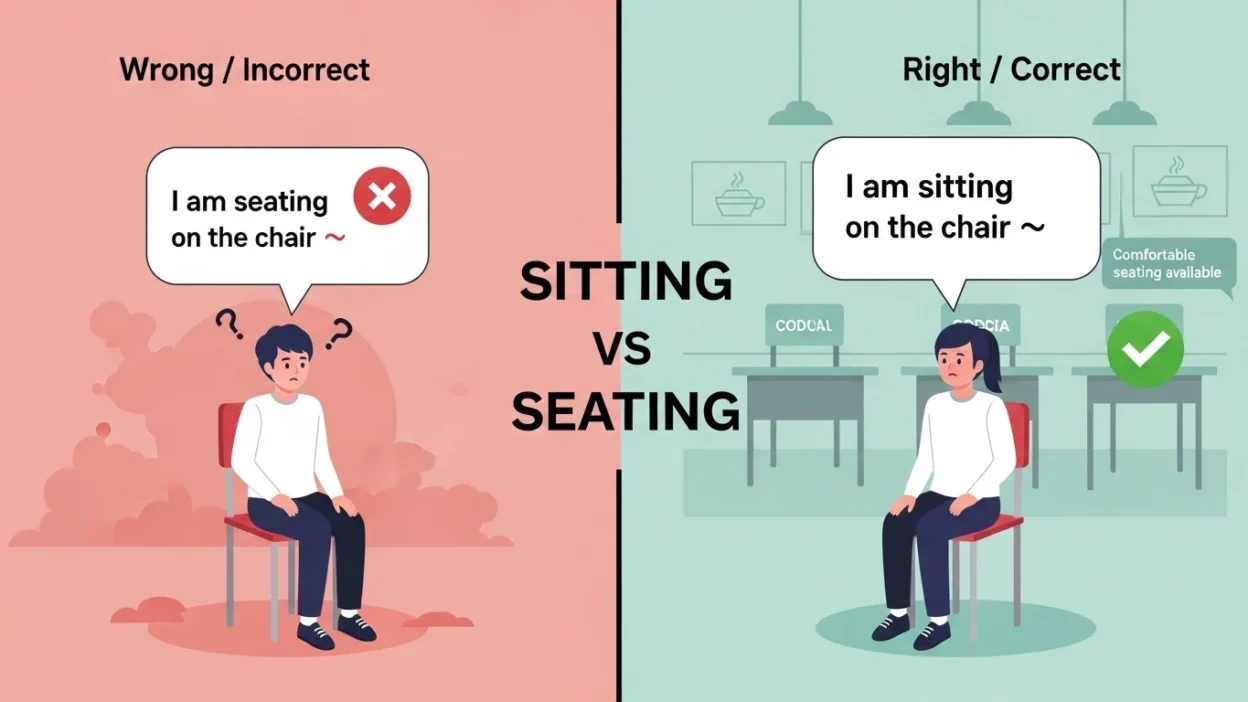
Many learners feel confused about “sitting” and “seating.” At first, they look almost the same. Both come from the word “sit,” so it’s easy to mix them up.
For example, many students say:
- ❌ I am seating on the chair.
But this is not correct.
If you have ever felt unsure about which word to use, don’t worry. This article will give you a clear and simple explanation so you can understand the difference quickly and use both words with confidence.
Quick Answer
- Sitting
- Action (what someone is doing)
- Example: She is sitting on the chair.
- Seating
- Seats or arrangement (a thing, not an action)
- Example: The hall has good seating.
Simple rule:
- Sitting = action
- Seating = place or arrangement
Background (Where These Words Come From)
Both words come from the verb “sit.”
- “Sit” means to rest your body on a chair or surface
- “Sitting” shows the action
- “Seating” developed to describe places or systems where people sit
Over time, English separated these meanings:
- One for doing
- One for arranging
The Real Difference (Easy Explanation)
What Does “Sitting” Mean?
“Sitting” describes an action. It tells us what someone is doing.
Examples:
- I am sitting on the sofa.
- They are sitting in class.
- He was sitting quietly.
👉 It answers: What is the person doing?
What Does “Seating” Mean?
“Seating” is not an action. It refers to:
- Chairs
- Seat arrangements
- Capacity (how many people can sit)
Examples:
- The restaurant has outdoor seating.
- The bus has limited seating.
- The seating capacity is 50 people.
👉 It answers: What is available?
Golden Rule (Very Important)
- You can sit or be sitting
- You cannot seat yourself by saying “I am seating”
✔ Correct: I am sitting
❌ Incorrect: I am seating
👉 “Seating” is something a place has, not something a person does
Comparison Table
| Feature | Sitting | Seating |
| Type | Verb (action) | Noun (thing) |
| Meaning | The act of sitting | Seats or arrangement |
| Used for | People and actions | Places and systems |
| Example | She is sitting | The seating is comfortable |
| Question | What is happening? | What is available? |
When to Use Sitting or Seating
Use “Sitting” When:
- Talking about an action
- Describing what someone is doing
Examples:
- She is sitting near me.
- They were sitting together.
Use “Seating” When:
- Talking about seats or arrangement
- Describing places like halls, buses, or restaurants
Examples:
- The café has comfortable seating.
- The stadium has seating for 1,000 people.
Common Mistakes (Wrong vs Right)
Here are the most common mistakes learners make:
- ❌ I am seating on the chair.
✔ I am sitting on the chair. - ❌ The restaurant has good sitting.
✔ The restaurant has good seating. - ❌ The sitting in the bus is full.
✔ The seating in the bus is full. - ❌ Please take your seating.
✔ Please take your seat.
👉 These mistakes happen when people confuse action with arrangement.
Everyday Real Life Examples
In Daily Conversation
- “Where are you sitting?”
- “The seating here is very comfortable.”
In a Restaurant
- “Do you have outdoor seating?”
- “We are sitting near the window.”
In Travel (Bus, Train, Plane)
- “The seating is full.”
- “Passengers must remain sitting.”
In School or Exams
- “Students are sitting quietly.”
- “Exam seating is arranged in rows.”
In Events or Functions
- “Seating has been arranged for guests.”
- “People are sitting in the front row.”
Learn It Easily
Simple Trick
Ask yourself:
- Is someone doing something? → Use sitting
- Is it about chairs or arrangement? → Use seating
Think of It This Way
- Sitting = doing
- Seating = having
👉 A person does sitting
👉 A place has seating
Practice Exercise
Fill in the blanks:
- She is ___ on the bench.
- The hall has limited ___.
- They are ___ in the park.
- The seating ___ is 200 people.
Answers:
- sitting
- seating
- sitting
- capacity
FAQ Section
1. What is the main difference between sitting and seating?
“Sitting” is an action. “Seating” refers to seats or arrangement.
2. Can I say “I am seating”?
No. This is incorrect. You should say “I am sitting.”
3. What does seating capacity mean?
It means how many people can sit in a place.
4. Is “seating” countable?
No. “Seating” is usually uncountable. We don’t say “many seatings.”
5. Can seating describe people?
No. It describes arrangements, not actions of people.
6. Why do signs use the word “seating”?
Because signs talk about available seats, not actions.
7. Which word is more common?
“Sitting” is more common in daily conversation.
8. How can I remember the difference easily?
Remember:
- Sitting = action
- Seating = arrangement
Conclusion
The difference between “sitting” and “seating” is simple when you understand the idea behind them.
- Sitting is what a person does
- Seating is what a place provides
If you remember this one rule, you will avoid most mistakes.
Practice using both words in real sentences, and soon you will feel confident using them correctly in everyday English.