Many learners, including students often get confused between sneaked vs snuck. Both are past tense forms of sneak, but their usage depends on formality, region, and context.
- Sneaked meaning: standard past tense, formal, widely accepted
- Snuck meaning: informal past tense, common in American English
Knowing the difference between sneaked and snuck helps you:
- Write sentences correctly in formal writing, exams, or emails
- Speak clearly in casual or storytelling contexts
- Avoid mistakes like “snucked”
Quick Answer: Sneaked vs Snuck
- Sneaked → Standard, formal past tense of sneak
- Snuck → Informal past tense, mostly American English
Examples:
- “He sneaked into the classroom quietly.” ✅ (formal)
- “He snuck into the classroom quietly.” ✅ (informal)
- “He sneaked/snuck into the classroom quietly.” ❌ (mixing forms)
Tip: For formal writing or exams, use sneaked. In casual conversation, snuck is acceptable.
Sneaked Meaning
Sneaked meaning:
Sneaked is the standard past tense of sneak, meaning to move quietly or secretly.
Pronunciation
- Sneaked → /sniːkt/ (“sneekt”)
Usage Examples
- “She sneaked a cookie from the jar.”
- “He sneaked out of the house without anyone noticing.”
- “The cat sneaked past the dog.”
Tip: Use sneaked in formal writing, exams, and professional contexts.
Snuck Meaning
Snuck meaning:
Snuck is an informal past tense of sneak, commonly used in American English.
Pronunciation
- Snuck → /snʌk/ (“snuck”)
Usage Examples
- “He snuck into the party late.”
- “I snuck a glance at the answers.”
- “The kids snuck out to play.”
Tip: Use snuck in casual conversation, storytelling, or informal writing.
Sneaked vs Snuck: Key Differences
| Feature | Sneaked | Snuck |
| Meaning | Past tense of sneak (formal/standard) | Past tense of sneak (informal) |
| Usage Context | Formal writing, British English, exams | Informal speech, American English |
| Pronunciation | /sniːkt/ | /snʌk/ |
| Example Sentence | “She sneaked a look at the test.” | “She snuck a look at the test.” |
| Formality | Formal | Informal |
| Regional Preference | UK & Worldwide formal writing | US casual speech |
| Typical Contexts | Exams, emails, professional writing, storytelling | Casual conversation, social media, storytelling |
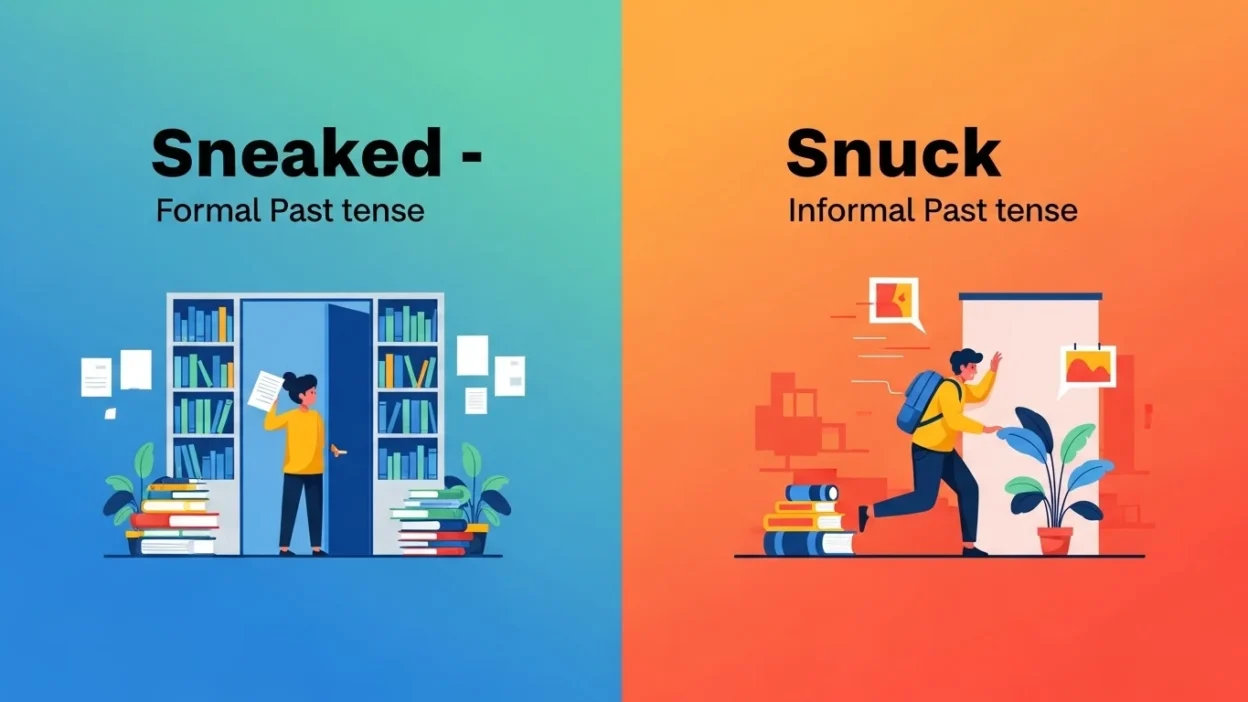
Visual Tip: A split-screen illustration showing Sneaked = formal vs Snuck = informal will help beginners remember the difference.
Which One to Use and When
- Sneaked → Formal writing, exams, professional contexts
- Snuck → Casual conversations, storytelling, American informal writing
Examples:
- “He sneaked into the library to read.” ✅ (formal)
- “He snuck into the library to read.” ✅ (informal)
- “He sneaked/snuck into the library for fun.” ❌ (choose one based on context)
Common Mistakes
❌ Wrong:
- “He snucked into the room.”
✅ Correct: - “He sneaked into the room.” or “He snuck into the room.”
❌ Wrong:
- “She sneaked out, but in casual storytelling, people say snucked.”
✅ Correct: - “She sneaked out.” (formal)
- “She snuck out.” (informal)
Tip: Never add “-ed” to snuck.
Real Life Examples
In Formal Writing or Exams
- “The spy sneaked past the guards.”
- “He sneaked a quick note to his friend during class.”
In Informal Conversation
- “I snuck a peek at the surprise party.”
- “They snuck out of the house to play.”
In Emails, Social Media, or Storytelling
- “I snuck in a quick coffee before the meeting.”
- “She sneaked a photo of the beautiful sunset.”
Short Learning Section for Students
Memory tips:
- Sneaked = formal past tense → exams, professional writing, British English
- Snuck = informal past tense → casual conversation, American English
Practice:
- He ______ into the room quietly. → Sneaked (formal) / Snuck (informal)
- She ______ a cookie from the jar. → Sneaked
- I ______ out to meet my friends last night. → Snuck
Mnemonic:
- Sneaked → S for Standard/formal
- Snuck → S for Speech/casual
FAQ: Sneaked vs Snuck
Are sneaked and snuck the same?
- Yes, both are past tense of sneak, but sneaked is formal, snuck is informal.
Which is correct in British English?
- Sneaked is preferred; snuck is less common.
Is snuck acceptable in American English?
- Yes, very common in casual speech.
Can I use sneaked in casual conversation?
- Yes, but it may sound formal.
Can I say “snucked”?
- ❌ No, “snucked” is incorrect.
Which form is better for exams or professional writing?
- ✅ Always use sneaked.
Are both forms used today?
- Yes, context and formality determine which is appropriate.
Can I use sneaked vs snuck in emails or social media?
- Yes, depending on formality: sneaked for formal, snuck for informal.
Conclusion
Now you clearly understand sneaked vs snuck:
- Sneaked → Standard/formal past tense, ideal for exams, professional writing, and British English
- Snuck → Informal past tense, common in casual American English
Next time you write or speak, choose based on formality:
- Formal → Sneaked
- Informal → Snuck
No more confusion between sneaked and snuck!

Andrew Christopher is a passionate visionary who blends creativity with purpose to bring ideas to life. With a focus on innovation and integrity, he inspires growth and lasting impact.