Many people feel confused when they see traveled and travelled. Both words look very similar. Both come from the same base word, travel.
Both are used to talk about past actions. So why are there two spellings?
The confusion happens because different countries follow different spelling rules. Some countries prefer traveled, while others prefer travelled.
This article explains everything in very simple English, step by step, so you can understand it easily and never feel confused again.
Quick Answer: The Simple Truth
Here is the fast and clear answer:
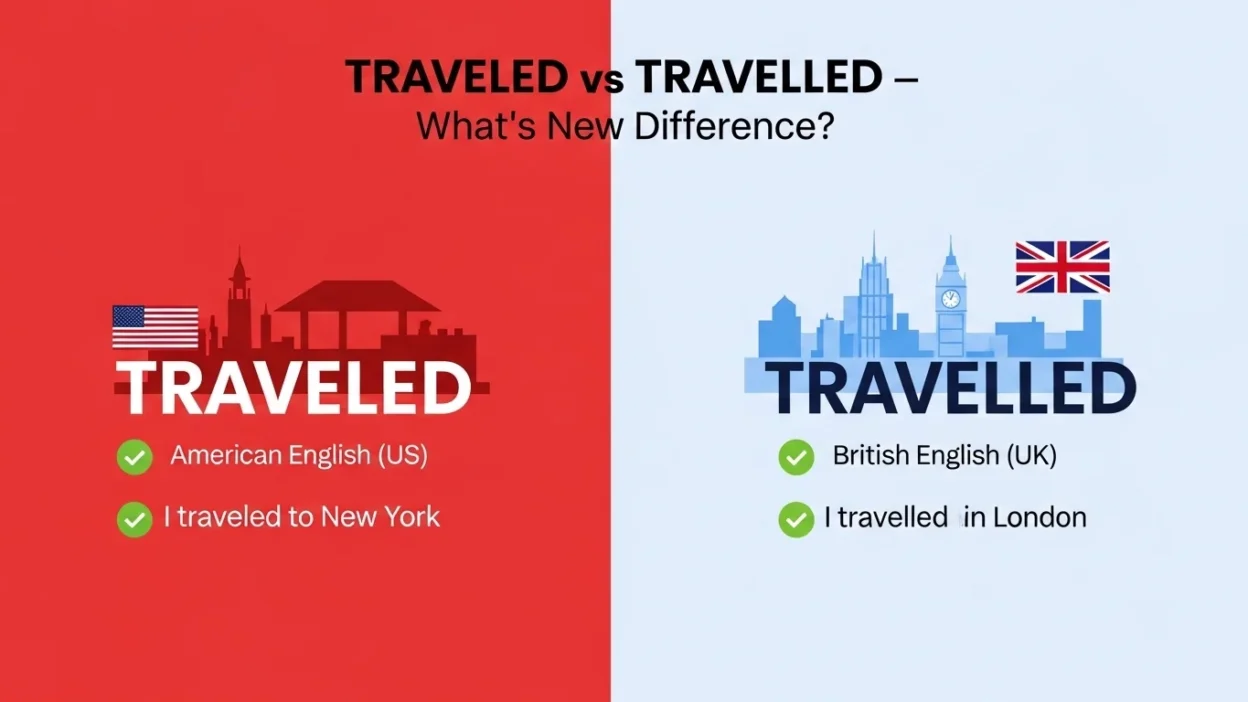
- Traveled → American English (used in the United States)
- Travelled → British English (used in the UK, Canada, Australia, and many other countries)
- Both spellings are correct
- The meaning is the same
So, the difference is spelling, not meaning.
Simple Background: Where Did This Difference Come From?
Long ago, English spelling was not fixed. Different places started to follow their own rules.
American English:
- American English prefers shorter spellings
- That is why Americans use:
- traveled
- canceled
- labeled
British English:
- British English keeps double letters in many cases
- That is why British English uses:
- travelled
- cancelled
- labelled
Both styles are correct. They simply follow different spelling traditions.
Clear Explanation of the Difference
Let’s break it down in the simplest way.
The base word is:
travel
When we talk about the past, we add -ed.
Now the spelling changes slightly depending on the English style.
In American English:
- travel → traveled
- Only one L
In British English:
- travel → travelled
- Two Ls
Important:
- The pronunciation is the same
- The meaning is the same
- Only the spelling changes
Comparison Table: Traveled vs Travelled
| Feature | Traveled | Travelled |
| English style | American English | British English |
| Number of Ls | One L | Two Ls |
| Used in | USA | UK, Canada, Australia, New Zealand |
| Meaning | Past of travel | Past of travel |
| Correct? | Yes | Yes |
Which One Should You Use and When?
The correct spelling depends on who you are writing for.
Use traveled if:
- You follow American English
- You are writing for people in the United States
- You study in an American-style school
Use travelled if:
- You follow British English
- You are writing for people in the UK, Canada, Australia, or similar countries
- Your school follows British spelling rules
Easy Tip:
- Choose one style and stay consistent
- Do not mix both spellings in one piece of writing
Common Mistakes People Make
Many learners make small mistakes with these words. Let’s look at them so you can avoid them.
1. Mixing both spellings
❌ I traveled to London and travelled to Paris.
✔ I traveled to London and traveled to Paris.
✔ I travelled to London and travelled to Paris.
Stay consistent.
2. Thinking one spelling is wrong
Some people think travelled is wrong or traveled is wrong.
✔ Both are correct
3. Using the wrong style for the audience
If you are writing for an American school, use traveled.
If you are writing for a British school, use travelled.
4. Confusing present and past forms
- Present: travel
- Past: traveled / travelled
❌ Yesterday I travel to Dubai.
✔ Yesterday I traveled to Dubai.
✔ Yesterday I travelled to Dubai.
Everyday Real-Life Examples
Let’s look at how people use these words in daily life.
1. Emails
American English:
I traveled to New York last week for work.
British English:
I travelled to New York last week for work.
2. Social Media Posts
American:
I just traveled across the country. What an amazing trip!
British:
I just travelled across the country. What an amazing trip!
3. News Headlines
American style:
The team traveled to Europe for the match.
British style:
The team travelled to Europe for the match.
4. Daily Conversation
- I traveled to my village last month.
- She travelled with her family during the holidays.
Short Learning Section for Students and Beginners
If you are a student or beginner, remember this simple rule:
One Meaning – Two Spellings
- Traveled = American spelling
- Travelled = British spelling
Easy Memory Trick
Think:
- USA = shorter spelling = traveled
- UK = longer spelling = travelled
Practice Exercise
Fill in the blanks:
- I ________ to Lahore last summer.
- She ________ with her parents to Canada.
Correct answers:
- traveled / travelled (both are correct depending on style)
Frequently Asked Questions (FAQ)
1. Are traveled and travelled both correct?
Yes. Both spellings are 100% correct. They are just used in different English styles.
2. Which spelling should I learn first?
Learn the spelling used in your school or country. If unsure, either one is fine as long as you stay consistent.
3. Is travelled British only?
Mostly yes. It is used in British, Canadian, Australian, and New Zealand English.
4. Is traveled only American?
Yes, it is mainly used in American English.
5. Do both spellings mean the same thing?
Yes. Both mean went from one place to another in the past.
6. Can I use both in one sentence?
No. Choose one spelling style and stay consistent.
7. Is this rule the same for other words?
Yes. Similar words include:
- canceled / cancelled
- labeled / labelled
- traveled / travelled
Conclusion
The difference between traveled and travelled is very simple. Both words mean the same thing. Both are correct. The only difference is spelling style.
- Traveled → American English
- Travelled → British English
Choose the spelling that matches your writing style or audience, and stay consistent.
Once you understand this small rule, English becomes easier and clearer. Now you can write with confidence and avoid confusion.
Happy learning and safe travels! ✨

Andrew Christopher is a passionate visionary who blends creativity with purpose to bring ideas to life. With a focus on innovation and integrity, he inspires growth and lasting impact.