Many students and English learners get confused about unalienable or inalienable. Both words describe rights that cannot be taken away, but they are used differently in history, law, and modern English.
For example:
- “Life, liberty, and the pursuit of happiness are unalienable rights.”
- “Everyone has the inalienable right to freedom of speech.”
This guide explains the difference between unalienable and inalienable, shows unalienable vs inalienable examples, and teaches you how to use them confidently.
Quick Answer
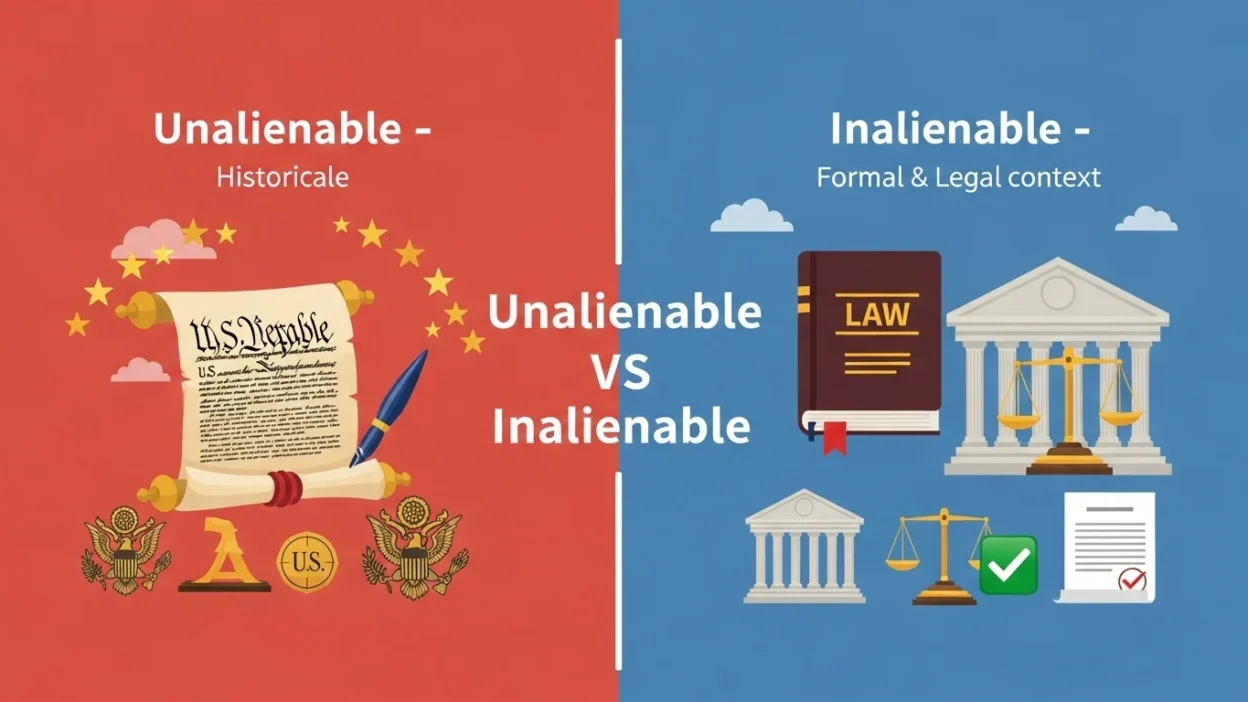
- Unalienable → cannot be taken away (mostly US historical context)
- Inalienable → cannot be taken away or transferred (formal/legal/international context)
Simple memory trick:
- Unalienable = US history
- Inalienable = formal/legal rights
Background and Origin
The confusion comes from history:
- Inalienable: Used in English since the 16th century, mainly in England.
- Unalienable: Popularized in the 18th century, especially in the Declaration of Independence.
Both words describe rights that cannot be surrendered, sold, or legally taken away.
Clear Explanation of the Difference
| Feature | Unalienable | Inalienable |
| Meaning | Cannot be taken away | Cannot be taken away or transferred |
| Usage | US historical/legal texts | Formal, legal, international |
| Examples | Unalienable rights (Declaration of Independence) | Inalienable rights (human rights documents) |
| Origin | 18th century (USA) | 16th century (England) |
Key point: You can use either word correctly, but consider the context:
- Historical US texts → unalienable
- Legal/international texts → inalienable
Real Life Examples
Historical Example
- “All men are created equal with certain unalienable rights.” – US Declaration of Independence
Legal/International Example
- “Everyone has the inalienable right to freedom of speech.” – Human rights documents
Social Media / Everyday Use
- “Your privacy is an inalienable right.”
- “Freedom to choose is an unalienable right.”
These are simple unalienable vs inalienable examples for understanding usage in different contexts.
Common Mistakes Students Make
- ❌ Using unalienable in formal international legal texts → use inalienable
- ❌ Thinking the words have very different meanings → they are almost identical
- ❌ Spelling errors: “inalienible” or “unalienible”
Easy Learning Section (For Students & Beginners)
Memory Trick
- Unalienable → US history / Declaration of Independence
- Inalienable → formal/legal/international
Practice Sentences
Fill in the blanks:
- Life, liberty, and the pursuit of happiness are ______ rights.
- Everyone has an ______ right to freedom of expression.
- Privacy is an ______ right in modern law.
- Freedom of religion is an ______ right recognized worldwide.
Answers:
- unalienable
- inalienable
- inalienable
- inalienable
FAQ (Simple Questions & Answers)
1. Are unalienable and inalienable the same?
Yes, both mean rights that cannot be taken away.
2. Which word is used in the Declaration of Independence?
Unalienable
3. Which is more formal?
Inalienable is more formal, often used in law or international documents.
4. Can you use them interchangeably?
Yes, context matters, but in modern English both are correct.
5. Are these words common in everyday conversation?
Not very common; mostly in legal, historical, or educational contexts.
6. How do I remember the difference between unalienable and inalienable?
Think: Unalienable = US history, Inalienable = legal/formal.
7. Can you give more examples of unalienable or inalienable rights?
- Life, liberty, pursuit of happiness → unalienable
- Freedom of speech, religion → inalienable
8. Can these words appear in social media or casual writing?
Yes, especially when emphasizing rights or freedoms in a simple, educational post.
Conclusion
Now you understand unalienable or inalienable and how to use them.
Final Rule to Remember:
- Unalienable = used in US history
- Inalienable = formal/legal/international
- Both mean: cannot be taken away
Memory trick:
“Unalienable = Declaration of Independence, Inalienable = law and global rights.”
With this guide, you can confidently read, write, and understand unalienable vs inalienable in historical, legal, and everyday contexts.

Daniel Matthew is a passionate visionary who believes in creativity, purpose, and innovation. With a focus on growth and authenticity, he turns every idea into meaningful impact.