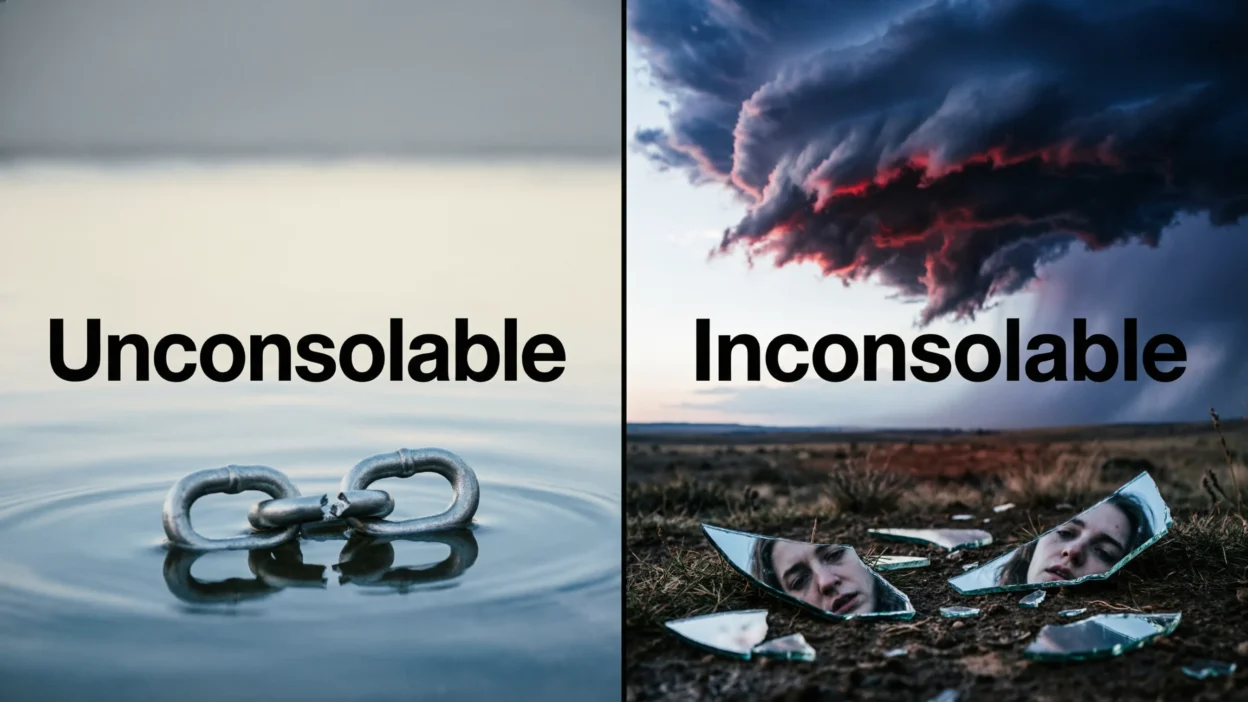
Many people feel confused when they see the words unconsolable and inconsolable. They look very similar.
They sound almost the same. They also seem to mean the same thing. Because of this, students, learners and even native English speakers often wonder:
- Are these two words different?
- Which one is correct?
- Can I use both?
The good news is that the answer is simple. This article explains everything in very easy English so anyone can understand it on the first read. By the end, you will feel calm, confident, and clear about these two words.
Quick Answer
Here is the short and simple answer:
- Inconsolable is the correct and standard word.
- Unconsolable is not standard and is rarely used.
- Both words try to mean the same thing, but only “inconsolable” is correct in proper English.
In short:
- ✅ Use inconsolable
- ❌ Avoid unconsolable
Simple Origin and Background Explanation
To understand why inconsolable is correct, let’s look at where the word comes from.
The word consolable means able to be comforted.
For example:
- A sad child can be consolable if kind words make them feel better.
Now, English often adds “in-” to mean “not.”
So:
- Consolable → able to be comforted
- Inconsolable → not able to be comforted
This follows normal English word rules.
The word unconsolable tries to do the same thing by adding “un-”, but English does not normally form this word that way. Because of this, unconsolable is not accepted as standard English.
That is why inconsolable is the correct and proper form.
Clear Explanation of the Difference
What Does “Inconsolable” Mean?
Inconsolable means:
So sad, upset, or hurt that no comfort helps.
When someone is inconsolable, nothing makes them feel better.
Examples:
- She was inconsolable after losing her pet.
- The child was inconsolable and cried for hours.
- He felt inconsolable after hearing the bad news.
This word shows very deep sadness or pain.
What About “Unconsolable”?
Unconsolable tries to mean the same thing, but it is not commonly accepted in standard English.
Some people may write or say it by mistake. Some very old texts or rare sources may show it. But in modern, correct English, it is better not to use it.
So:
- Unconsolable = non-standard and uncommon
- Inconsolable = correct and standard
Comparison Table: Inconsolable vs Unconsolable
| Feature | Inconsolable | Unconsolable |
| Correct English? | Yes | No (non-standard) |
| Common usage | Very common | Very rare |
| Accepted in exams | Yes | No |
| Safe to use in writing | Yes | No |
| Meaning | Cannot be comforted | Tries to mean the same |
| Grammar correctness | Correct | Not standard |
Which One Should You Use and When?
You should always use “inconsolable.”
Use inconsolable when:
- Someone is deeply sad
- Someone cannot stop crying
- Someone cannot be comforted
- The emotional pain is very strong
Examples:
- The mother was inconsolable after the accident.
- He became inconsolable when he lost his job.
- The baby was inconsolable all night.
Avoid using unconsolable in:
- School writing
- Exams
- Essays
- Formal emails
- Articles
- Professional communication
Common Mistakes People Make
Many learners make small mistakes with these words. Let’s look at them clearly.
Mistake 1: Using “unconsolable” instead of “inconsolable”
❌ She was unconsolable.
✅ She was inconsolable.
Mistake 2: Thinking both words are equally correct
Some people believe both are fine. This is not true.
- Only “inconsolable” is correct.
Mistake 3: Confusing “inconsolable” with “uncomfortable”
These words sound slightly similar, but their meanings are very different.
- Inconsolable → deeply sad
- Uncomfortable → feeling physical or emotional discomfort
Mistake 4: Using it for small problems
“Inconsolable” is a strong word. Do not use it for small sadness.
❌ I was inconsolable because my phone battery died.
✅ I was upset because my phone battery died.
Use inconsolable only for deep emotional pain.
Everyday Real-Life Examples
Here are examples from daily life to help you understand better.
Emails
- I was inconsolable after hearing about your loss. Please accept my deepest sympathy.
- She felt inconsolable when she read the sad news in your email.
News
- The family was inconsolable after the tragic accident.
- Fans were inconsolable after the death of the famous singer.
Social Media
- Feeling inconsolable today. Missing my best friend.
- The whole community is inconsolable after the disaster.
Daily Conversations
- He was inconsolable when his dog passed away.
- She became inconsolable after failing the final exam.
Short Learning Section for Students and Beginners
Easy Memory Trick
Remember:
“In-” = not
So:
- Consolable = able to feel better
- Inconsolable = not able to feel better
This makes it easy to remember.
Simple Sentence Pattern
Use:
Subject + was/were + inconsolable
Examples:
- She was inconsolable.
- They were inconsolable.
Practice Exercise
Fill in the blank:
- The boy was __________ after losing his toy.
Correct answer: inconsolable
Frequently Asked Questions (FAQ)
1. Are unconsolable and inconsolable the same?
They try to mean the same thing, but only “inconsolable” is correct and accepted.
2. Is unconsolable a real word?
It appears in very rare or old usage, but modern English does not accept it as standard.
3. Which word should I use in exams?
Always use inconsolable.
4. Can unconsolable be used in casual speech?
It is better not to use it at all. Use inconsolable instead.
5. What is the opposite of inconsolable?
- Comforted
- Calm
- Consoled
6. Is inconsolable a strong word?
Yes. It describes very deep sadness or emotional pain.
7. Can adults and children both be inconsolable?
Yes. Anyone can feel inconsolable when emotions are very strong.
8. Is inconsolable used for happy emotions?
No. It is used only for sadness, pain, or emotional distress.
Conclusion
The difference between unconsolable and inconsolable is easy once you understand it.
- Inconsolable is the correct and standard word.
- Unconsolable is not standard and should be avoided.
Whenever you want to describe deep sadness that cannot be comforted, choose inconsolable with confidence.
By remembering this simple rule, you will write and speak English more clearly, correctly, and confidently.
Keep learning, keep practicing, and your English will continue to improve every day.

Daniel Matthew is a passionate visionary who believes in creativity, purpose, and innovation. With a focus on growth and authenticity, he turns every idea into meaningful impact.