Many English learners make this mistake:
👉 “I did good in the test.”
It sounds okay, but it is actually wrong.
This is why people get confused about well or good. Both words are common, and sometimes they seem to mean the same thing.
But don’t worry — this guide will give you a clear, simple system so you always know which one to use.
Quick Answer
- Good = describes a thing (noun)
- Well = describes an action (verb)
👉 Simple idea:
- Use good for things
- Use well for actions
Examples:
- She is a good student ✅
- She studies well ✅
Why This Confusion Happens
The confusion between good vs well in English grammar happens because:
- “Good” is an adjective
- “Well” is usually an adverb
But English has one tricky point:
👉 “Well” can also mean healthy
👉 And verbs like feel, look, seem don’t follow normal rules
This is why many learners are unsure about when to use well and good.
The Clear Difference
1. Use “Good” for Things
“Good” describes a person, place, or thing.
Examples:
- This is a good book
- She is a good teacher
- That was a good idea
👉 Think: quality
2. Use “Well” for Actions
“Well” tells us how something happens.
Examples:
- He speaks English well
- She sings well
- They did well in the exam
👉 Think: how an action is done
Special Rule: Linking Verbs (Very Important)
This is where many learners make mistakes.
Words like:
- feel
- look
- seem
- appear
👉 These are called linking verbs.
After these verbs, use good, NOT well.
Examples:
- I feel good (correct)
- She looks good (correct)
❌ I feel well (only for health)
When “Well” Is Correct Here
Use “well” only when talking about health:
- I feel well = I am healthy
- I do not feel well = I am sick
Comparison Table (Easy to See)
| Situation | Correct Use | Example |
| Describing a thing | Good | This is a good book |
| Describing an action | Well | He writes well |
| After linking verbs | Good | I feel good |
| Talking about health | Well | I feel well |
| Performance | Well | She did well |
Quick Decision Guide (Very Important)
When you are confused, follow this:
👉 Step 1: Is it an action?
✔ Yes → use well
👉 Step 2: Is it a thing?
✔ Yes → use good
👉 Step 3: Is it after feel/look/seem?
✔ Yes → use good
👉 Step 4: Are you talking about health?
✔ Yes → use well
Common Mistakes (With Fixes)
❌ Mistake 1
He runs good
✔ He runs well
❌ Mistake 2
She is a well student
✔ She is a good student
❌ Mistake 3
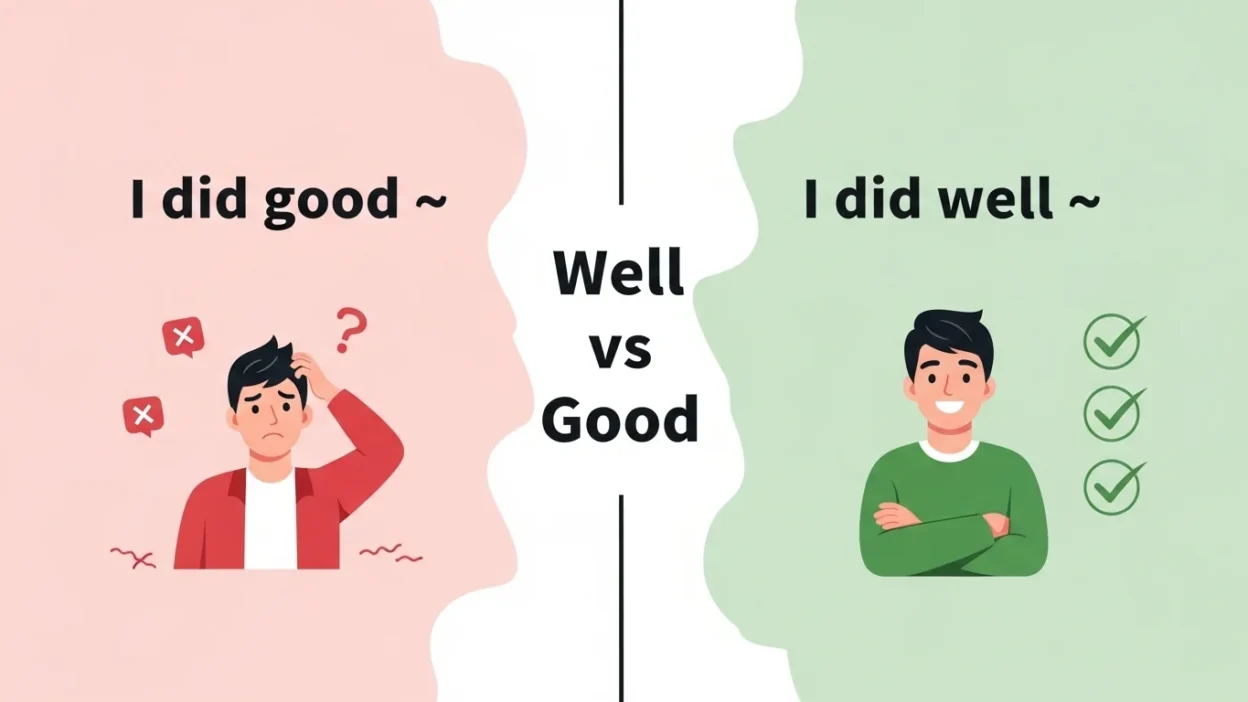
I did good in the exam
✔ I did well in the exam
❌ Mistake 4
She sings good
✔ She sings well
❌ Mistake 5 (Very Common)
I feel well (when you mean happy)
✔ I feel good
Real Life Examples (Daily Use)
In Emails
- I hope you are doing well
- That was a good meeting
On Social Media
- Feeling good today 😊
- You handled that situation well
In School
- He is a good student
- He studies well
At Home
- This food tastes good
- You cooked it well
At Work
- She did well in the presentation
- That was a good idea
Short Learning Section (Practice + Memory)
Easy Memory Trick
👉 Good = thing
👉 Well = action
👉 Feel / look / seem = GOOD
Practice Time
Fill in the blanks:
- She is a ______ person
- She speaks very ______
- I feel ______ today (happy)
- I feel ______ today (healthy)
- He did ______ in the test
Answers:
- good
- well
- good
- well
- well
FAQ
1. What is the difference between well and good?
“Good” describes things. “Well” describes actions.
2. Is it correct to say “I am good”?
Yes. It means you are happy or fine.
3. Is “I am well” correct?
Yes. It means you are healthy.
4. Why do people say “I did good”?
It is common in spoken English, but grammatically it should be “I did well.”
5. Which is correct: do good or do well?
- “Do good” = help others
- “Do well” = succeed
6. Can “well” describe a person?
Only for health (e.g., “She is well”).
7. Is “feel good” correct?
Yes, after linking verbs we use “good.”
8. Can I always use “good”?
No. Use “well” for actions.
Conclusion
Now you understand the difference between well or good in a simple way.
Final Rule to Remember:
👉 Good = describes things
👉 Well = describes actions
👉 Feel / look / seem = use GOOD
👉 Health = use WELL
If you follow these small rules, you will stop making mistakes and start using English more naturally and confidently.

Andrew Christopher is a passionate visionary who blends creativity with purpose to bring ideas to life. With a focus on innovation and integrity, he inspires growth and lasting impact.