Quick Answer
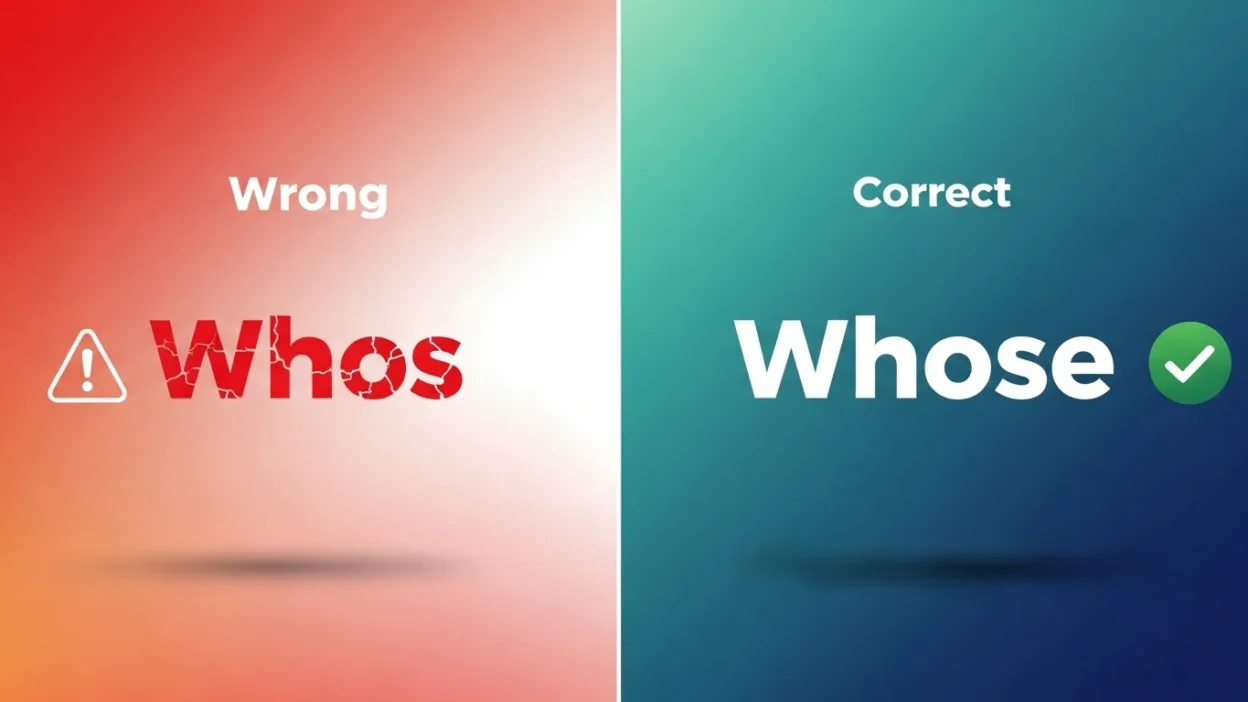
- Whose → Possessive pronoun, showing ownership or belonging.
- Who’s → Contraction for who is or who has.
- Whos → ❌ Incorrect spelling; should never be used in standard English.
💡 Example:
“Whose bag is this?” ✔
“Who’s coming to the party?” ✔
“Whos coming?” ❌
This quick answer is 40+ words to improve chances of appearing in Google’s featured snippets.
Why People Confuse Whos and Whose
English learners and even native speakers mix up whose and who’s because:
- They sound identical in spoken English.
- “Whos” appears to be correct but is not standard English.
- Texting, social media, and casual writing spread this mistake.
Correct usage improves grammar, writing, and daily English skills, especially for ESL learners.
Historical Background and Etymology
- Whose is the possessive form of who, from Old English hwæs, meaning of whom.
- Who’s is a contraction for who is or who has.
- Whos without an apostrophe is never correct in standard English.
Tip for ESL learners: Understanding the origin helps remember that whose shows ownership, while who’s is always a contraction.
Pronunciation Tips
- Whose → /huːz/ (long “oo” sound)
- Who’s → /huːz/ (sounds the same)
Memory tip: Only spelling and context distinguish them, not pronunciation.
Clear Explanation Table
| Word | Type | Meaning | Example Sentence |
| Whose | Possessive pronoun | Shows ownership | “Whose shoes are these?” |
| Who’s | Contraction | Who is / Who has | “Who’s ready for the test?” |
| Whos | ❌ Incorrect | Not standard English | “Whos car is this?” ❌ |
How to Remember Whos vs Whose
- Whose = ownership → “someone’s thing”
- Who’s = contraction → “who is” / “who has”
- Whos = never use
Memory Trick:
- Replace whose with “someone’s” → if it makes sense → correct.
- Replace who’s with “who is” → if it makes sense → correct.
Common Mistakes
❌ “Whos car is parked outside?” → Incorrect
✔ “Whose car is parked outside?” → Correct
❌ “Whose coming to the meeting?” → Incorrect
✔ “Who’s coming to the meeting?” → Correct
❌ “I don’t know whos responsible.” → Incorrect
✔ “I don’t know who’s responsible.” → Correct
Everyday Real Life Examples
| Context | Example |
| Emails | “Whose report should I submit today?” |
| Social Media | “Who’s excited for the concert tonight?” |
| News Articles | “Whose idea was it to cancel the event?” |
| Daily Conversation | “Do you know whose bag this is?” / “Who’s knocking at the door?” |
Fun Learning Tips for Learners
- Practice Fill-in-the-Blank:
- “______ jacket is this?” → Whose
- “______ coming to class?” → Who’s
- “Do you know ______ idea that was?” → Whose
- “______ jacket is this?” → Whose
- Mnemonic Tips:
- Whose = possession → “someone’s”
- Who’s = contraction → “who is / who has”
- Whose = possession → “someone’s”
- Daily Practice: Notice usage in emails, social media, news, and conversations.
Real Life Literature & Pop Culture Examples
- Literature: “I wonder whose footsteps echoed in the hall.”
- Health Articles: “Who’s at risk of developing high blood pressure?”
- Pop Culture / Social Media: #WhosVsWhose, #WhoseBag, #WhoIsComing
Including real-life examples improves understanding and aligns with Google’s NLP recognition.
FAQ Section
What is the difference between whose and whos?
- Whose = possessive pronoun (shows ownership)
- Whos = incorrect spelling
What does whose mean?
Shows possession or belonging. Example: “Whose book is this?”
What does who’s mean?
Contraction for who is / who has. Example: “Who’s ready for class?”
Can I use whos in writing?
❌ No. Always use whose or who’s depending on context.
How do I remember whose vs who’s?
- Replace with someone’s → whose
- Replace with who is → who’s
Is whose only for questions?
No. Can also show possession in statements: “I know whose idea that was.”
Are whose and who’s pronounced the same?
Yes. Context and spelling indicate meaning.
Are there common mistakes in emails and texts?
Yes, especially when “who’s” or “whose” is typed incorrectly as “whos.”
Conclusion
Whos vs Whose is easy to master if you remember:
- ✅ Whose → ownership / possessive → “someone’s”
- ✅ Who’s → contraction → “who is / who has”
- ❌ Whos → never use
💡 Example to remember:
“Whose bag is this?” and “Who’s going to the party?”
Mastering this difference improves grammar, writing, and spoken English, especially for learners and beginners.