Many English learners get confused between “wore” and “worn.” This confusion is very common because both words come from the same verb “wear,” but they are used in different ways. If you are learning English, you may ask: Which one should I use? or What is the correct form?
The difference between wore vs worn becomes easy once you understand a simple rule about tenses and helping verbs.
In this article, we will explain everything in very simple English with clear examples, so you can use these words correctly in daily speaking and writing.
Quick Answer (Simple Rule)
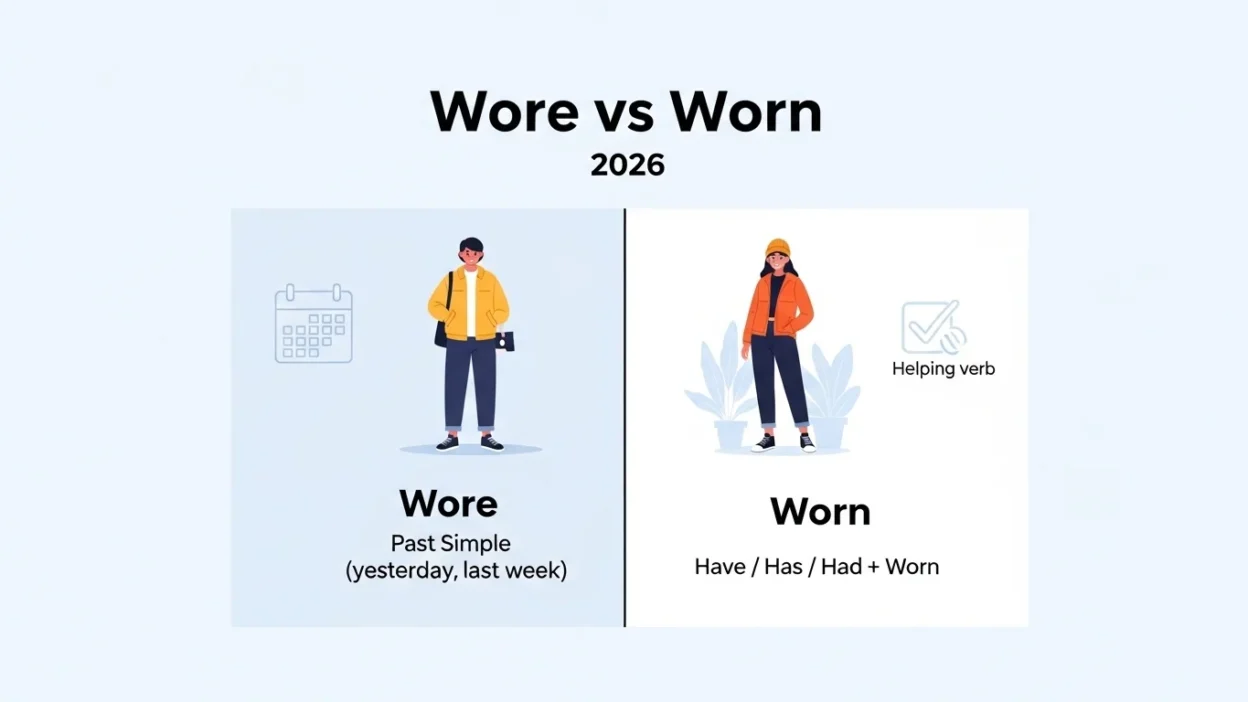
- Wore → Use for past actions (no helping verb)
- Example: I wore a jacket yesterday.
- Worn → Use with helping verbs like have, has, had
- Example: I have worn that jacket before.
👉 Easy shortcut:
- If there is no helping verb → use wore
- If there is have/has/had → use worn
What Is the Verb “Wear”?
The verb “wear” is irregular. That means it does not follow the normal “-ed” rule.
Its forms are:
- Present: wear
- Past: wore
- Past participle: worn
This is why learners often search for wear wore worn verb forms or past tense of wear. These forms must be learned because they do not follow a regular pattern.
Clear Difference Between Wore and Worn
1. Wore (Simple Past)
Wore is used when talking about something that happened and finished in the past.
- It does not need helping verbs
- It is used with time words like yesterday, last week, ago, etc.
Sentence pattern:
👉 Subject + wore + object
Examples:
- I wore a blue shirt yesterday.
- She wore glasses in school.
- They wore uniforms last year.
👉 These are completed actions, so we use “wore.”
2. Worn (Past Participle)
Worn is used with helping verbs such as:
- have
- has
- had
- is
- was
It is used in:
- present perfect tense
- past perfect tense
- passive voice
Sentence pattern:
👉 Subject + helping verb + worn + object
Examples:
- I have worn this shirt many times.
- She has worn that dress before.
- The jacket was worn by him.
👉 “Worn” depends on another verb and cannot usually stand alone.
Side by Side Comparison
| Feature | Wore | Worn |
| Type | Past simple | Past participle |
| Helping verb | Not needed | Needed (have/has/had) |
| Usage | Finished past actions | Perfect tenses / passive voice |
| Structure | Subject + wore + object | Subject + helping verb + worn |
| Example | I wore a hat yesterday | I have worn a hat before |
| Time reference | Specific past time | Connected to present or another action |
When to Use Wore
Use wore when:
- Talking about a completed action in the past
- No helping verb is used
- A clear past time is mentioned
Examples:
- He wore a cap yesterday.
- We wore warm clothes in winter.
- She wore a red dress to the party.
👉 Think: finished action = wore
When to Use Worn
Use worn when:
- A helping verb is present
- You are using perfect tenses
- You are using passive voice
Examples:
- I have worn this jacket many times.
- She has worn makeup today.
- The shoes were worn by many people.
👉 Think: helping verb = worn
Common Mistakes Learners Make
1. Using “worn” without a helping verb
❌ I worn a jacket yesterday
✔ I wore a jacket yesterday
2. Using “wore” with helping verbs
❌ I have wore that shirt
✔ I have worn that shirt
3. Mixing tense forms incorrectly
❌ She wore this dress many times
✔ She has worn this dress many times
4. Forgetting the verb form pattern
Learners sometimes forget that:
- wear → wore → worn
Understanding this pattern helps avoid confusion.
Simple Sentence Patterns to Remember
To make things easier, remember these patterns:
Simple Past Pattern (Wore)
- Subject + wore + object
- I wore a jacket
- She wore glasses
Perfect Tense Pattern (Worn)
- Subject + have/has/had + worn + object
- I have worn a jacket
- She has worn glasses
Passive Voice Pattern (Worn)
- Subject + was/were + worn + by + object
- The dress was worn by her
- The shoes were worn by him
Everyday Real Life Examples
Conversation
- Yesterday, I wore new shoes.
- I have worn these shoes many times.
Social Media
- Wore this outfit today 😊
- I have worn this style for years.
- I wore formal clothes to the meeting.
- I have worn similar outfits before.
Daily Life
- He wore a cap in the sun.
- He has worn that cap since morning.
These examples show how both forms are used naturally in real communication.
Quick Decision Trick
Use this simple method:
- Ask: Is there a helping verb (have/has/had)?
- Yes → use worn
- No → use wore
- Ask: Is the action finished in the past with a time word?
- Yes → use wore
👉 Example:
- Yesterday → wore
- Have/has → worn
FAQ Section
1. What is the main difference between wore and worn?
“Wore” is used for simple past actions, while “worn” is used with helping verbs in perfect tenses and passive voice.
2. Is wore past tense or present tense?
“Wore” is past tense.
3. Can worn be used alone in a sentence?
No, “worn” usually needs a helping verb like have, has, or had.
4. Can I say “I have wore”?
No, the correct form is “I have worn.”
5. What is the base form of wore and worn?
The base form is “wear.”
6. Why do we use worn in sentences?
We use “worn” because it is required in perfect tenses and passive voice structures.
7. Is wear wore worn an irregular verb?
Yes, it is an irregular verb because it does not follow the regular “-ed” rule.
8. How can I remember wore vs worn easily?
Remember this:
- Wore = past action
- Worn = have/has/had + worn
Conclusion
The difference between wore vs worn is simple once you understand the rule:
- Use wore for completed past actions without helping verbs.
- Use worn when using helping verbs like have, has, or had.
By remembering the pattern wear → wore → worn, and practicing simple sentence structures, you can avoid common mistakes and use these words correctly in everyday English.
Keep practicing with real examples, and soon choosing between “wore” and “worn” will become natural and automatic.

Andrew Christopher is a passionate visionary who blends creativity with purpose to bring ideas to life. With a focus on innovation and integrity, he inspires growth and lasting impact.